Every AWS vs Azure vs Google Cloud comparison guide eventually reaches the same unsatisfying conclusion: it depends. This one will too. But the goal here is to make "it depends" actually useful by being specific about what it depends on, for which workloads, and for which types of organisations.
The 2026 cloud market is a fundamentally different competitive landscape than even two years ago. AI spending has reshaped provider priorities, growth rates, and the services that actually differentiate one platform from another. A comparison built on 2023 data will steer you wrong in 2026.
This guide covers the 2026 market reality, each provider's genuine strengths and weaknesses, how they compare on pricing and AI capabilities, what aws vs azure vs google cloud for startups actually means, and a decision matrix that translates your specific situation into a defensible platform choice.
Our engineers will audit your workflow and estimate time-to-value at no cost.
Claim your free audit
The 2026 Cloud Market in 90 Seconds
The aws vs azure vs google cloud market share picture as of Q1 2026, per Synergy Research Group: AWS holds approximately 30% of global cloud infrastructure spending, Azure 25%, and Google Cloud 13%. Together the three control roughly 68% of enterprise cloud spending.
The share numbers matter less than the trajectory. Azure grew 40% year-over-year in its most recent reporting period. Google Cloud grew 63%, its fastest rate in years, driven almost entirely by AI workload demand. AWS grew 19%, which is substantial for the market leader but represents continued share erosion from the peak years.
What the growth rate tells you: Google Cloud's 63% growth is almost entirely AI-driven. Azure's 40% growth reflects both AI pull-through and its deepening grip on enterprise Microsoft ecosystems. AWS's 19% growth, while slower, still represents more absolute revenue added than either competitor given its larger base.
For vendor stability and long-term investment decisions, all three platforms are safe choices. No hyperscaler is at risk of exiting the market. The differentiation question is about fit, not survival.
AWS: The Breadth Platform
Amazon Web Services (AWS) | Largest footprint, deepest service catalogue, strongest DevOps ecosystem
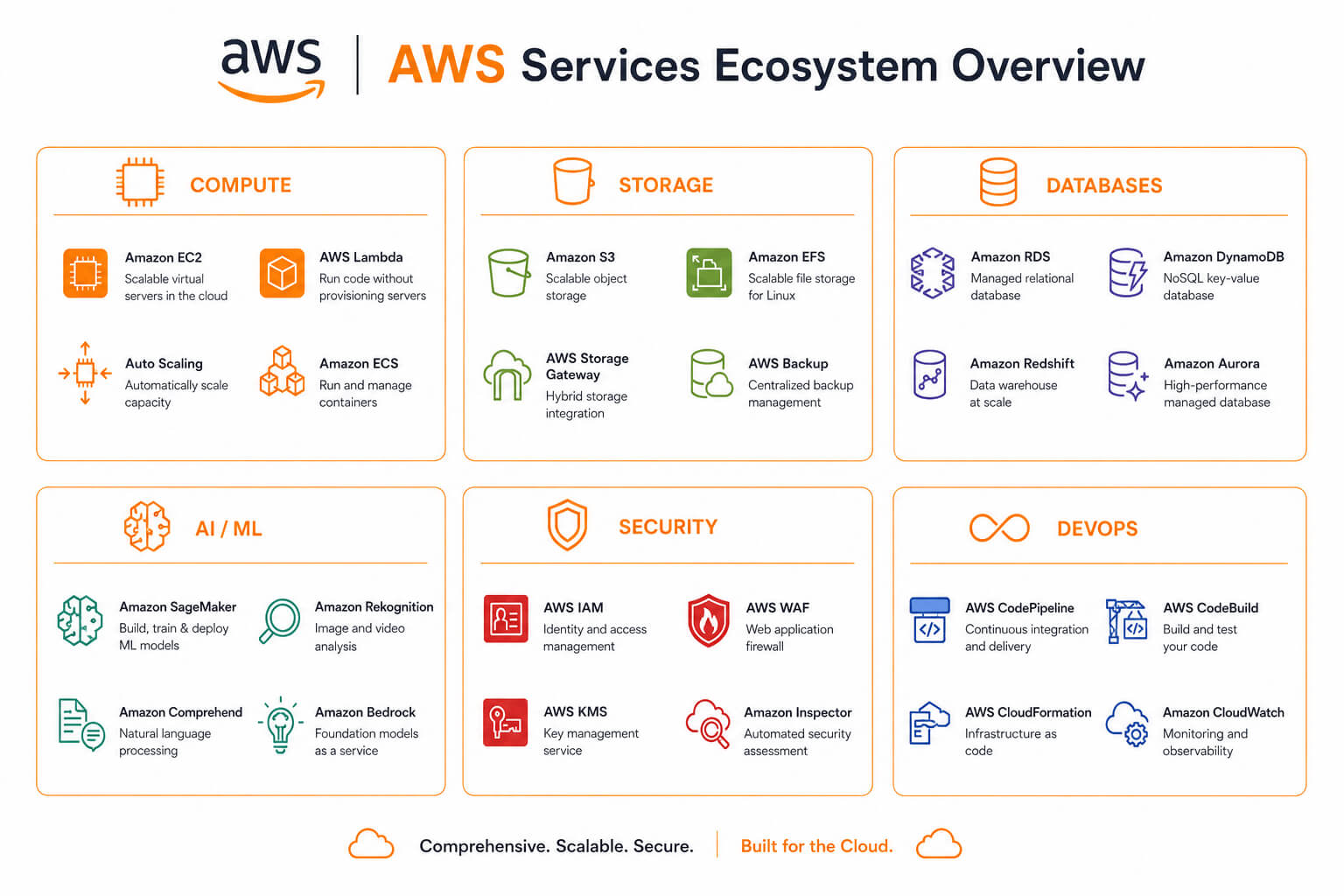
AWS launched in 2006 and has spent 18 years building what is now the broadest catalogue of cloud services of any provider: over 200 managed services covering compute, storage, networking, databases, ML, IoT, security, and developer tooling. If a service category exists in cloud, AWS almost certainly has a managed version of it.
What AWS does best
- Service depth: the only platform where you can find a managed service for almost any workload category without building custom
- Global footprint: 33 regions, largest availability zone count of any provider
- DevOps and tooling ecosystem: CodePipeline, CodeDeploy, CloudFormation, CDK, the most mature CI/CD and IaC toolchain
- Partner ecosystem: largest global network of certified partners, ISVs, and marketplace offerings
- AI/ML breadth: Amazon Bedrock gives access to the widest selection of third-party foundation models; SageMaker remains the most comprehensive end-to-end ML platform
Where AWS falls short
- Pricing complexity: 200+ services with different billing models, egress fees, and support tiers makes cost management a significant engineering discipline in itself
- Microsoft integration: AWS requires third-party tools or custom work for organisations running Microsoft 365, Active Directory, or SQL Server at scale
- Learning curve: the breadth that is AWS's strength is also its complexity, and onboarding a new team takes longer than on more opinionated platforms
Best fit organisations
Technology companies that need flexibility across workload types. Startups that want to avoid platform lock-in early. Enterprises with polyglot technology stacks that do not centre on Microsoft. Teams where cloud-native engineering skills are already present.
Microsoft Azure: The Enterprise Integration Platform
Microsoft Azure | Deepest Microsoft integration, strongest hybrid cloud, exclusive OpenAI access
Azure's competitive position in 2026 rests on three pillars that no competitor can replicate: native integration with the Microsoft software stack that most large enterprises already run, the exclusive enterprise partnership with OpenAI that puts GPT-5 and Azure OpenAI Service behind enterprise security and compliance controls, and Azure Arc's best-in-class hybrid and multi-cloud management.
What Azure does best
- Microsoft ecosystem integration: Active Directory, Microsoft 365, Teams, Dynamics 365, SQL Server, Windows Server all integrate natively with near-zero configuration overhead
- OpenAI exclusivity: Azure OpenAI Service is the only place to run GPT-4o, GPT-5, and o1 within enterprise-grade security, compliance, and networking controls. Azure integrated GPT-5 natively into all enterprise services in Q1 2026
- Hybrid cloud: Azure Arc extends Azure management across on-premises, AWS, and Google Cloud resources from a single control plane, making it the strongest hybrid story of the three providers
- Compliance depth: the broadest set of regulatory certifications including FedRAMP High, making it the default choice for US government and highly regulated industries
- Enterprise support and SLAs: Microsoft's enterprise relationship history means Azure sales and support teams understand enterprise procurement, legal, and compliance requirements better than either competitor
Where Azure falls short
- Non-Microsoft workloads: Linux-native and open-source-heavy teams consistently report higher friction on Azure than on AWS or GCP
- Learning curve for cloud-native teams: Azure's strength is integration with existing Microsoft tools, which can be a disadvantage for greenfield cloud-native architectures
- Regional pricing: Azure compute is typically 10-15% more expensive than AWS or GCP for equivalent non-Microsoft workloads
Best fit organisations
Enterprises running Microsoft 365 and Active Directory at scale. Organisations in regulated industries needing FedRAMP or extensive compliance certifications. Businesses whose AI strategy centres on GPT models and OpenAI integrations. Hybrid cloud environments that need a single management plane across on-prem and cloud.
Google Cloud: The AI and Data Specialist
Google Cloud Platform (GCP) | Best AI/ML infrastructure, BigQuery analytics leadership, Kubernetes origin
When comparing Google Cloud vs AWS or Azure, Google Cloud's position in 2026 is that of the specialist outgrowing its niche. Google Cloud achieved consistent profitability for the first time in 2025, is growing faster than either competitor at 63% YoY, and has built an AI infrastructure stack that Gartner acknowledges is the most cost-efficient for training and inference workloads.
What Google Cloud does best
- AI/ML infrastructure: Vertex AI, TPU v6, and TensorFlow are the best-integrated AI development and deployment platform. Google's custom TPU hardware delivers the best cost-performance ratio for large model training
- BigQuery: the strongest managed data warehouse for analytics workloads, typically faster, cheaper, and more serverless than Redshift or Synapse for most analytical query patterns
- Kubernetes: Google created Kubernetes, and GKE (Google Kubernetes Engine) remains the reference implementation and the most feature-complete and operationally mature managed Kubernetes service
- Network performance: built on Google's private global fibre network, GCP consistently outperforms AWS and Azure on latency for geographically distributed workloads
- Pricing model: sustained use discounts apply automatically without upfront commitment, and compute is typically 10-15% cheaper than Azure for equivalent workloads
Where Google Cloud falls short
- Enterprise footprint: smaller global partner ecosystem, fewer enterprise sales relationships, and less procurement experience than AWS or Microsoft
- Service breadth: 150+ services versus 200+ for AWS and Azure, with gaps in some niche workload categories
- Microsoft integrations: no native advantage for Microsoft-stack environments
Best fit organisations
AI-native startups and research organisations. Data engineering teams running analytical workloads at scale. Organisations already invested in Google Workspace or BigQuery. Cost-conscious teams where compute and AI training costs are primary concerns.
We'll map the exact workflows from this article to your business - free, in 30 minutes.
AWS vs Azure vs Google Cloud: Full Comparison Table
The following table compares aws vs azure vs google cloud across 14 dimensions relevant to enterprise and mid-market technology decisions.
AWS vs Azure vs Google Cloud Pricing
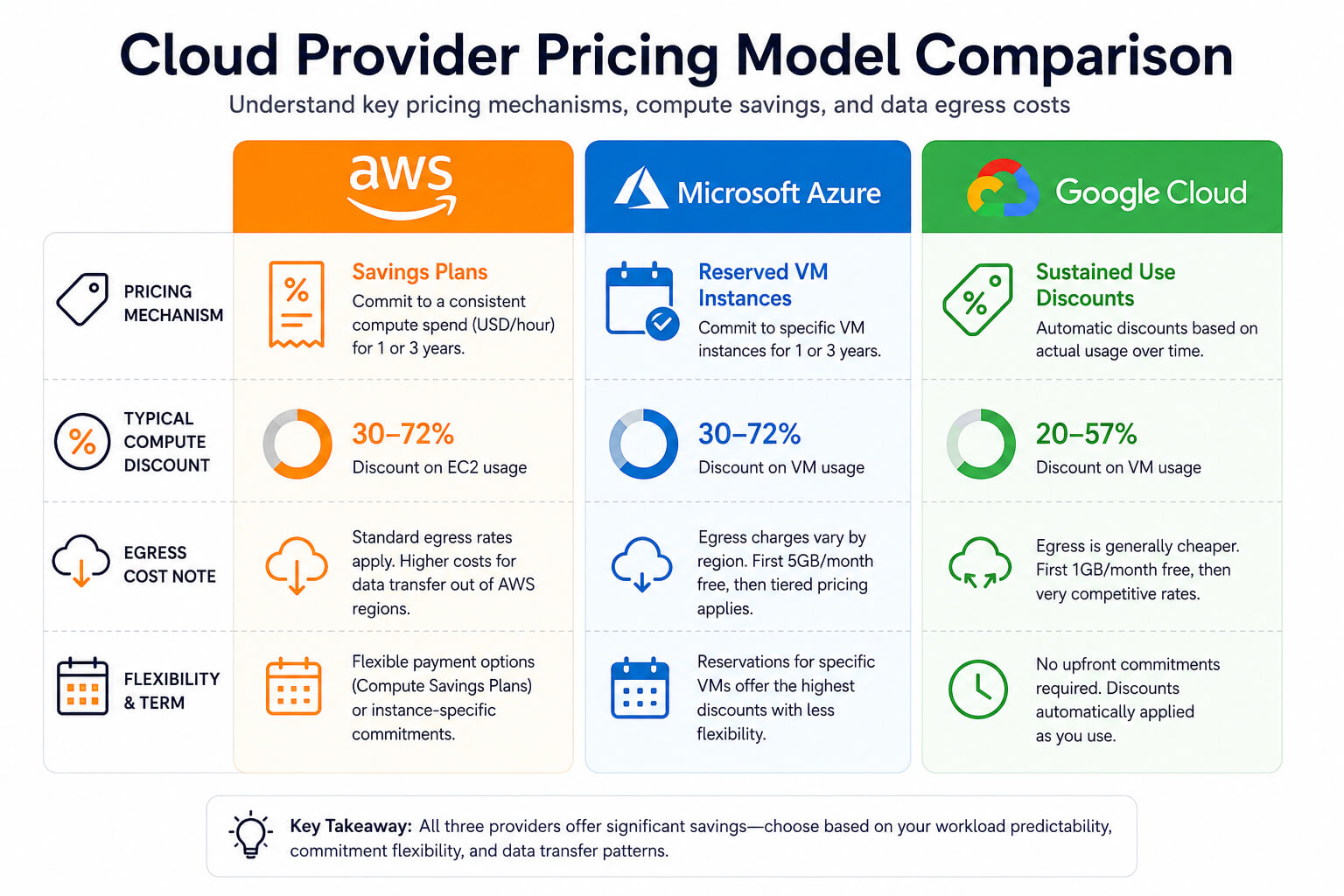
Every awsvs azure vs google cloud pricing comparison eventually reaches the same conclusion: the cheapest cloud is the one you have optimised correctly. Published list prices are almost meaningless in practice because the real cost drivers are architecture decisions, reserved instance commitments, egress charges, and storage class selection.
The real cost drivers
- Egress fees: all three providers charge for data leaving the cloud (typically $0.08-$0.09/GB). For data-intensive architectures, egress can be larger than compute costs. GCP offers more aggressive egress discounts for high-volume customers
- Reserved instances and savings plans: AWS Savings Plans and Azure Reserved VMs require 1-3 year commitments for up to 72% discount; GCP's sustained use discounts apply automatically at no commitment, making GCP more forgiving for variable workloads
- Support tiers: enterprise support adds 10% or more to the total bill on all three platforms and is effectively mandatory for production workloads above a certain scale
- Storage class complexity: all three have tiered storage (hot/warm/cold/archive) with different retrieval costs that compound significantly at petabyte scale
The practical pricing rule of thumb
For equivalent compute workloads, GCP and AWS are typically 10-15% cheaper than Azure. For AI training workloads specifically, GCP's TPU pricing delivers the best cost-performance of the three. Azure commands a premium that is justified specifically for organisations where the Microsoft integration benefits offset the compute cost differential. For startups and SMBs without Microsoft dependencies, GCP's sustained use discounts and Google Cloud credit programmes typically produce the lowest total cost of ownership through the first two years of scale.
AWS vs Azure vs Google Cloud for AI and Machine Learning
The aws vs azure vs google cloud for ai comparison in 2026 is more nuanced than the conventional wisdom of "GCP for AI" suggests. Model availability has effectively converged. All three providers now offer access to frontier models including Claude, GPT variants, Llama, Mistral, and Gemini. The differentiation has shifted to governance, integration, and the hardware cost-performance layer beneath the model APIs.
AWS Bedrock and SageMaker
Amazon Bedrock provides the broadest selection of third-party foundation models of any managed platform. SageMaker remains the most comprehensive end-to-end ML platform for organisations that need the full pipeline from data preparation through model training, deployment, and monitoring. AWS's custom Trainium chips for training and Inferentia chips for inference give it a cost advantage for large-scale model serving that has narrowed Google's historical hardware advantage.
Azure OpenAI Service
Azure's exclusive OpenAI partnership is its clearest AI moat in 2026. Azure OpenAI Service is the only enterprise-grade platform where you can run GPT-5 and o1 within your own virtual network, with your own encryption keys, under your own data residency controls. For organisations whose AI strategy centres on OpenAI models and whose compliance requirements prevent sending data to shared API endpoints, Azure is the only viable choice.
Google Cloud Vertex AI and TPUs
Vertex AI provides the most tightly integrated AI development environment, particularly for organisations training custom models rather than consuming foundation model APIs. Google's TPU v6 hardware delivers the best cost-performance ratio for large-scale training workloads. For LLM fine-tuning and custom model training at enterprise scale, GCP and AWS are preferred by the majority of ML engineers in 2026 according to Tech-Insider's 2026 survey.
AWS vs Azure vs Google Cloud for Startups and Small Business
For startups and small businesses, the aws vs azure vs google cloud for startups question has a more practical answer than for enterprises because the ecosystem lock-in concern is lower and the primary driver is usually cost, time-to-market, and access to managed services that reduce engineering overhead.
Free tier and credit programmes
- AWS Free Tier: 12-month free access to core services; AWS Activate provides up to $100,000 in credits for qualifying startups
- Microsoft for Startups (Founders Hub): up to $150,000 in Azure credits over two years, plus GitHub Enterprise, Microsoft 365, and LinkedIn credits
- Google for Startups Cloud Programme: up to $200,000 in Google Cloud credits over two years, plus access to Google technical support and mentorship
Which platform scales best for startups
For AI-native startups whose core product is built on ML or data, Google Cloud's Vertex AI, BigQuery, and TPU access provide the most cost-effective development environment from day zero to Series B. For startups that need the broadest range of managed services and want to avoid over-committing to a single AI platform, AWS offers the most flexibility. Azure is the right choice for startups whose product is deeply integrated with the Microsoft ecosystem, including Teams apps, M365 integrations, or Dynamics 365.
The best cloud platform for small business without specific Microsoft or AI requirements is typically GCP for cost-optimised compute or AWS for breadth, with the decision usually made by the founding team's existing cloud skills rather than a neutral technical comparison.
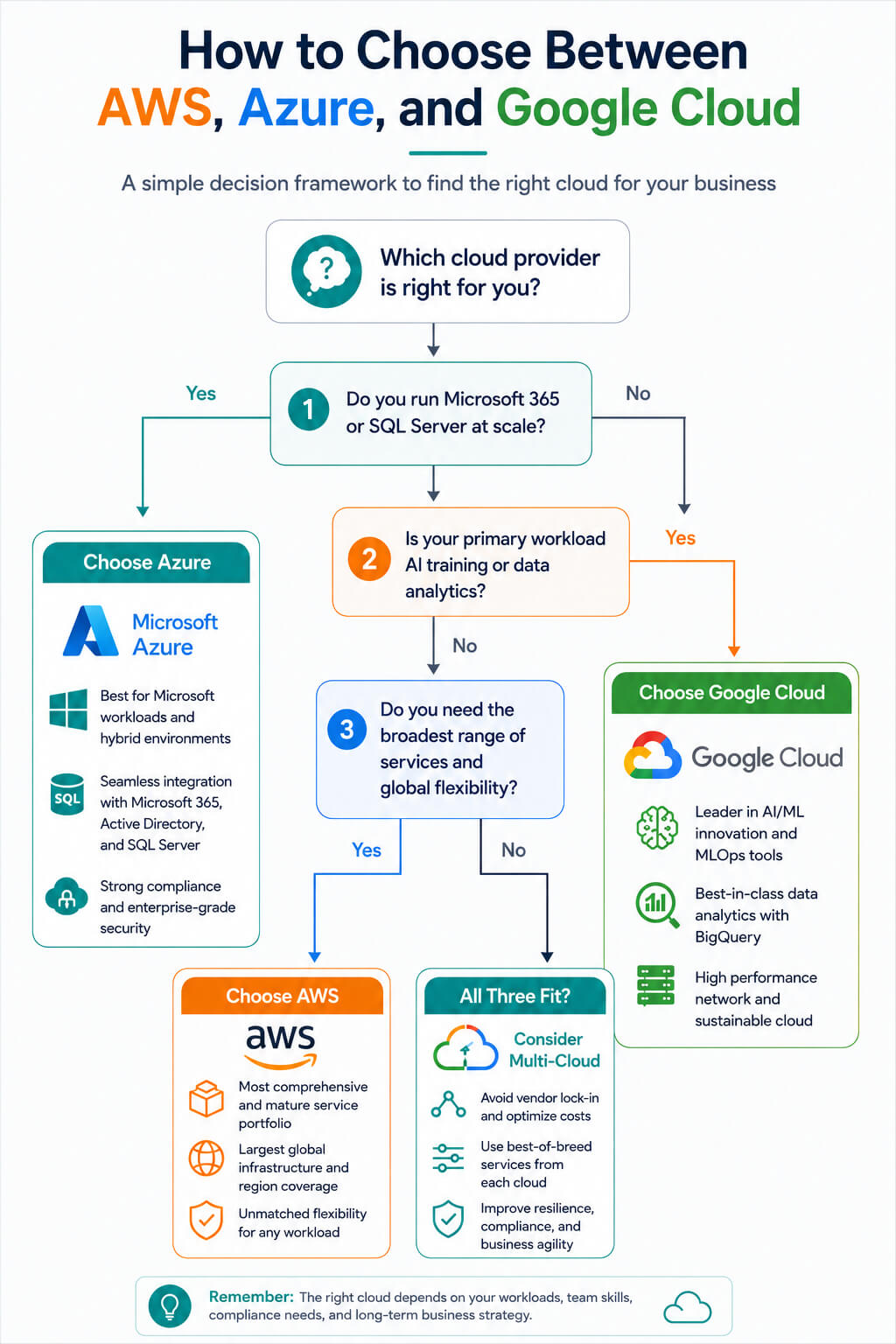
The Decision Matrix: How to Choose
Use this matrix to map your primary business need to the most appropriate platform in the aws vs azure vs google cloud comparison. Most enterprise decisions will surface multiple "best choice" columns, which is a signal that a considered multi-cloud strategy may be more appropriate than a single-vendor commitment.
When the matrix returns multiple strong options, the practical tiebreaker is almost always existing team skills and ecosystem dependencies rather than technical differentiation. A well-run workload on the platform your team knows will outperform a theoretically optimal choice on a platform they are learning. For organisations managing workloads across multiple providers, a structured multi-cloud strategy that addresses governance, cost visibility, and data portability becomes as important as the platform selection itself.
Enterprise Cloud Platform Comparison: Getting Implementation Right
The enterprise cloud platform comparison rarely comes down to features. By 2026, all three platforms are technically capable of running virtually any enterprise workload. The platform choice is approximately 20% of the implementation decision. The other 80% is migration planning, landing zone design, security architecture, governance model, and the operational capability to run cloud infrastructure at scale.
What gets organisations into trouble
- Selecting a platform based on a proof-of-concept that does not represent production workload complexity
- Underestimating data migration complexity, especially for legacy databases and on-premises data warehouses
- Not accounting for egress costs inthe business case, which can add 15-25% to projected cloud spend for data-heavy architectures
- Treating security and compliance asa post-migration activity rather than designing it into the landing zone before the first workload moves
- Skipping the cloud readiness assessment, which Gartner and IDC consistently identify as the strongest predictor of migration success
What well-executed cloud transformations have in common
They start with a clear architecture for the cloud landing zone before any workload moves. They run a formal dependency mapping exercise that identifies application interconnections that would otherwise surface as mid-migration failures. They build FinOps accountability into the programme from day one rather than treating cost optimisation as an after thought. And they treat the cloud platform selection as one input into a broader transformation programme rather than the programme itself.
Organisations at the start of this journey will find that structured cloud transformation services that span readiness assessment, architecture design, and migration execution produce significantly better outcomes than self-directed migrations, particularly for complex hybrid environments where AWS, Azure, and Google Cloud workloads need to coexist.
Conclusion
There is no universally best answer to the aws vs azure vs google cloud question, and any comparison guide that claims otherwise is selling you something. AWS wins on breadth and ecosystem maturity. Azure wins when Microsoft integration and OpenAI access are the primary requirements. Google Cloud wins on AI training cost-performance, data analytics, and Kubernetes engineering.
The practical framework: start with your existing technology ecosystem and team skills. Layer in your primary workload requirements. Apply cost sensitivity as a secondary filter. And treat the platform decision as the first step in a longer transformation programme rather than the destination.
For most enterprises operating at scale in 2026, the answer is not one of the three. It is a structured multi-cloud approach that uses each platform for the workloads it genuinely handles best, with the governance and cost visibility model to manage the complexity that brings.
Frequently Asked Questions
1. Which cloud has the largest market share in 2026?
AWS leads global cloud infrastructure with approximately 30% market share as of Q12026, according to Synergy Research Group. Azure holds approximately 25% and Google Cloud approximately 13%. Together the three account for roughly 68% of all enterprise cloud spending. However, Google Cloud is growing fastest at 63% year-over-year, and Azure is growing fastest in enterprise penetration.
2. Is AWS cheaper than Azure or Google Cloud?
Not categorically. For equivalent compute workloads, AWS and GCP are typically10-15% cheaper than Azure. GCP offers the best cost-performance for AI training workloads due to its custom TPU hardware and sustained use discounts that apply automatically. AWS pricing is more complex but highly optimisable with Savings Plans. The cheapest cloud for any given organisation depends on workload type, committed spend, and egress patterns.
3. Which cloud is best for AI and machine learning?
It depends on your AI strategy. Azure OpenAI Serviceis the only enterprise-grade platform for GPT-5 with full enterprise security controls. Google Cloud's Vertex AI and TPUs offer the best cost-performance for custom model training. AWS Bedrock provides the broadest selection of third-party foundation models. Gartner notes that model availability has converged and that differentiation now lies in governance and integration rather than model access.
4. Which cloud is best for startups?
For aws vs azure vs google cloud for startups: Google Cloud for AI-native startups (Vertex AI, TPUs, $200K credits), AWS for startups that need maximum service flexibility and the largest partner ecosystem, Azure for startups building on or integrating with Microsoft software. All three offer substantial startup credit programmes.
5. Can I use more than one cloud provider?
Yes, and most enterprises already do. 87% of organisations run a multi-cloud strategy in 2026, averaging 3.4 cloud providers. The main considerations are data transfer costs between clouds, governance and observability complexity, and ensuring that each provider is being used for workloads where it has a genuine advantage rather than spreading infrastructure arbitrarily.
6. How do I choose between AWS, Azure, and Google Cloud?
Start with your existing technology ecosystem: if you run Microsoft software at scale, Azure's integration advantages typically override other considerations. If your primary workload is AI training or big data analytics, Google Cloud's infrastructure is worth the evaluation. For maximum service flexibility and the largest partner ecosystem, AWS remains the default starting point. Use the decision matrix in Section 9 of this guide as a structured framework.
You may also want to read