Organizations are moving to AWS faster than at any point in the cloud era. The reasons are consistent: lower infrastructure cost, elastic scale, faster time to market, and access to managed services that would take years to build in-house. What has changed is not whether to migrate, but how to do it without the delays, budget overruns, and downtime that derail poorly planned projects.
This is where the choice of partner becomes decisive. The right AWS cloud migration services partner is the difference between a migration that finishes on time and on budget and one that stalls in complexity. The wrong partner can leave you with a half-migrated estate, runaway costs, and workloads that run worse in the cloud than they did on-premises.
Before selecting a partner, businesses should evaluate technical expertise, migration methodology, security posture, cost discipline, and the depth of support offered after go-live. This guide walks through exactly what to look for.
Our engineers will audit your workflow and estimate time-to-value at no cost.
Claim your free audit
What Are AWS Migration Services?
Not every provider covers all five stages. Some focus only on execution, lifting and shifting servers into AWS with little strategic input. Others provide AWS cloud migration consulting that shapes the strategy but hands execution to another team. The distinction matters when you choose a partner.
Migration Execution vs Strategic Consulting
Execution-only partners are useful when you already have a clear roadmap and just need hands to move workloads. Strategic partners add value earlier: they assess which workloads should move, in what order, and using which approach. The strongest partners do both, connecting the strategyto the execution, so nothing is lost in handoff. For most mid-market migrations, an end-to-end partner reduces risk more than stitching together separate consulting and execution vendors.
Why Choosing the Right AWS Migration Partner Matters
A migration touches the systems your business runs on. The quality of your AWS cloud migration partner determines how much risk that carries. Five areas show why the choice matters.
- Business continuity: a skilled partner sequences the migration so critical systems stay available throughout.
- Security and compliance: mistakes made during migration create exposure that is expensive to fix later.
- Migration complexity: legacy dependencies are the most common cause of stalled projects. Experience navigating them is what separates partners.
- Cost management: without cost discipline, cloud spend grows faster than governance can track it.
- Long-term operations: migration is the start, not the finish. The partner's operational depth shapes years of cloud performance.
8 Factors to Consider When Choosing an AWS Cloud Migration Partner
Use these eight factors as your evaluation framework. Together they separate a capable AWS cloud migration partner from one that only looks the part in a sales deck.
- AWS Expertise and Certifications
Look for AWS Partner tier status and specific competencies, such as Migration Competency, plus individually certified solutions architects and engineers. Certifications are not just badges. They signal proven, audited capability. Ask how many certified staff will actually work on your project, not just how many the firm employs. - Proven Cloud Migration Experience
Ask for migration experience with workloads and industries similar to yours. A partner that has migrated regulated fintech workloads understands constraints a generalist will not. Request case studies with measurable outcomes: downtime achieved, cost reduction delivered, timeline met. - Assessment and Migration Strategy
A strong partner starts with discovery and dependency mapping, not with moving servers. They should build a clear migration roadmap and recommend the right approach per workload using the AWS 6Rs (rehost, replatform, repurchase, refactor, retire, retain). A partner that recommends the same approach for everything has not done the assessment. - Security and Compliance Capabilities
Evaluate their approach to identity and access management, data protection in transit and at rest, and your specific compliance requirements (HIPAA, PCI DSS, GDPR, SOC 2). Security cannot be retrofitted after migration without cost and risk, so it must be designed infrom the assessment stage. - Cost and FinOps Expertise
The partner should estimate migration cost accurately, then optimise AWS spend continuously after cutover. Ask about their FinOps practices: rightsizing, Savings Plans and Reserved Instances, storage tiering, and tagging discipline. Cost optimisation during migration is where the largest savings are won or lost. - Application Modernization Capabilities
Rehosting (lift and shift) is fast but leaves cloud value on the table. The best partners know when to refactor for containers or serverless and when a simple rehost is the right call. They should design modern AWS architectures, not just relocate old ones. - Migration Tools and Methodology
Ask about their automation, testing and validation process, and cutover and rollback planning. Automated migration tooling reduces human error and speeds delivery. A tested rollback planis what protects you if a cutover goes wrong. A partner without one is gambling with your production systems. - Post-Migration Support and CloudOps
Migration success is measured months later. Evaluate their monitoring, performance optimization, managed services, and ongoing AWS support. A partner that disappears after cutover leaves you to operate an environment you did not design. Ongoing CloudOps is what sustains the migration's value.
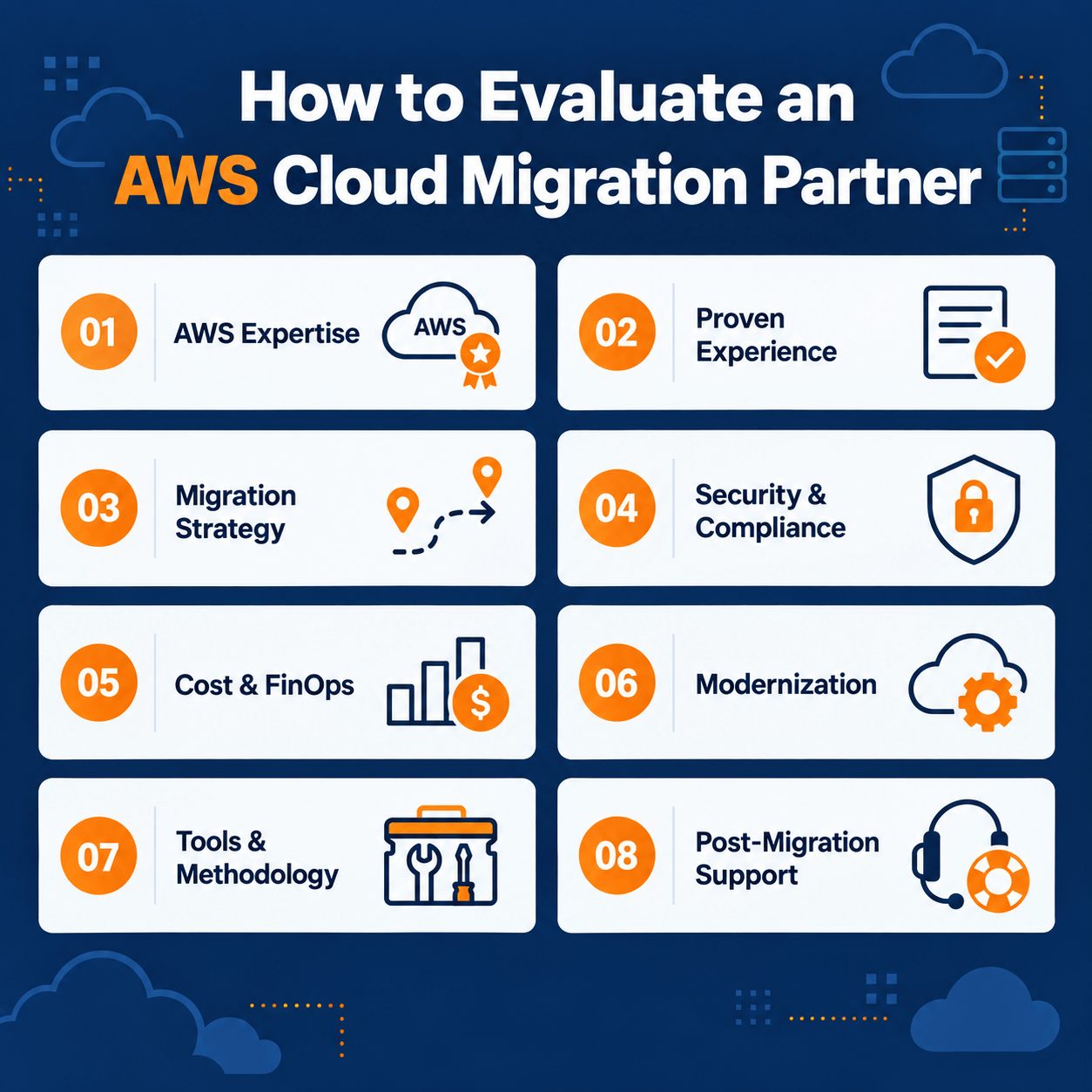
AWS Cloud Migration Partner Evaluation Checklist
Use this checklist when comparing partners side by side. A partner worth shortlisting should satisfy every item, and be able to prove it with references, not just claims.
Questions to Ask Before Selecting an AWS Migration Partner
The answers to these six questions reveal more than any sales deck. A strong partner answers them specifically and with evidence. A weak one answers in generalities.
AWS Cloud Migration Services: What to Expect From the Right Partner
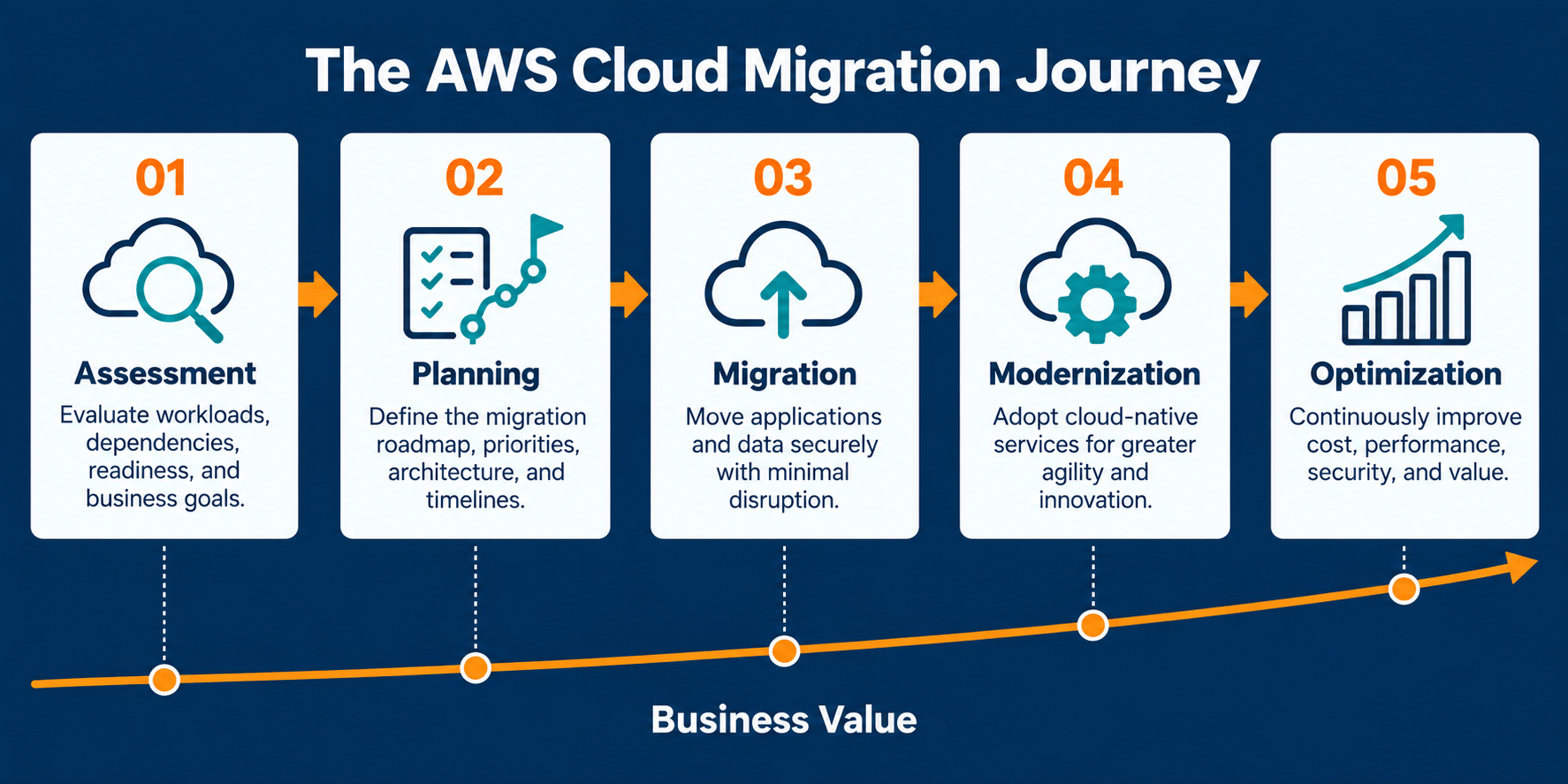
The right partner runs a clear, staged journey: assessment, then planning, then migration, then modernization, then optimization. Each stage feeds the next. A cloud migration assessment shapes the plan; the plan governs the migration; modernization and optimization turn a completed move into lasting cloud value.
This is why an end-to-end partner matters more than a point vendor. When one team owns the journey from cloud migration assessment through post-migration operations, accountability is clear and value compounds. To see how these stages fit together in practice, AWS Cloud Migration Services setout an end-to-end delivery model, and this AWS Cloud Migration Strategy checklist breaks the planning stage into concrete steps.
Conclusion
Choosing an AWS cloud migration services partner is a decision about capability, not cost alone. The criteria are consistent: proven AWS expertise and certifications, a structured migration methodology, security designed in from the start, disciplined cost and FinOps management, real modernization capability, and post-migration support that sustains the value over time.
Evaluate every prospective partner against those criteria, ask the hard questions, and insist on measurable references. As an AWS Advanced Tier partner, Pace Wisdom brings the certified expertise, end-to-end methodology, and long-term CloudOps support that turn a migration into a durable advantage. The right partner does not just move your workloads. It makes them run better than before.
We'll map the exact workflows from this article to your business - free, in 30 minutes.
Frequently Asked Questions
1. What should I look for in an AWS cloud migration partner?
Look for AWS Partner tier status and Migration Competency, named certified engineers, migration experience in your industry, a structured assessment and AWS cloud migration strategy, strong security and FinOps practices, and defined post-migration support. Measurable case studies matter more than sales claims.
2. How much do AWS cloud migration services cost?
Cost depends on the number and complexity of workloads, the migration approach (rehosting is cheaper than refactoring), and how much modernization is involved. A good partner provides an accurate upfront estimate and separates one-time migration cost from ongoing AWS run cost, then optimises the run cost after cutover.
3. How long does an AWS cloud migration take?
Timelines range from a few weeks for a straight forward lift-and-shift of a small estate to several months for a complex, multi-application migration with modernization. Legacy application complexity is the most common cause of delays, which is why the assessment stage is critical to setting a realistic timeline.
4. What are the main AWS migration strategies?
The AWS 6Rs framework: rehost (lift and shift), replatform (lift, tinker, and shift), repurchase (move to a new product), refactor (re-architect for cloud-native), retire (decommission), and retain(keep on-premises for now). A strong AWS migration partner applies the right approach per workload rather than one strategy across the board.
5. How can an AWS migration partner reduce downtime?
Through careful sequencing, parallel-run environments, automated migration tooling, thorough testing before cutover, and a tested rollback plan. The goal is to migrate critical systems with minimal or zero disruption to business operations, which requires planning that begins at the assessment stage.
6. Why is AWS certification important when choosing a migration partner?
AWS certifications and Partner competencies signal audited, proven capability rather than self-reported skill. They confirm the partner's engineers have demonstrated expertise in AWS services and migration practices, which reduces the risk of costly mistakes during your migration.
7. What happens after migrating applications to AWS?
After cutover comes optimization: rightsizing resources, tuning performance, tightening security, and managing cost through FinOps. Ongoing AWS cloud modernization and CloudOps support ensure the environment keeps improving. This post-migration phase is where much of the long-term cloud value is realised.
You may also want to read