Cloud migration is the #2 IT priority for CIOs in 2026, behind only cybersecurity, according to Gartner's CIO Survey. Yet despite record investment, 38% of migrations exceed their original budget and 31% miss their planned timeline, with legacy application complexity cited as the primary cause.
The difference between a migration that delivers and one that stalls almost always comes down to what happens before the first workload moves. A rigorous cloud migration checklist is not a bureaucratic formality. It is the planning foundation that determines whether migration creates the value it promised or creates a new set of problems in the cloud.
This guide walks through 12 essential steps every organisation should complete as part of their cloud migration plan before any production workload moves.
The 12-Step Cloud Migration Checklist
Step 1: Define Business Objectives and Success Metrics
Every cloud migration plan must start with a clear answer to why. Cost reduction, agility, scalability, developer productivity, and disaster recovery are all valid drivers, but they lead to very different architecture decisions, provider choices, and success criteria. Define specific, measurable outcomes before anything else: target cost savings percentage, deployment frequency improvement, SLA uptime requirements, and time-to-market benchmarks.
Without these anchors, migration becomes a technical exercise with no clear definition of success, and no way to tell leadership whether it worked.
Our engineers will audit your workflow and estimate time-to-value at no cost.
Claim your free audit
Step 2: Conduct a Cloud Migration Assessment
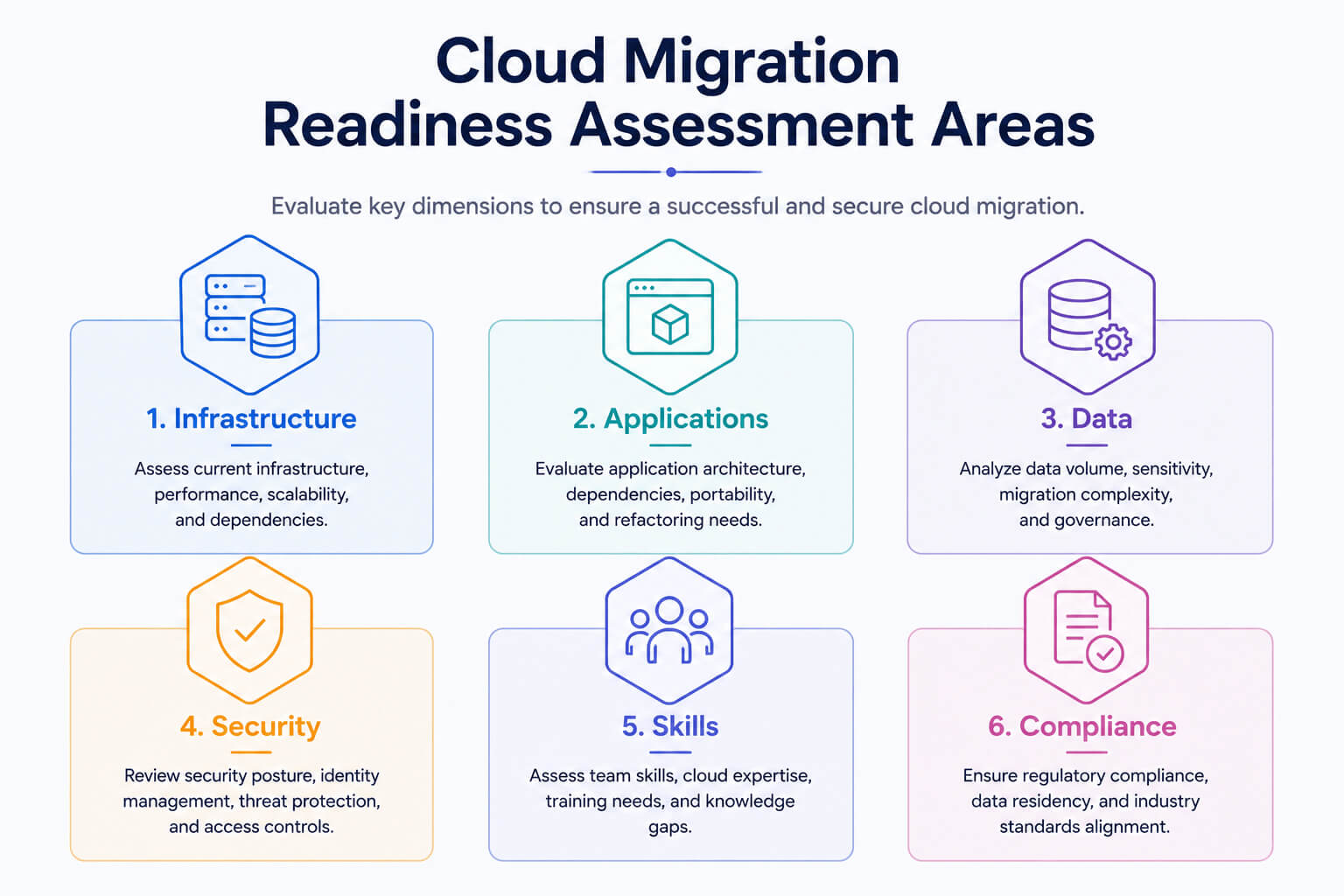
A formal cloud migration assessment evaluates your current environment's readiness across infrastructure, applications, data, security, skills, and compliance. This step is where most organisations underinvest and most migrations later fail.
According to IDC's Cloud Pulse survey, close to half of cloud buyers spent more on cloud than expected, with 59% anticipating similar overruns the following year. The root cause in most cases: inadequate pre-migration assessment that failed to surface hidden workload complexity, dependency conflicts, and data transfer costs before the project began.
Step 3: Build Your Cloud Migration Strategy
Your cloud migration strategy determines how each workload moves. The standard framework is the 7 Rs: Rehost (lift and shift), Replatform, Repurchase, Refactor, Retire, Retain, and Relocate. Lift-and-shift accounts for over a third of migrations in 2025 and remains the fastest path to cloud, but it preserves legacy architecture problems. Refactoring delivers better long-term outcomes but requires significantly more time and budget.
Document the migration approach for each workload category at this stage, not halfway through the project.
Step 4: Inventory and Classify All Workloads
Your application migration checklist starts here. Build a complete inventory of every application, database, service, and dependency in scope. Classify each workload by criticality, sensitivity of data it handles, compliance requirements, and migration complexity. This inventory becomes the input for your dependency mapping, sequencing, and wave planning in subsequent steps.
Tools like AWS Migration Hub, Azure Migrate, or third-party discovery platforms can automate much of this work and reduce the manual effort that often delays this phase.
Step 5: Map Application Dependencies
Hidden dependencies are one of the leading causes of mid-migration failures. The Uptime Institute's 2025 enterprise infrastructure survey found that 38% of failed migration projects encountered unanticipated dependency conflicts during testing, not during planning. Dependency mapping identifies which applications communicate with each other, which databases are shared, and which services cannot move in isolation.
This step directly informs your migration wave sequencing: tightly coupled applications must move together or be decoupled before either can migrate safely.
Step 6: Choose Your Cloud Provider and Deployment Model
For enterprise cloud migration, the provider and deployment model decision has long-term architectural implications. AWS, Azure, and Google Cloud each have distinct strengths across AI/ML, compliance, global reach, and ecosystem integration. Public cloud, private cloud, hybrid, and multi-cloud each carry different cost, control, and complexity profiles.
Avoid making this decision based on a single team's familiarity with a platform. Evaluate against your business objectives, compliance requirements, and the workload classifications from Step 4.
We'll map the exact workflows from this article to your business - free, in 30 minutes.
Step 7: Build Your Cloud Migration Roadmap
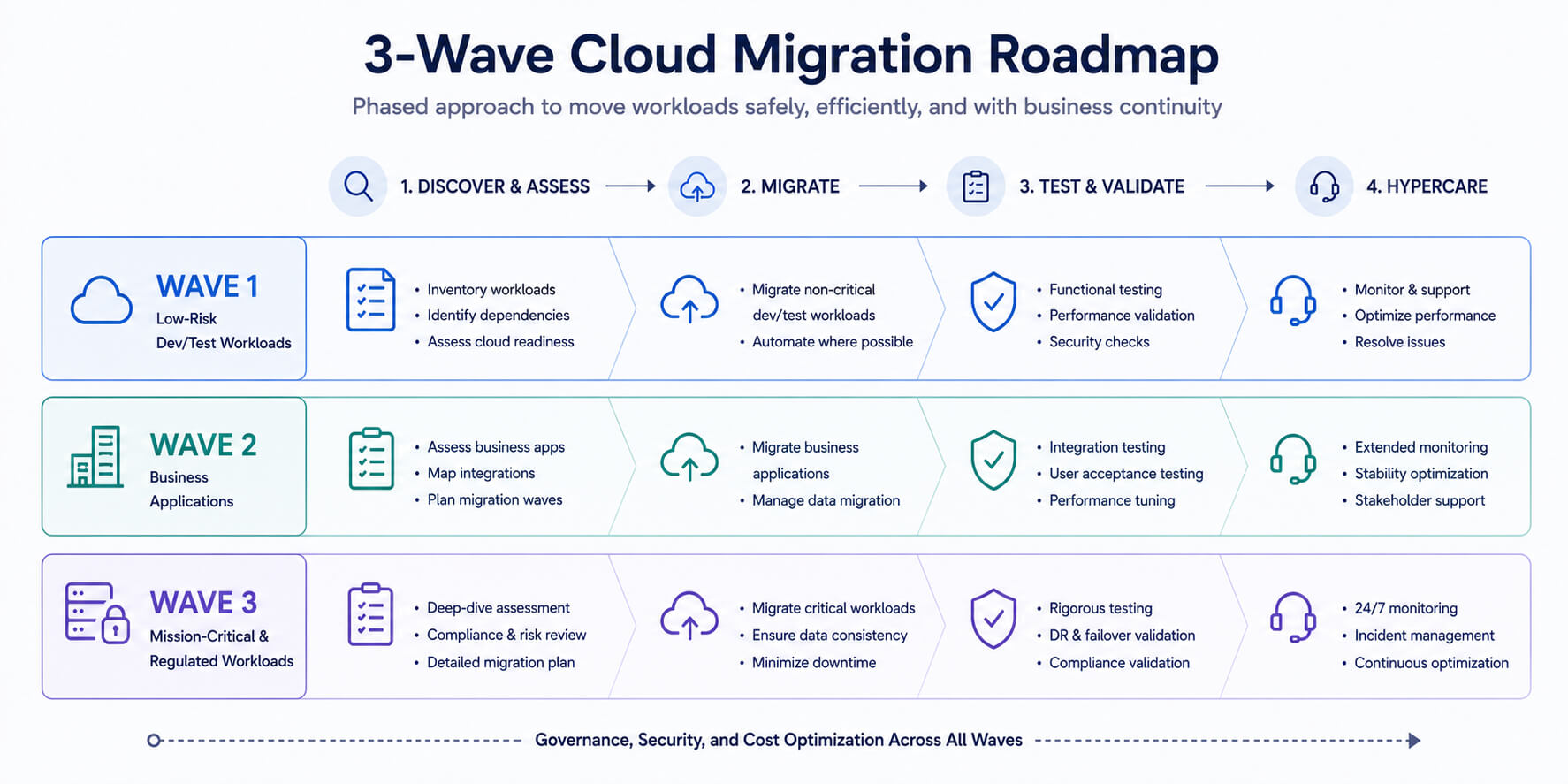
Your cloud migration roadmap translates strategy into a sequenced, time-bound execution plan. Break the migration into waves, starting with low-risk, low-dependency workloads that can serve as learning opportunities before you tackle business-critical applications.
Each wave should include discovery, dependency mapping validation, migration execution, testing, and a hypercare period. For complex enterprise migrations, plan for 8 to 12 months per major wave. Pace Wisdom's cloud transformation services team supports this roadmap planning end-to-end, from initial scoping through wave execution.
Step 8: Set Up Your Cloud Landing Zone
A landing zone is the pre-configured, governed cloud environment where migrated workloads will land. It includes account structure, identity and access management (IAM) policies, network topology, logging and monitoring configuration, and cost allocation tagging. Setting up a properly governed landing zone before migration begins prevents the configuration drift and security gaps that cause issues later.
Treating the landing zone as a post-migration task is one of the most common and costly sequencing mistakes in enterprise cloud projects.
Step 9: Complete Your Cloud Migration Security Checklist
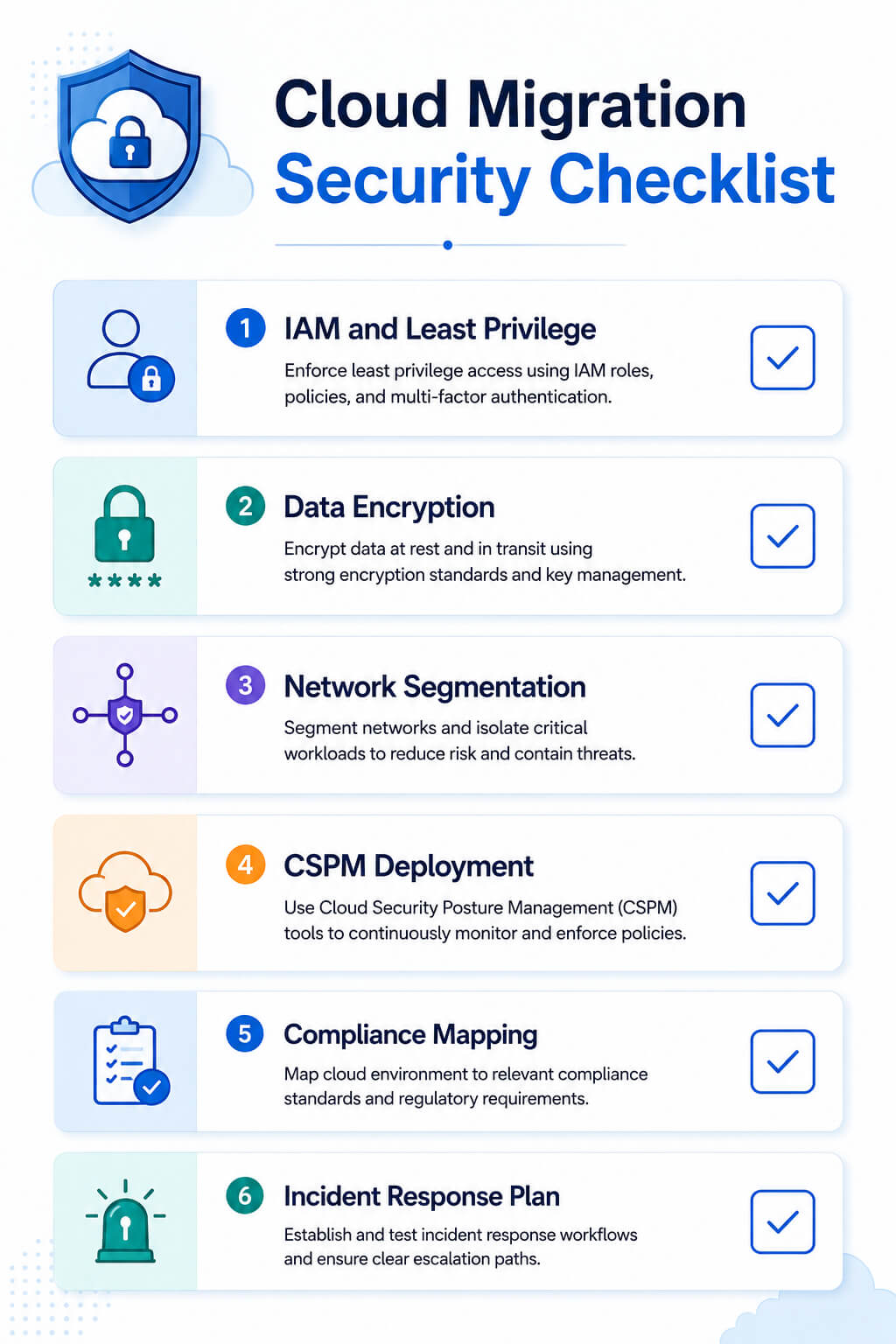
Security is where migrating organisations most frequently underinvest, and where the consequences are most severe. Gartner found that through 2025, 99% of cloud security failures were the customer's fault, primarily due to misconfigurations. Your cloud migration security checklist should cover:
- IAM policies: least-privilege access, MFA enforcement, no shared service accounts
- Encryption: data at rest and in transit, key management strategy
- Network segmentation: security groups, private subnets, no overly permissive rules
- CSPM: cloud security posture management to catch misconfigurations automatically
- Compliance mapping: GDPR, HIPAA, PCI-DSS, or SOC 2 requirements documented and validated
- Incident response plan: updated specifically for the cloud environment, not carried over from on-prem
Step 10: Plan for Data Migration and Compliance
Data migration is frequently the most technically complex and time-sensitive part of any cloud migration. Define your data transfer approach (online vs offline, streaming vs batch), validate data integrity checkpoints, and document retention policies for each data classification.
For regulated industries, compliance requirements must be baked into your cloud migration plan from the outset, not reviewed after cutover. Data residency, sovereignty, and audit logging requirements vary significantly by regulation and by cloud region.
Step 11: Train Your Team and Prepare for Change
A 2025 Gartner study found that 70% of migration issues stem from a lack of cloud expertise rather than technology failure. Teams accustomed to managing on-premises infrastructure need upskilling in cloud-native operations, DevSecOps practices, infrastructure-as-code, and cloud cost management before they go live.
Change management and stakeholder communication are equally important. Migration projects that treat the technical work as separate from the organisational change consistently underperform against those that treat them as one integrated programme.
Step 12: Test, Validate, and Plan Your Cutover
No workload should move to production without load testing, failover testing, and a documented rollback plan. Cloud migration best practices call for canary deployments or blue-green deployments to reduce cutover risk, progressive traffic shifting to validate performance at scale, and a defined go/no-go checklist for the cutover window itself.
Test your rollback procedure before you need it. Teams that have practiced rollback cut mean time to recovery significantly when something unexpected happens during cutover.
Post-Migration: What Comes After the Checklist
Completing the 12-step checklist gets you to a stable cloud environment. Extracting full value from that environment is an ongoing discipline.
Hypercare and Monitoring
Establish a formal hypercare period of 30 to 90 days post-migration, with heightened monitoring, a dedicated incident response team, and clear escalation paths. Most performance issues and configuration gaps surface in the first few weeks after cutover.
FinOps and Cost Optimisation
Enterprises that implement structured cost optimisation programs report an average 25 to 30% reduction in monthly cloud spend. Idle and over-provisioned resources typically account for 28 to 35% of cloud waste in the first 6 months post-migration. Assign FinOps accountability from day one.
Continuous Modernisation
Migration is not the destination; it is the starting point. The most value-creating organisations use the cloud as a platform for ongoing application modernisation, DevSecOps adoption, and AI/ML integration. Pace Wisdom's on-prem to cloud modernisation guide covers the full modernisation journey from initial lift-and-shift through cloud-native re-architecture.
Conclusion
A cloud migration checklist is the difference between a migration that delivers on its business case and one that becomes an expensive, drawn-out lesson in what not to skip. The 12 steps in this guide are not theoretical best practices; they are the gaps most consistently found in migrations that overspend, run late, or create new security exposure in the cloud.
Use this cloud migration plan as your pre-migration baseline. Adapt the sequencing to your environment, your compliance requirements, and your team's capacity. And ensure that security, compliance, and FinOps are embedded from step one, not retrofitted after the fact.
Frequently Asked Questions
1. What is a cloud migration checklist?
A cloud migration checklist is a structured pre-migration framework that guides organisations through the planning, assessment, security, and validation steps required before moving workloads to the cloud. It ensures critical areas like dependency mapping, compliance, and team readiness are addressed before migration begins rather than discovered during it.
2. How long does enterprise cloud migration take?
A typical enterprise migration wave takes 8 to 12 months from initial assessment to stabilisation. The full migration programme for large organisations with complex legacy estates often spans multiple waves over 18 to 36 months. Organisations that conduct thorough assessments and build detailed roadmaps before starting consistently complete migrations faster than those that begin without them.
3. What is a cloud readiness assessment?
A cloud readiness assessment evaluates an organisation's current environment across infrastructure, applications, data, security posture, team skills, and compliance requirements. It identifies which workloads are ready to migrate, which need refactoring, and which should be retained on-premises, forming the foundation of the cloud migration roadmap.
4. How do I choose the right cloud migration strategy?
Start by classifying each workload using the 7 Rs framework: Rehost, Replatform, Repurchase, Refactor, Retire, Retain, or Relocate. Match the strategy to each workload's complexity, business criticality, and technical debt level, rather than applying a single approach across the entire estate.
5. What are the biggest cloud migration risks?
The most common risks are budget overruns from unplanned refactoring and egress costs, timeline slippage from undiscovered application dependencies, security misconfigurations during the migration window, and skills gaps that create operational problems post-migration. All of these are addressable with proper pre-migration planning.
6. How can I ensure cloud migration security?
Involve your security team from the first planning meeting, not after the project starts. Build your cloud migration security checklist around IAM least-privilege, encryption at rest and in transit, network segmentation, CSPM tooling, and a compliance framework review. Security should be designed into the landing zone before the first workload migrates, not layered on afterward.
You may also want to read
What Is a Cloud Transformation Assessment? A Guide for Enterprises