The pharmaceutical industry runs on one of the least efficient innovation models inany sector. It costs an average of USD 2.67 billion to bring a single drug to market, a figure that has risen consistently for decades. Only 12 percent of drug candidates entering clinical trials ultimately receive regulatory approval. Development timelines routinely span 10 to 15 years.
AI in drug development is the most significant structural intervention this pipeline has seen. Machine learning screens billions of compounds computationally. Generative AI designs novel molecules from scratch. Predictive models surface toxicity signals before animal studies begin. AI agents are beginning to redesign clinical trial workflows that have remained largely unchanged for decades. This guide covers how each of these capabilities works, where the value is clearest, and what pharmaceutical organisations need to build to capture it.
Our engineers will audit your workflow and estimate time-to-value at no cost.
Claim your free audit
The State of AI in Drug Development in 2026
The market for AI for drug discovery has moved decisively from experimental to operational. Investment reflects the trajectory: BCG, McKinsey, and Deloitte have all noted pharma AI R&D budgets grew significantly over 2025 levels, with major companies committing substantial capital to internal AI platforms and partnerships.
The honest assessment: Deloitte's 2025 pharma R&D productivity report found R&D costs still at a record USD 2.67 billion per asset despite growing AI investment. AI is delivering clear value in early discovery. In clinical development, the gains are real but not yet transformational at scale.
AI for Drug Target Identification
Modern AI in drug discovery for target identification trains machine learning models on combined genomic, proteomic, transcriptomic, and clinical outcome data to surface disease-gene-protein associations invisible to manual analysis. Where a human research team might evaluate hundreds of candidate targets over several years, a trained ML model prioritises thousands of candidates in days, scoring each by predicted druggability, disease association strength, and clinical translatability.
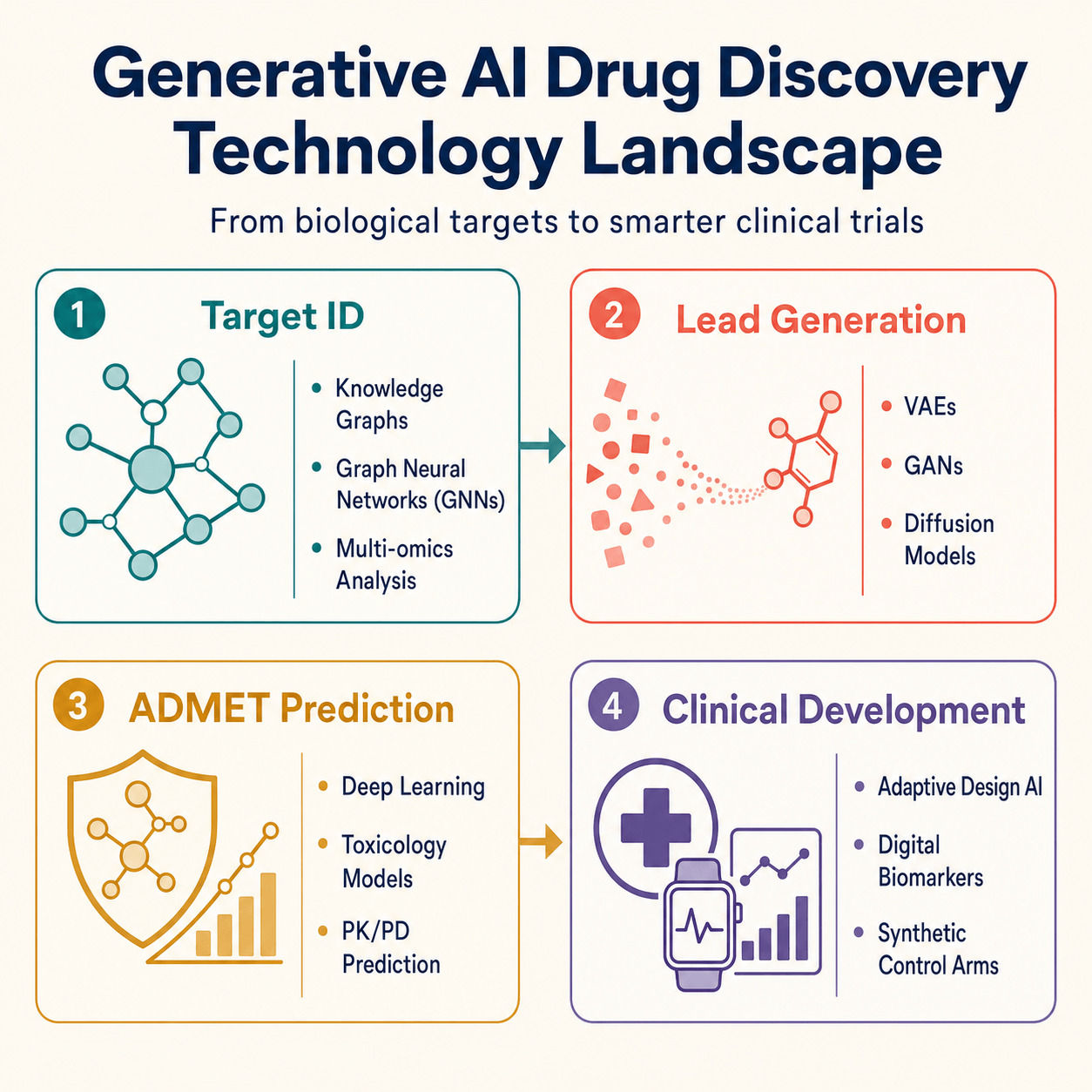
Knowledge Graphs and Graph Neural Networks
Graph neural networks applied to biological knowledge graphs map multi-step causal relationships between genes, proteins, metabolic pathways, and disease phenotypes. This is particularly effective for rare diseases, where limited patient data makes traditional statistical approaches unreliable, and for polypharmacology research where multiple disease pathways need simultaneous modulation.
Real-World Impact
Insilico Medicine's AI-designed fibrosis drug candidate, rentosertib, completed the target identification through preclinical stages in 30 months, versus an industry average of approximately 6 years. This is the most clearly documented proof that AI-driven target identification compresses the earliest pipeline stage without sacrificing scientific rigour.
How AI improves drug target identification:
- Mines genomic, proteomic, and transcriptomic datasets simultaneously to surface novel target-disease associations
- Scores thousands of candidate targets by druggability, disease association, and clinical translatability in days
- Maps multi-step causal disease-gene-protein relationships using biological knowledge graphs
- Identifies polypharmacology targets where one molecule can modulate multiple disease pathways
- Reduces target selection failure by predicting clinical translatability before significant wet-lab investment
Generative AI Drug Discovery: Virtual Screening and De Novo Drug Design
The application of generative AI in pharmaceutical research to molecular design is where the technology is most visibly transforming what is possible. Three complementary approaches now form the core of AI-driven lead generation.
De novo drug design uses generative AI architectures including variational autoencoders (VAEs), generative adversarial networks (GANs), and diffusion models to create novel molecular structures optimised simultaneously for binding affinity, selectivity, solubility, and synthetic accessibility.
What generative AI delivers for drug discovery:
- Generative AI drug discovery explores chemical spaces containing billions of novel compounds not in any existing library
- Virtual screening with AI evaluates billions of compound-target interactions in days versus months for wet-lab assays
- De novo generative models propose novel structures optimised for multiple drug-like properties simultaneously
- ADMET prediction in silico identifies toxicity, solubility, and metabolism problems before animal testing begins
- Reinforcement learning-guided lead optimisation iteratively improves candidates through directed structural modification
We'll map the exact workflows from this article to your business - free, in 30 minutes.
AI Clinical Trials: Redesigning the Most Expensive Phase
AI clinical trials represent the area of highest potential value. Clinical development accounts for nearly 70 percent of total R&D expenses, and a single 12-month reduction in timelines adds substantial net present value across a sponsor's portfolio.
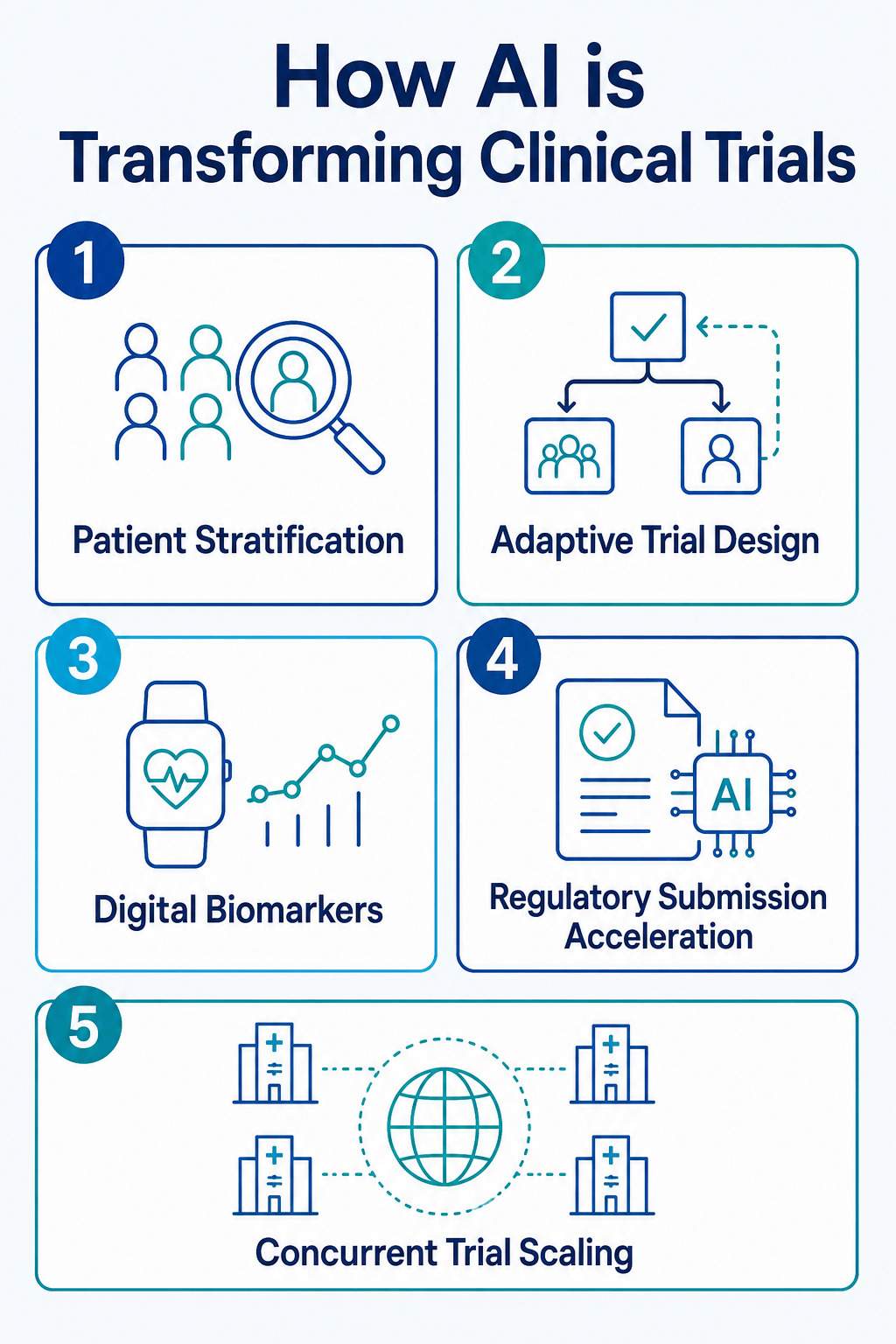
Patient Stratification and Cohort Selection
AI models trained on electronic health records, genomic profiles, and biomarker data identify patient subpopulations most likely to respond to a treatment. This reduces required sample sizes, improves efficacy signal strength, and identifies patients at elevated adverse event risk who should be excluded from early-phase trials.
Adaptive Trial Design
AI-powered adaptive designs use pre-specified statistical decision rules and real-time interim analysis to modify doses, endpoints, or cohort allocation in response to emerging data, within a regulatory-accepted framework. This approach reduces both trial duration and protocol amendment burden.
Digital Biomarkers and Remote Monitoring
Wearable devices and digital biomarkers generate continuous patient data streams that AI models process in real time, detecting efficacy signals and safety events faster than periodic clinic visit assessments. This enables earlier trial decisions and reduces late-stage safety surprises.
Regulatory Submission Acceleration
AI-assisted document generation and regulatory writing tools reduce submission preparation times significantly, with generative models producing regulatory module drafts that clinical affairs teams review and refine rather than write from scratch.
Key AI applications in clinical trials:
- AI clinical trials use genomic and real-world data to identify best responders, improving signal-to-noise in efficacy endpoints
- Adaptive design with AI modifies protocols in response to interim data, reducing design time and amendment burden
- Digital biomarker monitoring via wearables enables continuous real-time safety and efficacy data collection
- AI-generated regulatory documents reduce submission preparation time and improve consistency
- AI agent coordination allows concurrent trials to scale without proportional increases in staffing
Challenges, Risks, and the Regulatory Landscape
The gap between AI in drug development's demonstrated potential and its industry-wide impact remains substantial. Understanding why is as important as understanding the opportunity.
Data Quality and Proprietary Dataset Access
AI models are only as good as the data they train on. Pharmaceutical datasets are often proprietary, siloed across legacy systems, and inconsistently structured. The genomic and clinical data needed to train the most powerful models is largely held by individual health systems and academic medical centres, creating access barriers that slow model development.
Regulatory Acceptance and the FDA AI/ML Framework
The FDA requires that decisions affecting patient safety be explainable. Deep learning models that produce predictions without interpretable reasoning face significant barriers in clinical applications. The FDA AI/ML Software as a Medical Device action plan and EU AI Act requirements for high-risk systems are the primary frameworks shaping which AI applications can enter clinical use and on what timeline.
The Clinical Failure Rate Remains Unchanged
Despite improvements in early discovery efficiency, the approximately 90 percent clinical failure rate for drug candidates has not materially declined. AI has not yet solved the fundamental challenge of predicting clinical efficacy from preclinical data, which remains the central cause of pharmaceutical pipeline attrition.
Key challenges facing AI in drug discovery:
- Data quality and access: siloed, proprietary, inconsistently structured pharmaceutical datasets limit model training
- Regulatory acceptance: black-box deep learning models face interpretability requirements not fully satisfied by current architectures
- IP complexity: unresolved ownership questions in AI-pharma partnerships where models are trained on proprietary data
- Clinical efficacy prediction: the core challenge of predicting trial success from preclinical data remains unsolved
For a broader view of how generative AI is transforming clinical settings alongside pharmaceutical R&D, how Gen AI is transforming healthcare covers the clinical delivery and patient-facing dimensions in depth.
How Pharma Organisations Should Approach AI in Drug Development
The organisations extracting the most value from AI in the pharmaceutical industry share a common pattern: they treat AI investment as a data infrastructure programme first and an AI deployment programme second.
Partner First, Build Data Capability Internally
Building proprietary AI platforms from scratch requires molecular biology expertise, large labelled datasets, ML engineering, and MLOps infrastructure simultaneously. The current market consensus favours partnering with specialised AI drug discovery platforms for capability access while building internal data science teams to evaluate, integrate, and govern the outputs.
Data Strategy as the Prerequisite
The limiting factor for most pharmaceutical AI programmes is not model sophistication. It is data availability, quality, and accessibility. Organisations that invest in data standardisation, electronic lab notebook integration, and clinical trial data harmonisation will have disproportionate AI capability relative to those that do not.
Four priorities for pharmaceutical AI implementation:
- Partner first: engage specialised AI drug discovery platforms while building internal governance and evaluation capability
- Invest in data infrastructure before AI tooling: standardise and harmonise the datasets that models will train on
- Integrate regulatory affairs into AI programme design from the first sprint, not after the model is built
- Start narrow: deploy AI in one high-value pipeline stage and measure rigorously before expanding
For organisations evaluating the technology infrastructure needed to support AI-driven R&D programmes, healthcare and pharma software solutions covers the platform, integration, and compliance considerations relevant to pharmaceutical technology programmes.
Conclusion
AI in drug development has moved from speculative to demonstrable. The timeline compression in early discovery is documented. The clinical trial efficiency gains are real. The regulatory frameworks are being written. The question is not whether AI will reshape pharmaceutical R&D. It is which organisations will have the data foundation, governance model, and partner ecosystem in place to capture the value as these capabilities compound.
Frequently Asked Questions
1. What is AI in drug development?
AI in drug development refers to machine learning, deep learning, and generative AI applied to pharmaceutical R&D, spanning drug target identification, virtual screening, de novo molecular design, ADMET property prediction, clinical trial optimisation, and regulatory submission. AI accelerates the computationally intensive work that bottlenecks each pipeline stage without replacing scientific expertise. The global AI in drug discovery market reached USD 5 billion in 2026 and is growing at approximately 12 percent CAGR.
2. How is generative AI used in pharmaceutical research?
Generative AI in pharmaceutical research is primarily used for de novo drug design, protein structure prediction and biologics design, synthetic patient data for trial modelling, ADMET prediction to reduce attrition, and regulatory document generation. Generative models including VAEs, GANs, and diffusion models are the most deployed architectures. The generative AI drug discovery segment alone was USD 260.56 million in 2025 and is projected to reach USD 2.7 billion by 2035.
3. What is de novo drug design?
De novo drug design is the computational generation of entirely new molecular structures optimised fora specific biological target, rather than selecting from existing compound libraries. Generative AI models learn the statistical properties of known drug molecules and generate novel structures optimised for binding affinity, selectivity, solubility, and synthetic accessibility. This opens chemical spaces that traditional medicinal chemistry and high-throughput screening cannot efficiently explore.
4. How is AI used in clinical trials?
AI clinical trials applications include patient stratification using real-world data and genomic profiles, adaptive trial design that modifies protocols based on interim data, digital biomarker monitoring through wearables, and AI-assisted regulatory submission preparation. McKinsey estimates AI agents could allow companies to run twice as many trials with the same resources and cut trial durations by as much as 12 months.
5. What are the main challenges of AI in drug discovery?
The primary challenges are data quality and proprietary dataset access, model interpretability for regulatory acceptance, unresolved IP questions in AI-pharma partnerships, and the stubbornly unchanged clinical failure rate of approximately 90 percent. AI has demonstrably improved early discovery efficiency but has not yet significantly changed the probability that a drug candidate entering clinical trials will gain approval.
6. How long does AI-assisted drug development take?
AI-assisted drug discovery and preclinical development has been compressed to as little as 18 to 30 months in the best documented cases, compared to a traditional average of 4 to 6 years for equivalent stages. End-to-end, AI-optimised programmes are targeting 7 to 8 years from first-in-class target identification to regulatory approval, versus the historical 12 to 15 years. Most of the timeline gain comes from compressed early discovery and more efficient clinical trial design.
You may also want to read