Quality control has always been manufacturing's quiet tax. Every defect that reaches a customer costs a warranty claim, a return, or a lost account. Every defect caught late costs rework and scrap. And the cost of poor quality is not small: across the sector, it absorbs an estimated 20 percent of total manufacturing revenue.
For decades, the defence against defects was human inspectors and, later, fixed-rule vision systems. Both share the same limit. They can find a defect, but they cannot act on it.
Agentic AI in manufacturing changes that. It does not just see the defect. It responds, halting the line, routing the part, and tracing the cause, without waiting for a person. This guide explains how agentic AI reshapes quality control, from inspection through corrective action, and how to deploy it on your floor.
Our engineers will audit your workflow and estimate time-to-value at no cost.
Claim your free audit
What Is Agentic AI in Manufacturing Quality Control?
To understand the shift, you have to separate two things that are often confused: AI for manufacturing quality control that assists a human, and AI that acts on its own. The second is what makes a system agentic.
Copilot vs Agent: The Difference That Matters
The distinction is not marketing. It changes the economics:
- A copilot answers when asked. It saves an inspector a few minutes per query.
- An agent acts on triggers and schedules. It removes an entire monitor-and-respond loop from the human queue, escalating only when confidence is low.
This is why quality control is one of the clearest ROI cases for AI agents for manufacturing. Its inputs and outputs, defect rate, scrap rate, return rate, are all measurable, so the value shows up fast.
The Problem With Manual Quality Inspection
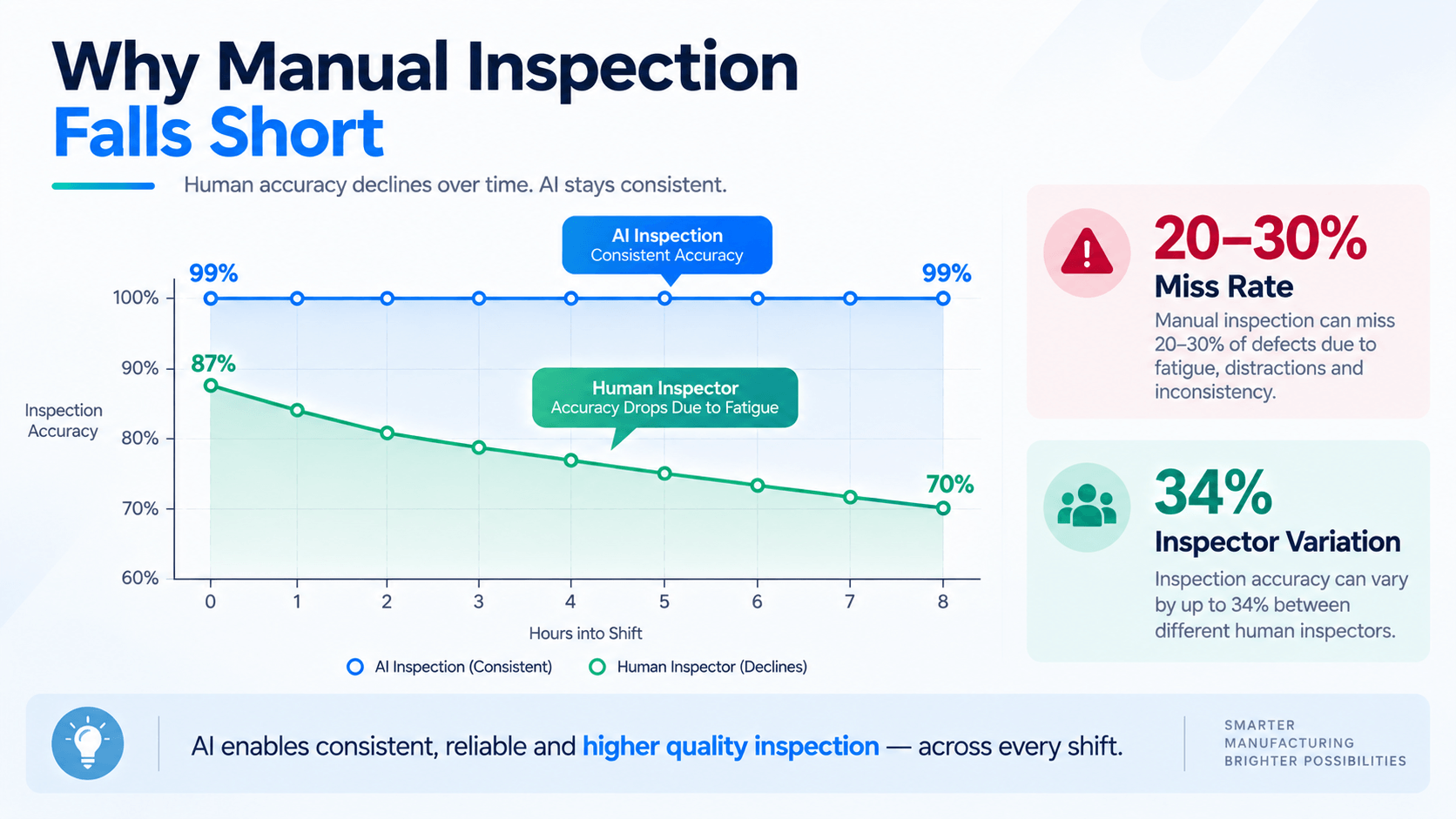
Human inspection has a ceiling that no amount of training removes. The issue is not skill. It is biology and statistics.
Two structural problems compound the accuracy gap:
- Sampling, not coverage. Manual inspection checks a fraction of output. Defects in the unchecked majority ship uncaught.
- Inconsistency over time. The same inspector applies different judgement at hour one and hour eight. Quality becomes a function of shift timing.
This is the exact gap agentic AI closes. It inspects every part, not a sample, and holds the same standard on every part, regardless of the hour.
How AI-Powered Quality Inspection Works
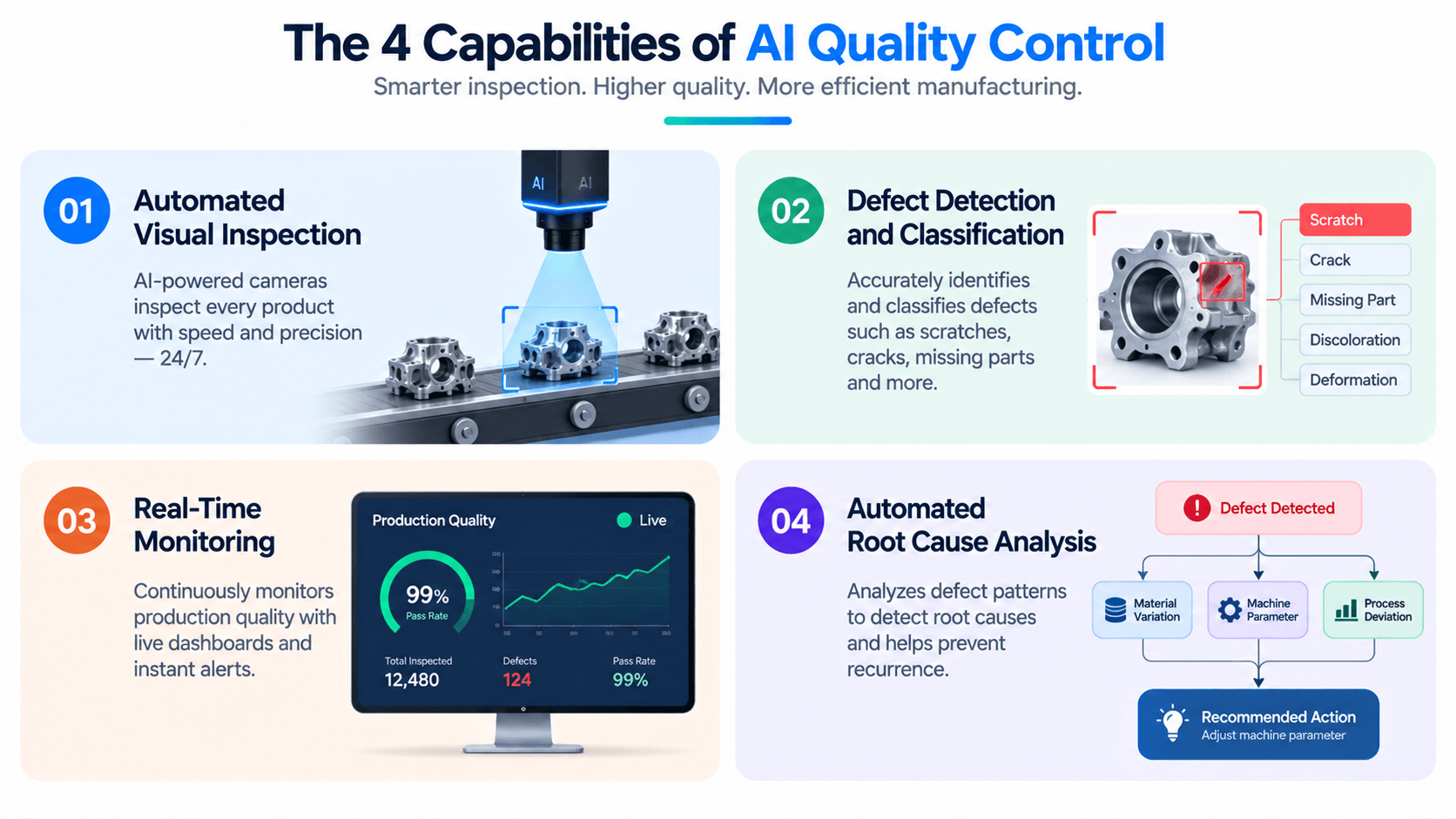
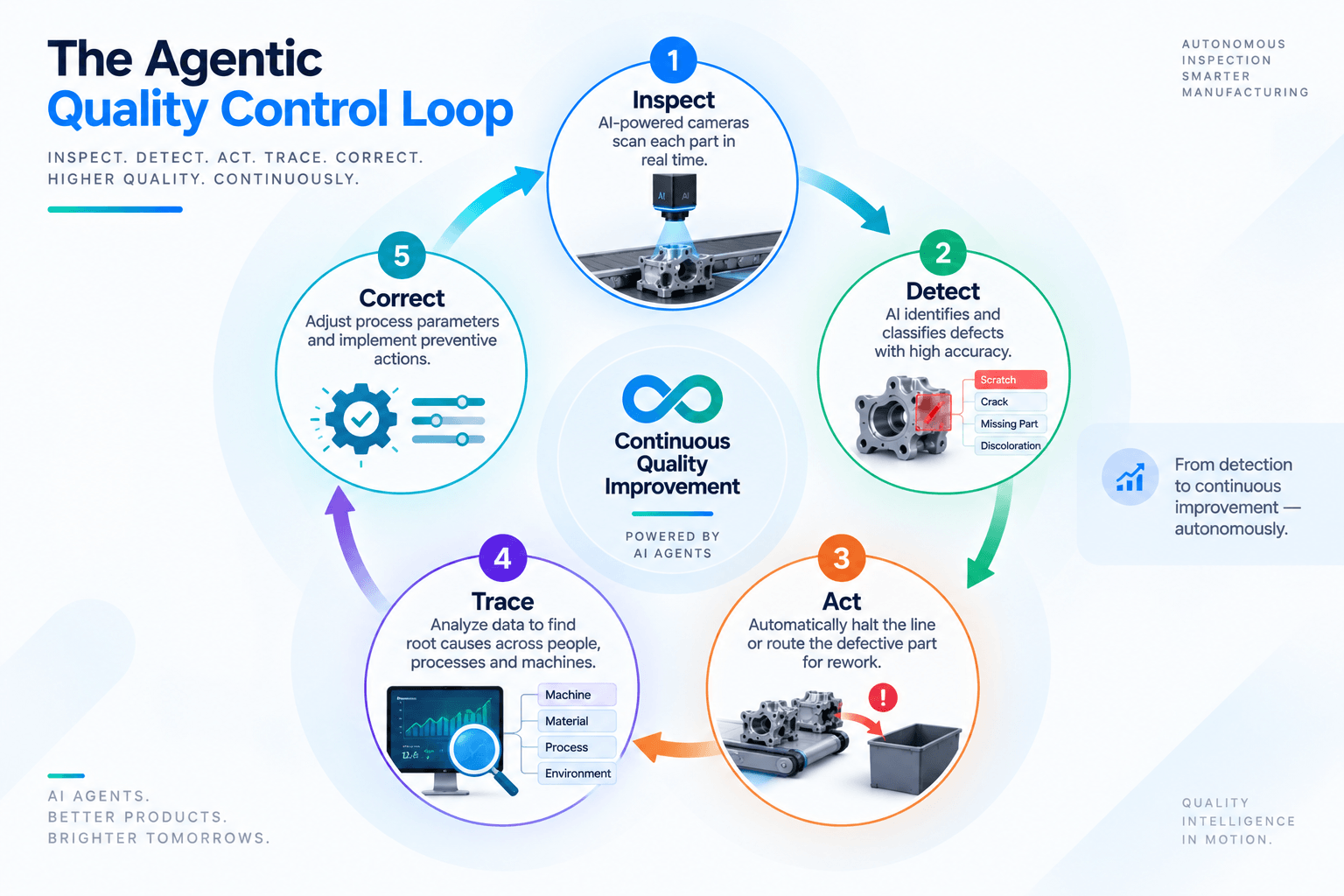
AI-powered quality inspection combines two layers: a perception layer that sees defects, and an action layer that responds to them. Four capabilities make up a complete agentic QC system.
- Automated Visual Inspection
High-resolution cameras and computer vision models inspect every part at line speed. They catch defects far smaller than the human eye can reliably see: micro-cracks, weld flaws, paint inconsistencies, and dimensional drift. - Defect Detection and Classification
The model does not just flag an anomaly. It identifies the defect type, scratch, dent, contamination, misalignment, and its severity, so the right action can follow. This classification is what lets the agent decide whether to scrap, rework, or route for review. - Real-Time Quality Monitoring
The system watches the whole line continuously, not part by part in isolation. It spots trends, like a defect rate creeping up on one machine, before they become batch failures. - Automated Root Cause Analysis
When defects cluster, the agent links them back to process data, temperature, pressure, material batch, or machine wear, to find the cause, not just the symptom.
The perception layer handles manufacturing defect detection and real-time quality monitoring. The agentic layer is what turns detection into action, the step covered next.
Manual vs Agentic Intelligent Manufacturing Quality Control
The clearest way to see the value of the agentic model is a direct, dimension-by-dimension comparison against the traditional approach.
The single most important row is the first one: what happens after a defect is found. A flag-and-wait system is only as fast as the human queue behind it. A detect-and-act system closes the loop in milliseconds, before the next defective part is even produced.
The Agentic Advantage: Acting on Defects
Detection accuracy gets the headlines, but the real value of AI agents for manufacturing quality control is what happens in the moment after a defect is found. This is where agentic systems separate from every generation of QC tools before them.
From Detection to Action
When an agentic system finds a defect, it can, within the same second, halt the production run to stop more defective parts, route the unit to human review or a reject bin, open a corrective-action case in the quality system, and alert the line supervisor. No human has to notice, decide, and act. The loop closes itself.
Closed-Loop Quality Control
The most advanced deployments feed defect data straight back into process control. If a defect traces to a machine drifting out of tolerance, the agent can adjust the setting or flag it for maintenance before the next batch. Quality stops being an inspection step and becomes a continuous control loop.
How to Deploy Agentic AI in Manufacturing QC
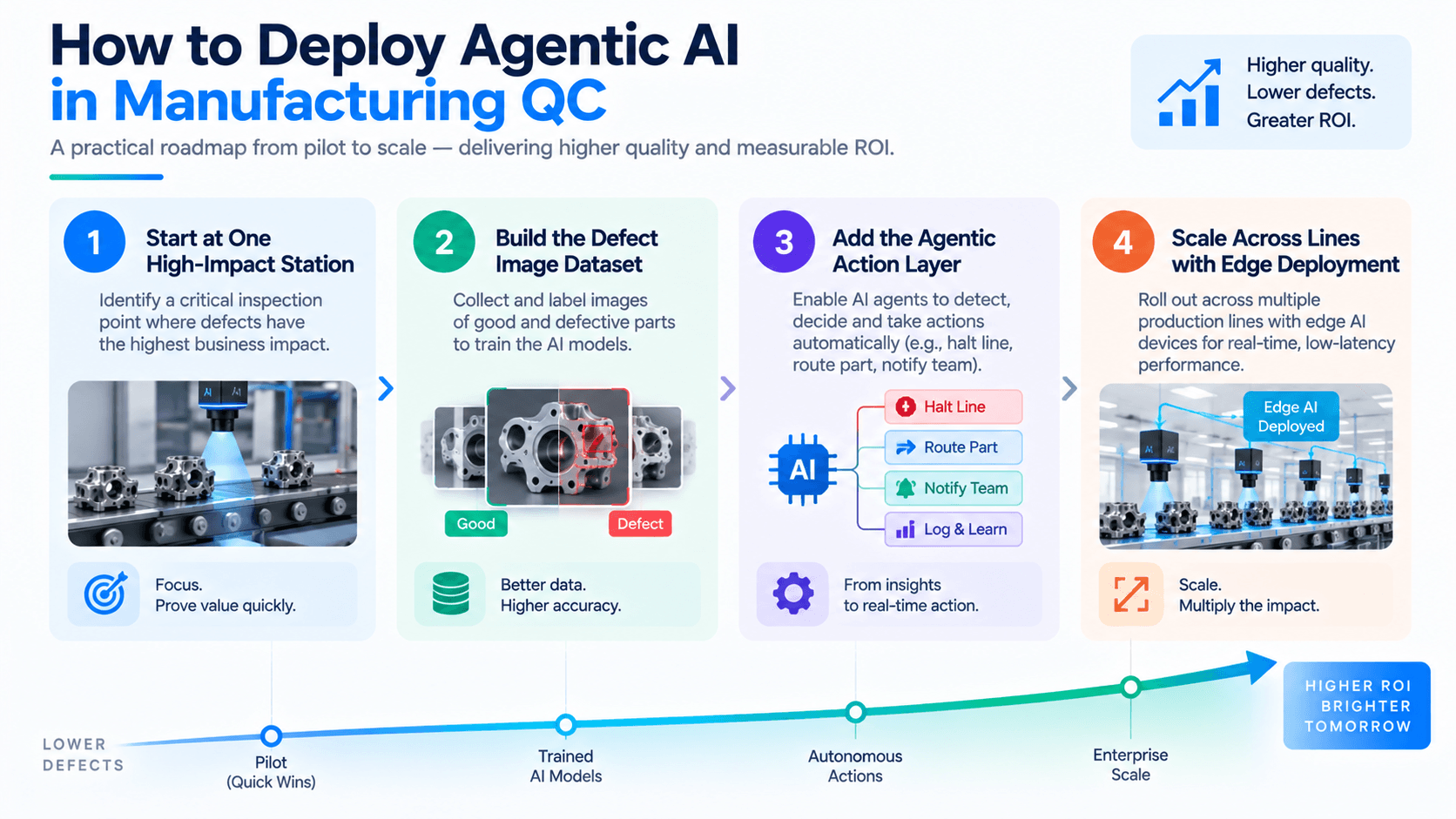
Deploying agentic AI in manufacturing quality control does not require an enterprise-wide transformation on day one. The teams that succeed start at a single station, prove the return, and scale from there. Follow four steps.
- Start at one high-impact inspection station.
Pick the point on your line where defects cost the most or escape most often. Position cameras there and measure against your current defect escape rate. ROI shows up in weeks, not years. - Build the defect image dataset.
Capture images across good, marginal, and defective parts. Modern active-learning tools minimise the labelling effort, and synthetic images can fill gaps for new product lines with no defect history. - Add the agentic action layer.
Detection alone is a vision system. Connect the model to line controls, the quality system, and alerting so the agent can act on what it finds, not just flag it. - Scale across lines with edge deployment.
Push inference to on-device GPUs for millisecond response at line speed. Manage model accuracy and retraining across lines as you expand to new stations and product variants.
For manufacturers building the systems integration, datainfrastructure, and edge deployment that agentic QC requires, AI-driven manufacturing IT servicesprovide the plant-floor engineering foundation. For organisations that need aquality control agent built around their specific defects and processes, customAI development services cover the modeldevelopment, action-layer integration, and deployment end to end.
We'll map the exact workflows from this article to your business - free, in 30 minutes.
Key Takeaways
Conclusion
Quality control is shifting from a cost centre to a control system. Agentic AI in manufacturing is the reason. When inspection covers every part, holds constant accuracy, and acts on defects the moment they appear, quality stops being something you check and becomes something you control.
The manufacturers moving now are not running science projects. They are starting at one station, proving the numbers, and scaling. The technology is production-proven, the ROI is measurable, and the cost of poor quality is too large to keep paying. The question is which station you start with.
Frequently Asked Questions
1. What is agentic AI in manufacturing?
Agentic AI in manufacturing is autonomous AI that monitors production data, reasons about what it sees, and takes action without a human directing each step. In quality control, it inspects every part, decides pass or fail, and acts on defects by halting the line, routing the part, or opening a corrective case.
2. How does AI defect detection work?
AI defect detection in manufacturing uses high-resolution cameras and computer vision models, usually convolutional neural networks, to analyse every part at line speed. The models are trained on images of good, marginal, and defective parts, then flag anomalies in real time, with an agentic layer acting on each detection.
3. How accurate is AI quality inspection compared to humans?
AI vision systems hold detection accuracy around 99 percent regardless of shift length. Human inspectors peak near 87 percent accuracy but drop to about 70 percent after four hours due to fatigue, and miss 20 to 30 percent of defects overall. AI also inspects 100 percent of parts rather than a sample.
4. What is the difference between a copilot and an agent in quality control?
A copilot answers questions when an operator asks, saving minutes per query. An agent acts on its own when a trigger occurs, detecting a defect and halting the line or opening a case without being prompted. The agent removes the entire monitor-and-respond loop from the human queue, which is where the larger economic value comes from.
5. What does agentic AI quality control cost to deploy?
Deployment typically starts at a single inspection station, which keeps initial cost and risk low. AI-powered quality inspection delivers measurable ROI within months in most cases, because defect rate, scrap, and return rateare all directly trackable against the deployment cost.
6. How do I start with AI quality control?
Start at your highest-impact inspection point, where defects cost the most or escape most often. Capture a defect image dataset, deploy automated quality inspection at that one station, and measure against your baseline defect escape rate. Once proven, add the agentic action layer and scale across lines.
You may also want to read