Quick Answer – GCC Vs Outsourcing
The GCC vs outsourcing choice comes down to one question: do you want to own a capability or rent a service? A Global Capability Center (GCC) is your own offshore team, usually in India, that you own, control, and build as a long-term asset. Outsourcing means hiring a third-party vendor to deliver work for you under a contract. GCCs give you ownership, control, and better long-term economics for core work. Outsourcing gives you speed and flexibility for non-core or short-term work. In 2027, with India's GCC ecosystem mature and models like Build-Operate-Transfer lowering the entry risk, more companies are choosing the GCC route for strategic work than ever before.
Every company that builds software faces the same question: should you own your tech team or rent one? It is the classic build-versus-buy decision, and the answer shapes your cost, your control, and your ability to move fast for years.
For a long time, outsourcing was the default answer. That is changing. GCC vs outsourcing is now a real strategic choice, not a foregone conclusion. India's Global Capability Center ecosystem has matured, entry models like Build-Operate-Transfer have lowered the risk of building your own center, and more companies are choosing ownership over rental for their core work. This guide compares the two models side by side, so you can choose the one that fits your company in 2027.
Our engineers will audit your workflow and estimate time-to-value at no cost.
Claim your free audit
Global Capability Center vs Outsourcing: The Core Difference
GCC vs Outsourcing (definition)
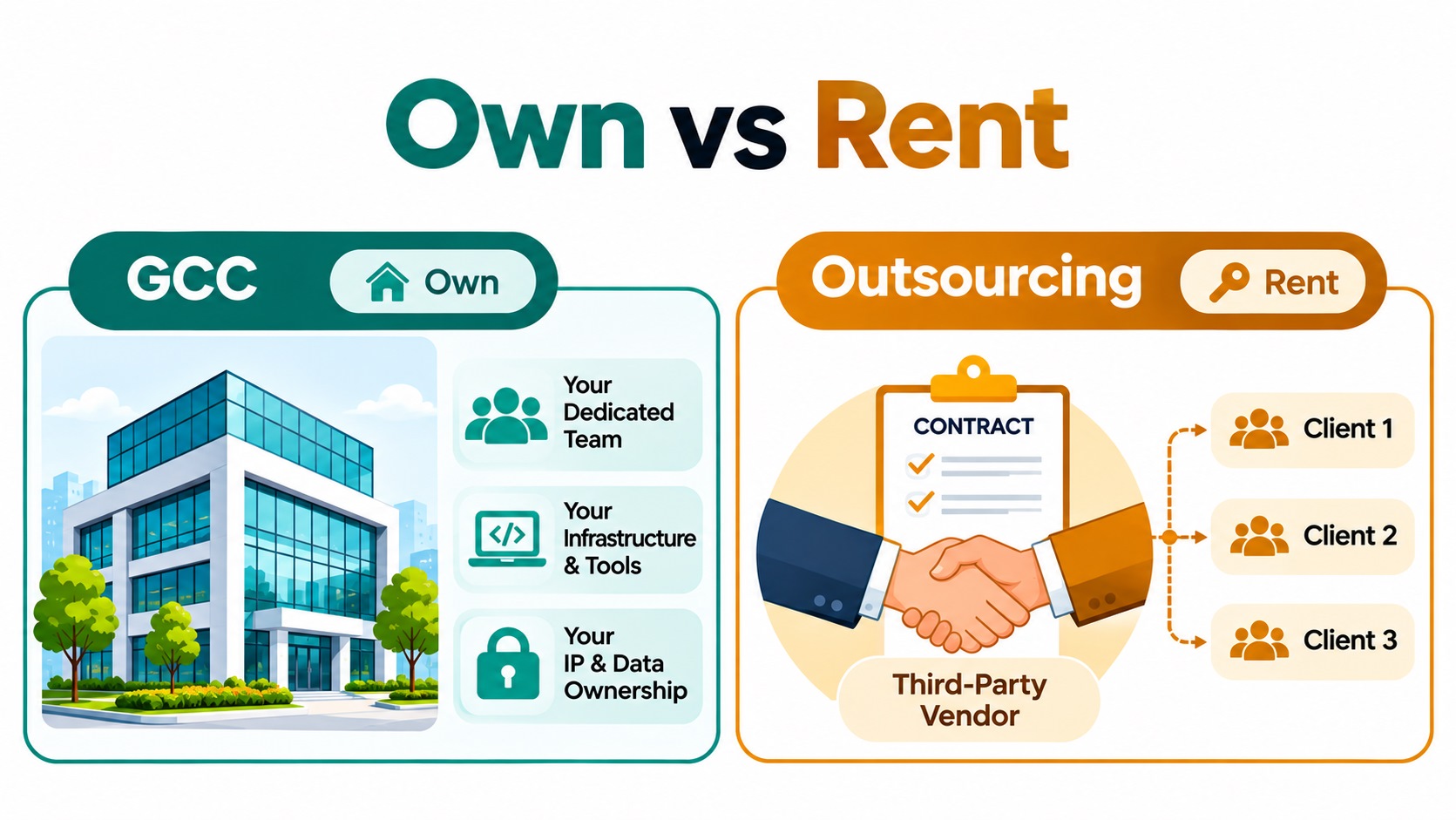
A Global Capability Center (GCC) is a captive offshore entity that a company owns and runs itself, usually in a talent hub like India, to handle technology, engineering, or operations work for the parent company alone. Outsourcing is the opposite: you hire a third-party vendor that serves many clients to do the work for you under a contract. One is owning a team; the other is buying a service.
The simplest way to frame the captive center vs outsourcing decision is ownership. With a GCC, the people, the code, the data, and the institutional knowledge are yours. With outsourcing, you own a contract and a deliverable, while the team and much of the knowledge stay with the vendor.
That difference used to make GCCs feel like a big, slow commitment reserved for giants. Not anymore. The model has shifted from a cost-saving back office to a strategic, owned capability.
KEY STAT: GCCS NOW OWN CORE WORK
96 percent of GCCs set up in India after FY2021 launched with product or portfolio ownership from day one, skipping the old crawl-walk-run model. GCCs are no longer just execution hubs; they now own core work from the start.
Source: Zinnov-NASSCOM GCC Value Orbit Report, FY2026
GCC vs Outsourcing: Side-by-Side Comparison
The clearest way to weigh the two models is factor by factor. The table below compares them across the eight things that matter most to a decision-maker.
| Factor | GCC (Captive Center) | Outsourcing (Vendor) |
|---|---|---|
| Ownership | You own the entity, team, and IP | The vendor owns the team; you hold a contract |
| Control | Full control over people and priorities | Managed by the vendor to an SLA |
| Cost model | Higher upfront, lower long-run per-person cost | Low upfront, vendor margin built into every hour |
| Speed to start | Slower: entity setup and hiring | Fast: a vendor team can start in weeks |
| Talent | Your brand, your culture, lower attrition | Shared across the vendor's clients |
| IP and data | Stays inside your own entity | Shared with a third party; needs tight contracts |
| Scalability | Scales as a long-term capability | Scales fast up or down, but not owned |
| Best for | Long-term, core, strategic work | Short-term, non-core, or variable work |
No model wins on every row. GCCs lead on ownership, control, talent, and long-term cost. Outsourcing leads on speed to start and flexibility. The right choice depends on which of these matters most for the work you are placing.
What Is a GCC and When It Wins: Global Capability Center Benefits
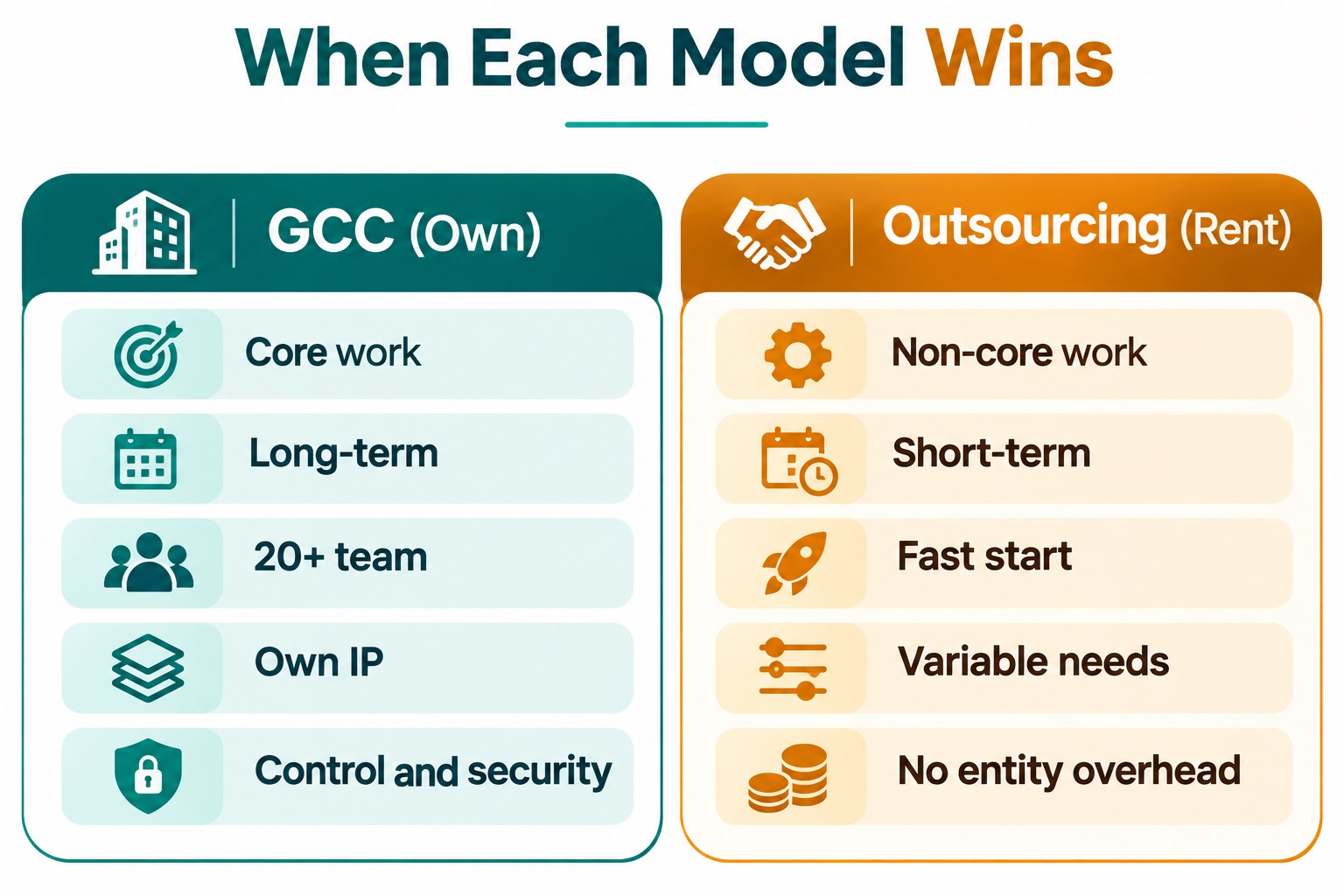
The global capability center benefits are strongest for work that is core, long-term, and strategic. When you own the team, you build lasting capability instead of renting it by the hour.
The main benefits of a GCC:
- Full ownership of talent, IP, and institutional knowledge
- Direct control over priorities, quality, and culture
- Lower cost per person over the long run, with no vendor margin
- A team that grows into deep product and domain expertise
- Better data security, since everything stays in your own entity
CHOOSE A GCC IF A GCC fits your company when:
- The work is core to your product or business, not a side task
- You are planning a team of roughly 20 or more people
- You want to own the IP, data, and talent long term
- You expect the need to last for years, not months
- Control and security matter more than the fastest possible start
Setting up and running a captive center takes local expertise in entity law, hiring, and compliance. Global Capability Center Services cover that end to end, from strategy and setup through running the center.
What Outsourcing Offers and When It Wins: GCC vs IT Outsourcing
Outsourcing is not the weaker option. It is the better one for a different kind of work. The GCC vs IT outsourcing trade-off flips when the work is short-term, non-core, or highly variable.
Common IT Outsourcing Models
There are three main IT outsourcing models to know:
- Project-based: the vendor delivers a defined project for a fixed scope and price.
- Dedicated team: the vendor provides a team that works only on your work, billed monthly.
- Managed service: the vendor owns an entire function and runs it to an agreed service level.
This offshore development model gives you speed and flexibility that a GCC cannot match in the short term.
CHOOSE OUTSOURCING IF Outsourcing fits your company when:
- The work is non-core, short-term, or one-off
- You need a team up and running in weeks, not months
- Your needs vary a lot and you want to scale up or down fast
- You do not want to own an offshore entity or its overhead
- Speed and flexibility matter more than long-term ownership
GCC vs Outsourcing Cost Comparison
Cost is where the GCC vs outsourcing cost comparison gets misunderstood. The honest answer is that it depends on time horizon.
Outsourcing is cheaper to start. There is no entity to set up and no hiring to do, and a vendor team can begin in weeks. But every hour you buy includes the vendor's margin, so the cost per person stays high for as long as you use them.
A GCC costs more upfront: entity setup, office, and hiring. But once it is running, there is no vendor margin, so the cost per person is lower. Over a multi-year horizon, an owned center usually becomes the cheaper option for a stable, long-term team. The crossover point is typically somewhere between year one and year two, depending on team size.
LATEST STAT: THE SCALE OF THE GCC SHIFT
The global GCC market is worth roughly USD 601 billion, and India hosts around half of all the world's GCCs. The scale of the shift shows how many companies now treat an owned capability center, not outsourcing, as the model for strategic work.
Source: Business of GCC Industry Report 2026
The Middle Path: GCC vs BOT Model and Hybrid Options
The GCC vs outsourcing decision is not strictly either-or. Build-Operate-Transfer (BOT) is a middle path that blends the two.
In a BOT model, a partner builds and runs your center for a fixed period, usually 18 to 24 months, then transfers full ownership to you. It gives you the speed and low early risk of outsourcing, with the eventual ownership of a GCC. For many first-time entrants, the GCC vs BOT model question answers itself: BOT is how you reach a captive center without the captive-center learning curve.
To see exactly how the phases and economics of this model work, the Build Operate Transfer (BOT) Model guide breaks it down in full.
How to Choose the Right Model for Your Company
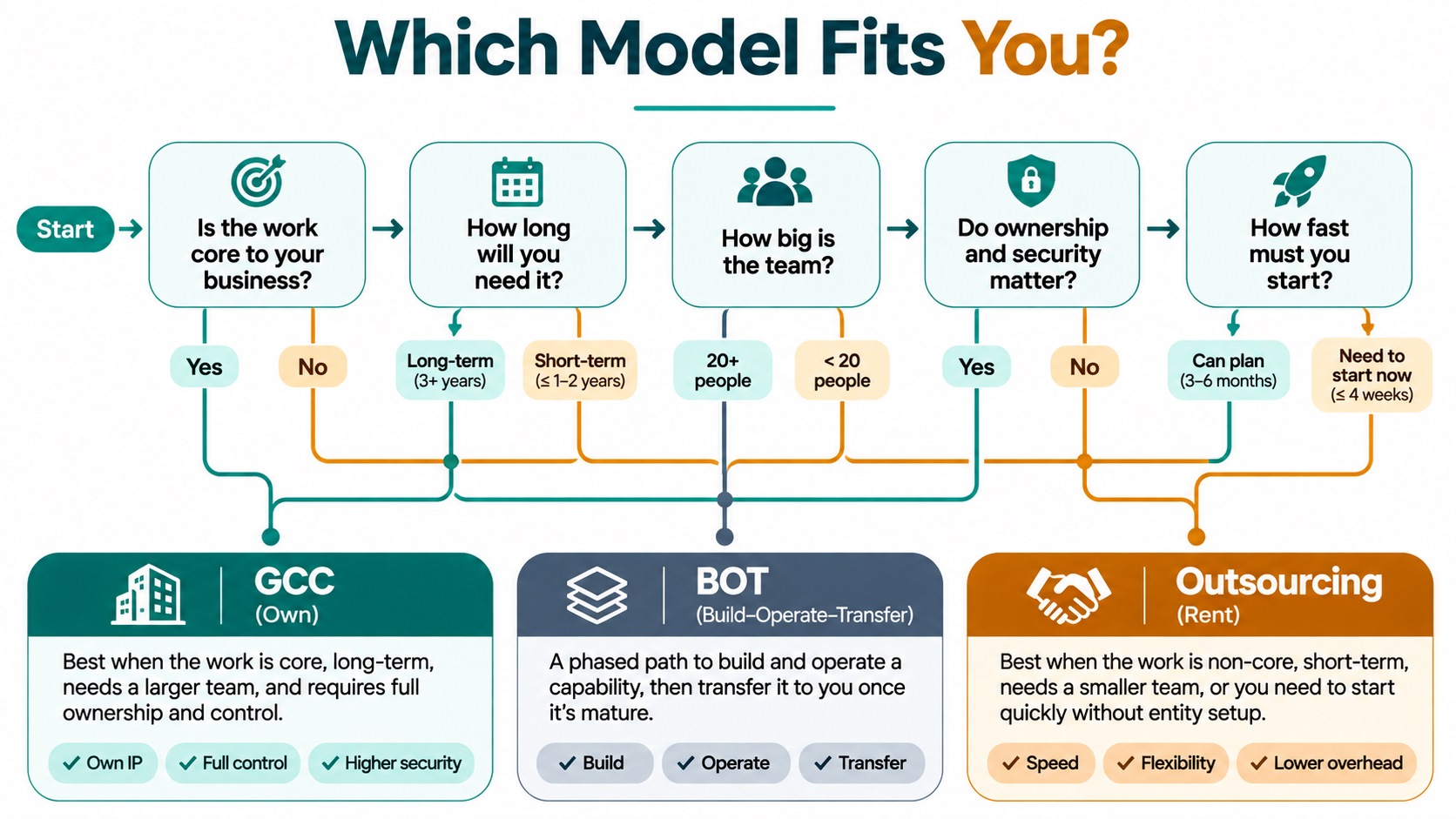
The outsourcing vs in-house technology team decision becomes clear once you answer a few honest questions about the work and your plans.
Ask yourself:
- Is the work core to your business? Core and strategic points to a GCC. Non-core points to outsourcing.
- How long will you need the team? Years favour a GCC. Months favour outsourcing.
- How big is the team? Around 20 or more people makes a GCC worth the setup. Smaller suits a vendor.
- How much do ownership and security matter? High importance favours a GCC. If they matter less, outsourcing is simpler.
- How fast do you need to start? If weeks, outsource or use BOT. If you can plan ahead, a GCC pays off.
If most answers point one way, your model is clear. If they are split, BOT is usually the right bridge.
We'll map the exact workflows from this article to your business - free, in 30 minutes.
Key Takeaways
Key Takeaways
- The GCC vs outsourcing choice is about owning a capability versus renting a service.
- A GCC gives ownership, control, better long-term economics, and stronger security. It suits core, long-term, strategic work.
- Outsourcing gives speed, flexibility, and a low upfront cost. It suits non-core, short-term, or variable work.
- On cost, outsourcing is cheaper to start, but a GCC usually wins over a multi-year horizon once the vendor margin is gone.
- 96 percent of new India GCCs now launch owning core work from day one, showing the model has moved well beyond cost savings.
- Build-Operate-Transfer is the middle path: outsourcing-like speed and low risk, ending in full GCC ownership.
Conclusion
There is no single winner in GCC vs outsourcing. There is only the right fit for the work in front of you. Rent a service when the work is non-core, short-term, or needs to start fast. Own a capability when the work is core, long-term, and strategic.
In 2027, with a mature India ecosystem and BOT lowering the entry risk, owning that capability is more achievable than ever. Match the model to the work, and the decision makes itself.
Frequently Asked Questions
What is the difference between a GCC and outsourcing?
A GCC is a captive offshore center that you own and run yourself, so the team, IP, and knowledge are all yours. Outsourcing means hiring a third-party vendor to do the work under a contract. In short, GCC vs outsourcing is the difference between owning a capability and renting a service.
Is a GCC cheaper than outsourcing?
It depends on the time horizon. Outsourcing is cheaper to start because there is no setup or hiring. A GCC costs more upfront but has no vendor margin, so it is usually cheaper per person over a multi-year period. The GCC vs outsourcing cost comparison crossover is typically between year one and year two.
When should a company choose a GCC?
Choose a GCC operating model when the work is core and strategic, you need the team for years, you are hiring roughly 20 or more people, and ownership, control, and data security matter. These are the conditions where owning a capability beats renting one.
When is outsourcing the better choice?
Outsourcing is better when the work is non-core, short-term, or one-off, when you need a team running in weeks, or when your needs vary a lot and you want to scale up and down quickly. It is also right when you simply do not want to own and operate an offshore entity.
What is the BOT model and how does it fit in?
Build-Operate-Transfer (BOT) is a middle path. A partner builds and runs your center for 18 to 24 months, then transfers full ownership to you. The GCC vs BOT model choice suits companies that want to end up owning a GCC but want outsourcing-like speed and low risk to get there.
You may also want to read

EUDAMED Requirements for Medical Device Manufacturers: A Compliance Guide