Gettinga device to market in Europe is hard. The rules are strict, and the paperwork is deep. Medical device regulatory compliance means proving, in writing, that a device is safe and performs as claimed. Under the EU Medical Device Regulation (MDR), that proof lives in the technical file. One weak section can stall an approval for months.
The problem is not effort. Regulatory teams work hard. The problem is scale. A single medical device technical file can run to thousands of pages across design, risk, clinical, and post-market data. Checking all of it by hand is slow and easy to get wrong. This is where ai in regulatory affairs changes the work. This article explains how AI automates MDR technical file gap analysis, where it helps most, and how to adopt it safely.
Our engineers will audit your workflow and estimate time-to-value at no cost.
Claim your free audit
What Medical Device Regulatory Compliance Means Under MDR
Under the MDR, a device cannot be sold in the EU without a complete technical file. The file shows how the device meets the General Safety and Performance Requirements, known as the GSPR. A notified body reviews that file before a certificate is granted.
Compliance is not a one-time event. The file must stay current for the life of the device. New risk data, design changes, and field feedback all flow back into it. A file that was complete at approval can drift out of date within a year.
Why Technical File Gaps Stall Market Access
Most delays do not come from unsafe devices. They come from incomplete files. Are viewer finds a missing test report, a risk control with no evidence, or a clinical claim that is not backed up. The file then goes back to the manufacturer. Each round of questions adds weeks or months.
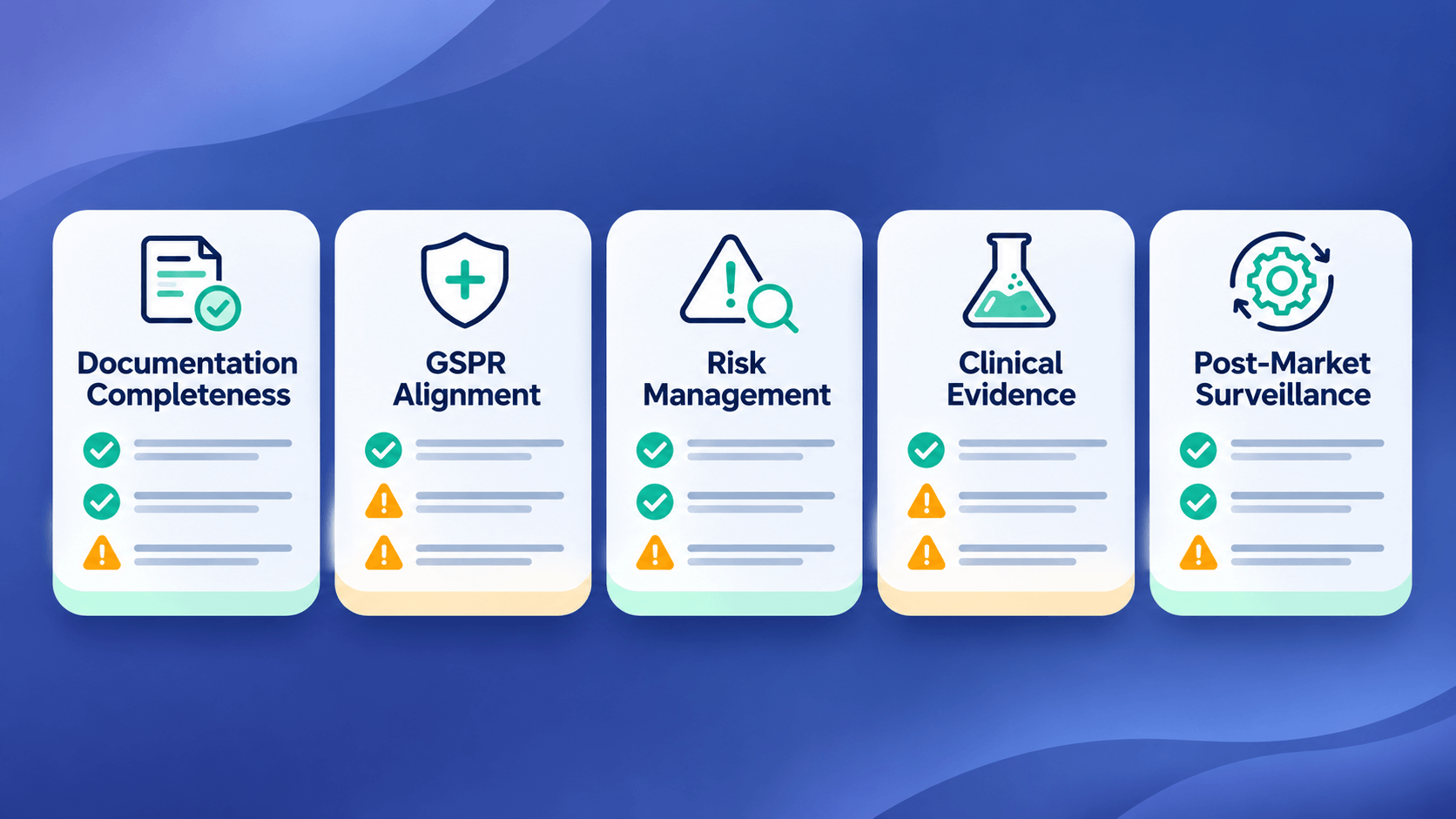
The most common gaps include:
- GSPR items marked as met, but with no linked evidence.
- Risk controls that are not traced to design or test data.
- Clinical evaluation that does not cover every claim.
- Labelling and instructions that do not match the design file.
- Post-market documents that are out of date.
That gap is expensive. A delayed certificate means delayed revenue. It also ties up senior reviewers in rework instead of new submissions. Closing gaps before a file is sent is the single best way to protect the timeline.
How AI Automates MDR Gap Analysis
AI does not replace the reviewer. It does the reading first. A medical device compliance software layer built on AI ingests the full technical file, understands what each requirement asks for, and checks whether the evidence is there. It works in four steps.
- Ingest the full technical file
The system reads every document in the file. Design records, risk files, clinical reports, labelling, and the gspr checklist. Nothing is sampled. Everything is in scope. - Map each requirement to evidence
AI links every GSPR item and MDR Annex II and III requirement to the exact document that supports it. Each link is traceable back to its source page. - Flag the gaps
Where evidence is missing, weak, or out of date, the system flags it. Reviewers get a ranked list of gaps, not a thousand pages to re-read. - Draft the gap report
The system drafts a clear gap report with findings and locations. A regulatory expert reviews, corrects, and signs off. The draft saves hours of clerical work.
Pace Wisdom builds this kind of workflow for life sciences teams. Our AI-powered technical file gap check reads the full file and surfaces gaps against the MDR before a notified body ever sees it.
Manual vs AI-Assisted Gap Analysis
The difference is not only speed. It is coverage and consistency. A manual review samples. An AI review checks every item, the same way, every time.
Used well, ai in regulatory affairs turns gap analysis from a slow, manual sweep into a fast, repeatable check. Reviewers stop chasing clerical errors and focus on the calls that need human judgment.
Compliance Across the Device Lifecycle
A technical file is never finished. Medical device regulatory compliance is a lifecycle task. AI helps keep the file current long after the first certificate. Three jobs matter most.
Keeping the GSPR checklist current
Design changes and new standards shift what the file must show. AI re-checks the gspr checklist against the latest evidence and flags any item that has fallen behind.
Drafting post-market reports
The psur medical device report pulls together complaints, field data, and safety signals on a set schedule. AI gathers the inputs and drafts a first version, so the team edits rather than builds from scratch.
Staying audit ready
Before a medical device audit, teams often rebuild evidence trails under time pressure. AI keeps a living record of what supports each requirement, so audit prep is a check, not a scramble.
AI is reshaping this whole field, not just gap analysis. For a wider view, see our take on how AI is transforming the life sciences industry, from discovery through post-market compliance.

Governance, Validation, and Human Oversight
AI in a regulated setting must be governed like any other tool that touches safety. The output has to be trustworthy, and the process has to be defensible in an audit.
A sound setup covers four controls:
- Validation. The system is tested and documented so its outputs can be trusted.
- Traceability. Every finding links to its source, so any claim can be checked.
- Audit trail. Who reviewed what, and when, is recorded.
- Data security. Sensitive design and clinical data stays protected and access-controlled.
These controls also align with emerging AI governance rules, including the EU AI Act. Building them in from the start keeps medical device regulatory compliance intact while the team adopts AI.
How to Adopt AI in Regulatory Affairs
Adoption works best in steps. Start small, prove value, then scale. A practical path looks like this.
- Start with one device family. Pick a product line with a clear technical file.
- Run AI gap analysis in parallel with your manual review. Compare the findings.
- Measure the difference in time, coverage, and gaps caught.
- Set the governance controls before you scale: validation, traceability, and sign-off.
- Expand to more device families and to lifecycle tasks like the GSPR checklist and post-market reports.
The goal is not to remove people. It is to let skilled teams cover more files, with fewer misses, in less time.

Key Takeaways
Conclusion
Strong medical device regulatory compliance comes down to one thing: a complete, well-evidenced technical file, kept current. AI does not change that goal. It makes reaching it faster and more reliable. By automating gap analysis, AI frees regulatory experts to focus on judgment and strategy, while the machine handles the reading and the cross-checking.
For teams facing long review cycles and rising file complexity, that shift is no longer optional. It is how modern ai in regulatory affairs keeps devices moving to market, safely and on time. Pace Wisdom partners with life sciences teams to build these workflows with governance built in from day one.
We'll map the exact workflows from this article to your business - free, in 30 minutes.
Frequently Asked Questions
What is MDR technical file gap analysis?
It is a structured check of a medical device technical file against the MDR. It confirms that every requirement, including each gspr checklist item, is backed by evidence. Gaps are flagged and fixed before a notified body review.
Can AI replace regulatory experts?
No. AI reads the file, maps evidence, and flags gaps. A qualified professional reviews and approves every finding. AI speeds up the work. People still own every medical device regulatory compliance decision.
How does AI improve MDR gap analysis?
It checks the full file instead of a sample, applies the same rules every time, and links each finding to its source. That makes mdr gap analysis faster, more complete, and easier to audit.
Is AI allowed in a regulated compliance process?
Yes, when it is governed well. The system must be validated, its outputs traceable, and every decision signed off by a person. These controls also support alignment with the EU AI Act.
What lifecycle tasks can AI support?
Beyond gap analysis, AI helps keep the GSPR checklist current, drafts the psur medical device report, and keeps evidence ready for a medical device audit.
You may also want to read

EUDAMED Requirements for Medical Device Manufacturers: A Compliance Guide