
CAPA is the process medical device makers rely on most, and the one that trips them up most often. It is the single most common reason companies receive FDA Form 483 observations, and it has held that top spot for over a decade. The reason is rarely bad intent. It is that the work is slow, manual, and spread across disconnected systems.
Reading every complaint, spotting a recurring failure, and finding the true root cause takes weeks of expert time. Generative AI in medical device CAPA changes the speed of that work. It reads the data, surfaces the patterns, and drafts the records, while the quality expert stays in control of every decision. This guide explains how it works, where it helps most, and how to adopt it safely.
Our engineers will audit your workflow and estimate time-to-value at no cost.
Claim your free audit
What Are CAPA and Root Cause Analysis in Quality?
Why Root Cause Analysis Matters
A fix only works if it targets the true cause. Good root cause analysis techniques such as the 5 Whys and fishbone diagrams get past the symptom to the real source. Weak root cause work is why the same problem keeps coming back as a new complaint months later.
How Root Cause Analysis Supports the CAPA Process
Root cause analysis sits at the heart of the medical device CAPA process. A CAPA starts with a problem: a complaint, a non conformance, or an audit finding. Root cause analysis finds why it happened. Only then can the corrective and preventive actions be chosen. Skip or rush this step, and the whole CAPA fails, which is exactly what regulators keep citing.
Challenges of Traditional CAPA and Root Cause Analysis
Traditional CAPA struggles for structural reasons, not a lack of effort. The problems are consistent across the industry.
Four challenges drive those numbers:
- Fragmented data: complaints, nonconformances, and audits live in separate systems that do not talk to each other.
- Slow investigations: gathering and reading all the relevant records by hand takes weeks.
- Missed patterns: a recurring failure is easy to miss when the signals are scattered across systems.
- Delayed closure: inconsistent documentation and manual effort push CAPA closure past its due date.
How Generative AI in Medical Device CAPA Transforms Root Cause Analysis
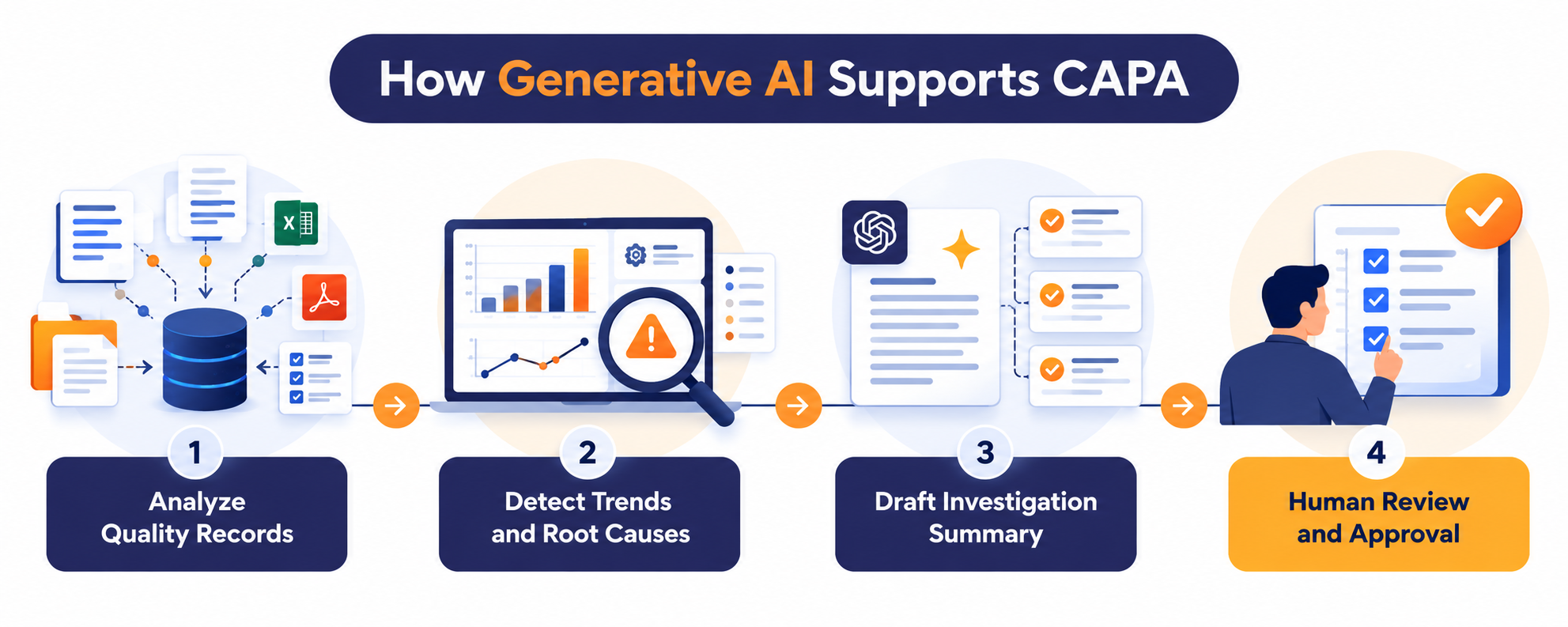
Generative AI targets each of those four challenges directly. It works across four areas.
AI-Powered Analysis of Complaints and Quality Records
AI reads thousands of complaint and quality records in minutes. It summarizes each one, extracts the key facts, and highlights the records that need a human to look closer. This removes the slowest manual step of any investigation.
Identifying Recurring Trends and Potential Root Causes
AI is strong at pattern detection. It spots a rising defect rate on one component or a cluster of similar complaints across product lines. It can then suggest likely root causes for a human to confirm, supporting proven root cause analysis methods rather than replacing them.
Generating Investigation Summaries and CAPA Documentation
AI drafts a first-pass investigation summary and CAPA record in a consistent format. The quality expert reviews, corrects, and approves it. This cuts hours of writing and makes documentation consistent across every CAPA.
Connecting Evidence Across Quality Systems
Modern CAPA management systems hold data in many places. AI connects evidence across complaints, nonconformances, audits, and supplier records, giving investigators the full picture in one view. For a wider look at how AI is reshaping the sector, How AI Is Transforming the Life Sciences Industry covers the broader shift across pharma, devices, and manufacturing.
Key Use Cases of AI in CAPA Management
The strongest uses of AI in CAPA are the high-volume, pattern-heavy tasks. Here is a practical medical device CAPA example set, drawn from where teams are seeing the most value.
- Complaint Handling and Adverse Trend Analysis
AI reviews every complaint, groups similar ones, and flags adverse trends early. This is where most systemic issues first appear, and where humans most often miss the pattern. - Nonconformance Investigation and Root Cause Identification
AI pulls the relevant records for a nonconformance, summarizes the evidence, and proposes likely root causes for the investigator to confirm or reject. - CAPA Report Drafting and Evidence Summarization
AI drafts the investigation summary and CAPA record ina consistent, audit-ready format. The quality team reviews and signs off. Writing time drops sharply. - Supplier Quality and Manufacturing Defect Analysis
AI connects supplier records with manufacturing and complaint data to spot defects that trace back to one supplier or one process step. - Corrective Action Tracking and Effectiveness Verification
AI monitors whether a corrective action actually worked by watching for the same issue after closure. A returning pattern flags an ineffective CAPA before the next audit does.

Generative AI vs Traditional CAPA Workflows
The difference between the two workflows is clearest when compared step by step. AI changes the speed and consistency of every stage except one: the final decision, which always stays with a human.
Benefits of Using AI for Medical Device Quality Management
The benefits of AI-assisted CAPA are concrete and measurable:
- Faster CAPA closure: investigations that took weeks can move in days, keeping closures inside their due dates.
- Better trend detection: AI catches recurring issues across systems before they become warning-letter findings.
- Consistent documentation: everyCAPA record follows the same audit-ready structure.
- More time for experts: quality staff spend their time on judgement and decisions, not manual data gathering.
- Stronger audit readiness: complete, traceable records make inspections far less stressful.
Regulatory, Data Security, and Human Oversight Considerations
AI in a regulated quality process comes with firm rules. Get these right from the start, not after an audit flags them.
Four requirements sit alongside human oversight:
- Audit trails and traceability: every AI output and every human review must be logged and traceable, preserving data integrity.
- Validated outputs: AI suggestions must be checked against the source evidence so no unsupported conclusion enters a record.
- Quality system alignment: AI-assisted steps must map to your existing CAPA procedures and QMSR or ISO 13485 requirements.
- Data protection: sensitive product and patient information must stay secured, with access controls on who and what the AI can see.
How to Implement Generative AI in Medical Device CAPA Workflows
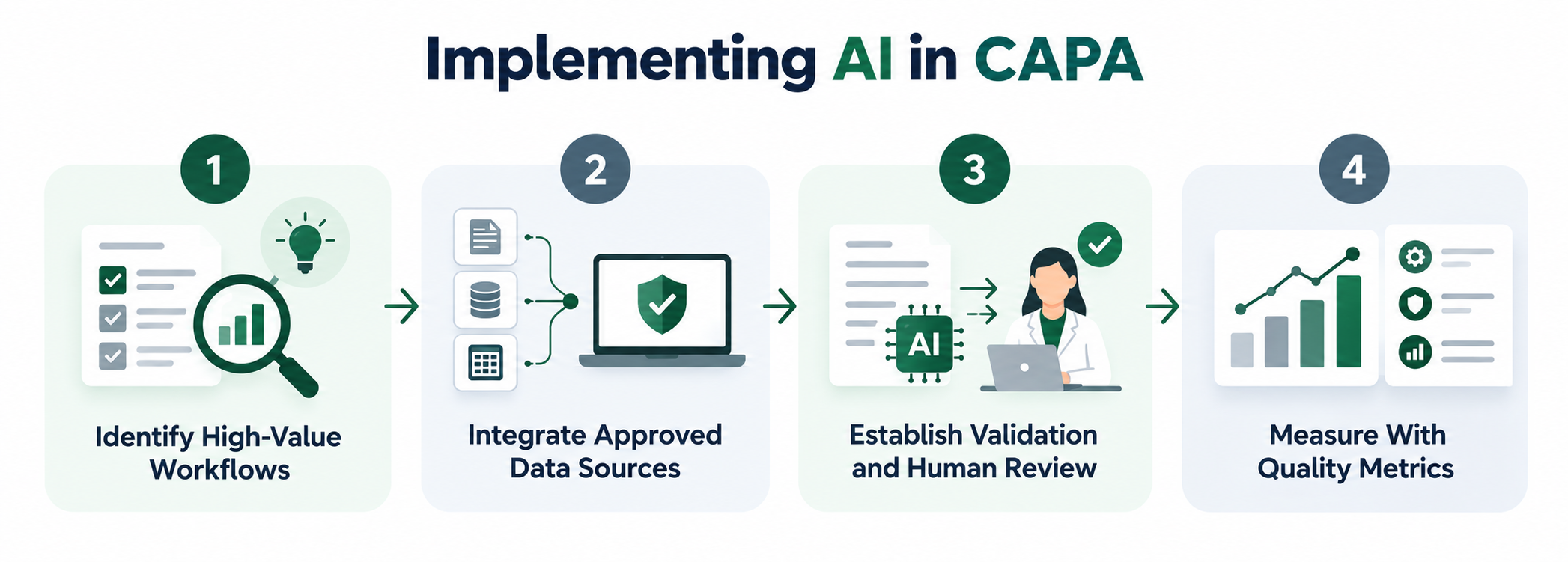
A safe rollout follows four steps in order. Start narrow, validate, then expand.
- Identify high-value quality workflows.
Begin where the volume is highest and the risk is lowest, such as complaint summarization or trend detection. Prove the value before touching final decisions. - Integrate with approved data sources and quality systems.
Connect the AI only to validated, approved data in your eQMS. The quality of the data sets the quality of the output. - Establish validation, access controls, and human review.
Build the human-review checkpoints, access limits, and output validation into the workflow before go-live, not after. - Measure results with quality metrics.
Track CAPA closure time, on-time rate, recurring-issue rate, and audit findings to prove the value and guide expansion.
Building this into a regulated quality system needs both AI engineering and medical device domain knowledge. Pace Wisdom provides AI solutions for life sciences that combine the two, so AI-assisted CAPA is deployed safely, validated, and audit-ready.
Key Takeaways
Conclusion: Building Smarter CAPA Workflows with AI
Generative AI in medical device CAPA does not replace the quality expert. It removes the slow, manual work that keeps the expert from doing their real job: judgement. The AI reads the data, finds the patterns, and drafts the records. The human decides.
For an industry where CAPA is the number-one compliance risk, that shift is significant. Faster investigations, better trend detection, and consistent records, all under human control, is how smarter CAPA workflows get built. The teams that adopt it carefully will spend less time on paperwork and more time preventing the next problem.
We'll map the exact workflows from this article to your business - free, in 30 minutes.
Frequently Asked Questions
1. How can generative AI improve CAPA management in medical devices?
Generative AI in medical device CAPA improves CAPA by reading large volumes of complaint and quality records, summarizing them, detecting recurring trends, suggesting likely root causes, and drafting investigation and CAPA documentation. This cuts investigation time from weeks to days and makes records consistent, while a qualified person reviews and approves every output.
2. Can AI perform root cause analysis independently?
No. AI can suggest likely root causes by analyzing patterns in quality data, but it cannot make the final determination on its own. A qualified quality professional must review the AI's analysis against the source evidence and confirm the root cause. In a regulated environment, human judgement and accountability are required for every CAPA decision.
3. Can AI integrate with an electronic quality management system (eQMS)?
Yes. AI tools can connect to an eQMS and other CAPA management systems through approved integrations, reading validated data such as complaints, nonconformances, and audit records. The key requirement is that the AI only accesses approved, controlled data sources, with access controls and full audit trails in place.
4. How can medical device manufacturers validate AI-generated CAPA recommendations?
Validation means checking every AI output against the source evidence before it enters a quality record. Manufacturers should define a human-review step for all AI suggestions, log both the AI output and the human decision for trace ability, and align the whole process with their CAPA procedures and QMSR or ISO 13485 requirements. The AI assists; the validated human review makes it defensible.
You may also want to read

What Is a Cloud Transformation Assessment? A Guide for Enterprises