Factories, hospitals, fleets, and farms now run on connected devices. Every sensor sends data, and every reading needs somewhere to go. Without a clear structure, that data turns into noise, cost, and risk.
This guide shows how the pieces fit together. It covers the layers, the key parts, the cloud and edge split, and how an IoT build moves from idea to production. It is written for product and engineering leaders who want a practical view without heavy jargon. AWS services are used as examples.
Our engineers will audit your workflow and estimate time-to-value at no cost.
Claim your free audit
What Is IoT Architecture?
An IoT system has many moving parts. Devices sense the physical world. Networks carry the readings. Cloud platforms store and analyze them. Applications turn the results into decisions. The blueprint that joins all of this into one working system is the architecture.
Think of it as a pipeline. Data starts at a sensor and ends as an action, such as a maintenance alert or a valve closing. Each layer adds value along the way, and a weakness in any one layer shows up in the whole system.
Why IoT Architecture Matters
A weak design fails as it grows. Devices multiply fast, and a pilot that works for 50 sensors can break at 50,000. Without a solid structure, systems become slow, costly, and hard to secure.
A strong design gives you four things
- Scale. It handles more devices without breaking.
- Speed. Data moves andis processed with low delay.
- Security. Devices, data, and access are protected.
- Control. The system is easy to monitor and manage.

The IoT Architecture Layers
Most references describe three to five layers. This guide uses five, because data storage and analytics deserve a layer of their own. Data moves up through them, from the physical device to the user.
Perception layer: devices and sensors
This is the physical layer. Sensors collect data such as temperature, vibration, motion, or location. Actuators carry out actions, like switching a pump off. This is where the real world meets the system.
Network and connectivity layer
This layer moves data from devices to the systems that use it. IoT device connectivity relies on Wi-Fi, Bluetooth Low Energy, LoRaWAN, NB-IoT, LTE-M, 5G, or wired links, along with protocols such as MQTT, HTTPS, and CoAP. In factories, OPC UA and Modbus are common. Gateways often sit here to collect data from many devices and forward it safely.
Edge and processing layer
Here, data is filtered and analyzed close to where it is created. Edge processing cuts delay, reduces the volume sent to the cloud, and keeps working when the connection drops. It is also where small machine learning models run, for example to spot an unusual vibration pattern in milliseconds. On AWS, AWS IoT Green grass is acommon way to run this local logic.
Data and cloud layer
This layer ingests, stores, and analyzes the stream of readings. It holds the device registry, time-series data, data lakes, and the models trained on them. AWS IoT Core receives device messages over MQTT, and rules route them on to services such as Amazon S3 for storage and Amazon SageMaker for model training.
Application layer
This is the top layer, and the heart of IoT application architecture. It turns data into dashboards, alerts, and actions. Increasingly, AI agents use it too. They read live data, check it against rules and history, and trigger work such as raising a maintenance ticket.
Here is a quick view of the five layers side by side:
Key IoT Architecture Components
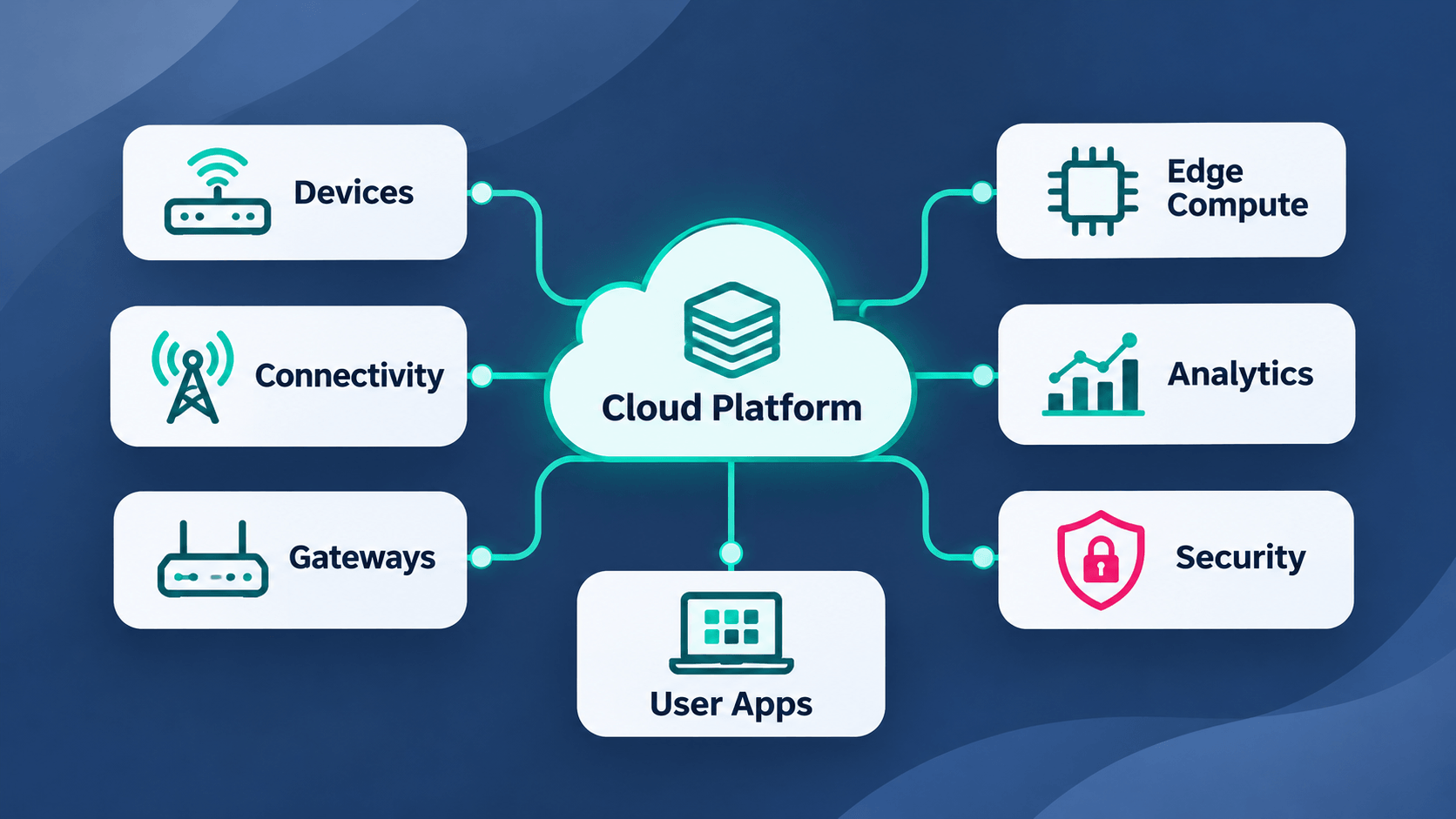
Layers describe the flow. Components are the building blocks inside that flow. A complete IoT system architecture brings these parts together, and none of them can be skipped.
Security runs across every component, not just one. It covers device identity, data in transit, and user access at the same time. These IoT architecture components work as one set. If you weaken one, you weaken the rest.
Cloud-Based and Scalable IoT Architecture
Most modern IoT runs on the cloud. A cloud-based IoT architecture gives you storage, compute, and analytics that grow on demand, so you do not have to build data centers to scale.
The major platforms, AWS, Azure, and Google Cloud, each offer managed services for device management, data pipelines, and analytics. This makes a scalable IoT architecture far easier to build and run.
On AWS, the building blocks line up with the layers. AWS IoT Core handles secure device messaging. AWS IoT Device Management handles fleet setup and updates. AWS IoT SiteWise collects industrial data. AWS IoT Greengrass runs logic at the edge. Pace Wisdom Solutions is an AWS Advanced Tier Partner.
Cloud and edge work together. The edge handles fast, local decisions. The cloud handles heavy storage, model training, and fleet-wide analytics. A good design splits the work between them, based on how fast a decision must be made and how much data is worth sending.
IoT Architecture Design: A Practical Approach
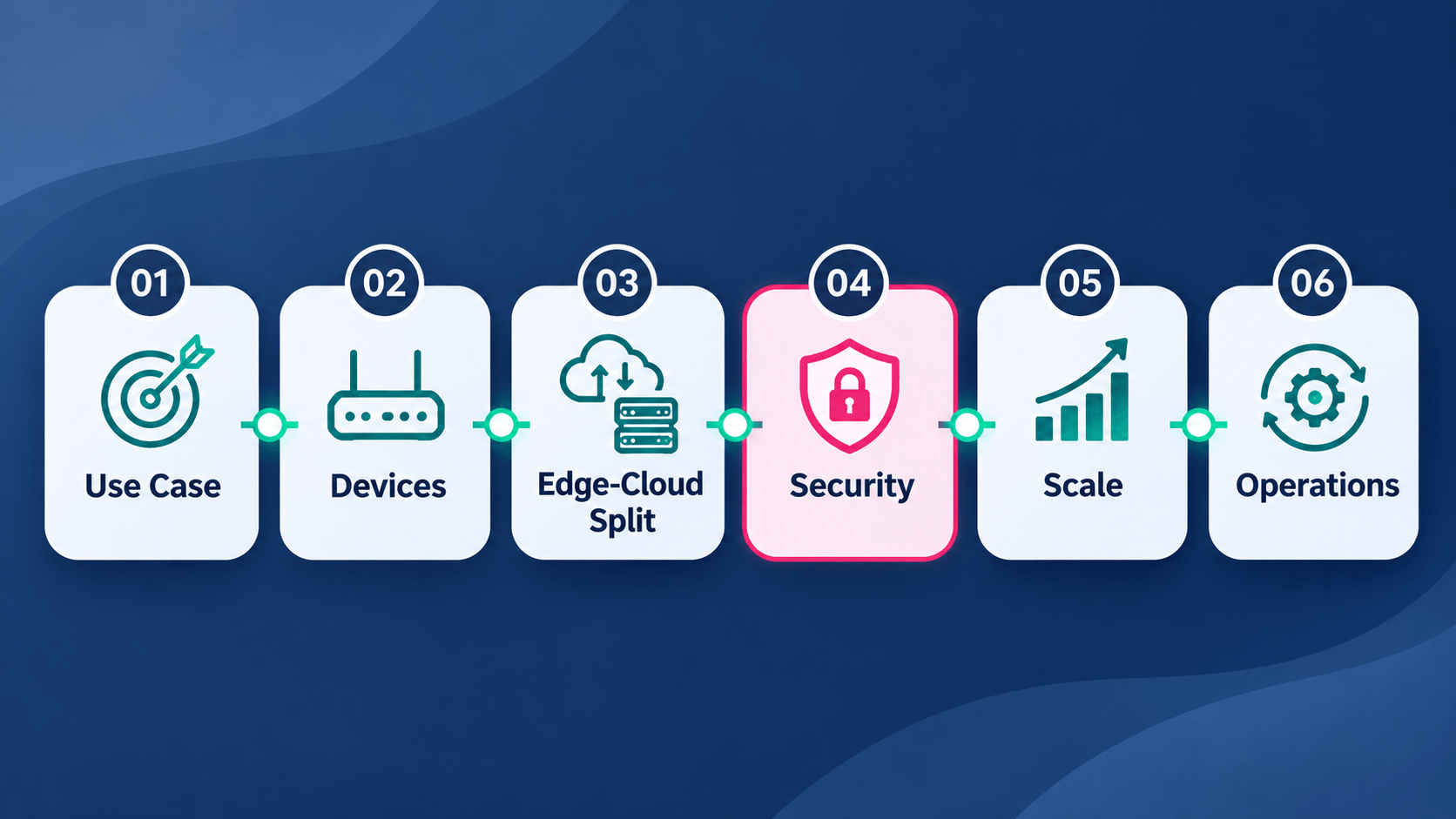
Good design starts with the goal, not the technology. These steps keep a build on track.
- Define the use case.
Know what problem the system solves, what decision it supports, and what data it needs. - Choose devices and connectivity.
Match sensors and networks to the environment. - Plan the edge and cloud split.
Decide what is processed locally and what goes to the cloud. - Design for security.
Build in device identity, encryption, and access control from the start. - Plan for scale.
Make sure the system can grow in devices, data, and users. - Plan for operations.
Decide how you will monitor devices, push updates, and retire old units.
Security basics that cannot wait
- Give every device a unique identity, such as an X.509 certificate.
- Encrypt every connection with TLS.
- Apply least-privilege policies, so a device can only do what it must.
- Use secure boot and signed firmware, and keep an over-the-air update path.
- Watch for odd device behavior. AWS IoT Device Defender can flag it.
How IoT Development Works
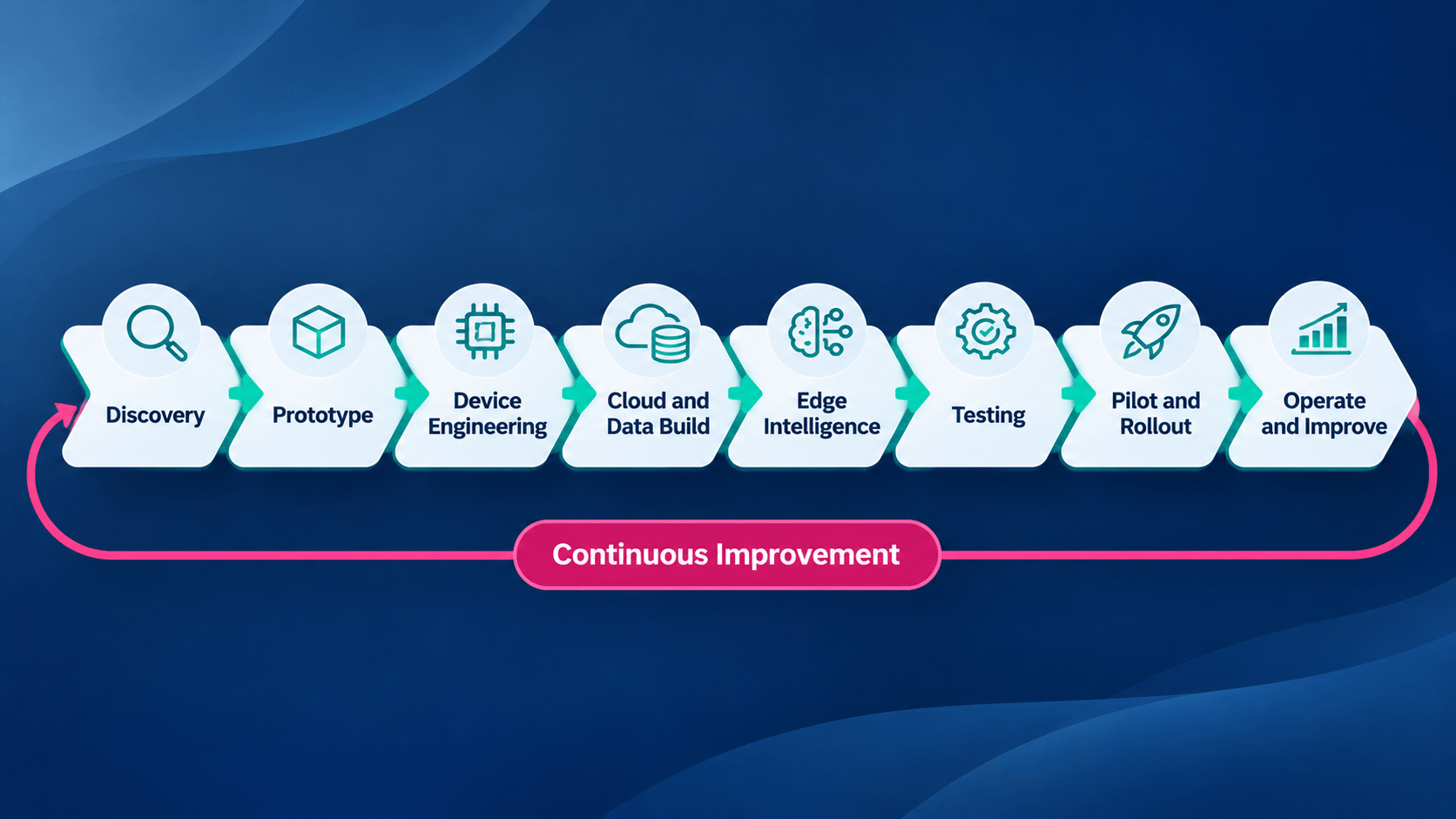
Architecture is the plan. Development is how you build it. Most projects move through the same stages:
- Discovery.
Agree on the business outcome, the data needed, and how success will be measured. - Prototype.
Test sensors, connectivity, and a thin slice of the cloud pipeline on a small set of devices. - Device engineering.
Write and test the firmware that runs on the device, including power use, reconnect logic, and update support. - Cloud and data build.
Set up ingestion, storage, device management, dashboards, and the rules that route data. - Edge intelligence.
Add local processing and, where it pays off, machine learning models that run on the gateway. - Testing.
Test at load and test failure modes, such as a lost network. - Pilot and rollout.
Start with one site or one fleet, measure, then expand in waves. - Operate and improve.
Monitor fleet health, push updates over the air, and retrain models as conditions change.
Many teams stall between the prototype and the rollout. A prototype hides the hard parts: thousands of devices, patchy networks, and updates in the field. Planning for these from the start removes much of the risk. Pace Wisdom Solutions offers IoT development services that cover architecture, build, cloud, and security end to end.
An Illustrative Example: Predictive Maintenance
Here is a simple sample scenario that shows the layers working together. It is an illustration, not a client case.
- Perception:
Vibration and temperature sensors sit on motors and pumps on a factory floor. - Network:
A plant gateway sends readings to AWS IoT Core over MQTT. - Edge:
A small model on the gateway flags unusual vibration in milliseconds and can slow a machine before it is damaged. - Data and cloud:
Raw data lands in Amazon S3. Models are retrained in Amazon SageMaker using months of history. - Application:
A dashboard shows machine health. An AI agent raises a maintenance ticket with the likely cause and the right spare part.
Key Takeaways
Conclusion
IoT turns physical data into real action. The structure that makes this work is the design beneath it. Get the layers, components, and cloud design right, and the system stays fast, secure, and ready to grow. Treat IoT architecture as a business decision as well as an engineering one, because it sets cost, risk, and speed for years.
Pace Wisdom Solutions helps enterprises design and build IoT systems that scale. As an IoT development company with deep cloud and engineering expertise, our team takes your IoT idea from planning to a working, production-ready system.
We'll map the exact workflows from this article to your business - free, in 30 minutes.
Frequently Asked Questions
How many layers does an IoT system have?
Most references describe three to five layers. This guide uses five: perception (sensors and devices), network (connectivity), edge (local processing), data and cloud(storage and analytics), and application (dashboards, alerts, and AI agents). Data flows up through them, from device to user.
What are the main components of IoT architecture?
The core parts are devices and sensors, connectivity, gateways, edge compute, a cloud platform, data analytics, security, and user applications. Together they collect, move, process, and act on data.
What is cloud-based IoT architecture?
It runs storage, compute, and analytics in the cloud. It scales on demand, so you can add devices and data without building your own data centers. Services such as AWS IoT Core handle secure device messaging, and managed services handle storage and analysis.
Why does scale matter in IoT?
Device counts grow fast. A design that handles more devices, data, and users without slowing down avoids costly rework later. Build for scale early with managed services, automatic device setup, and filtering at the edge.
How is edge computing used in IoT?
Edge computing processes data near the device. It cuts delay, lowers the data sent to the cloud, and keeps local decisions running when the network drops. It also lets small AI models run next to the machine, which makes real-time responses possible.
You may also want to read

Medical Device Regulatory Compliance: How AI Automates MDR Technical File Gap Analysis