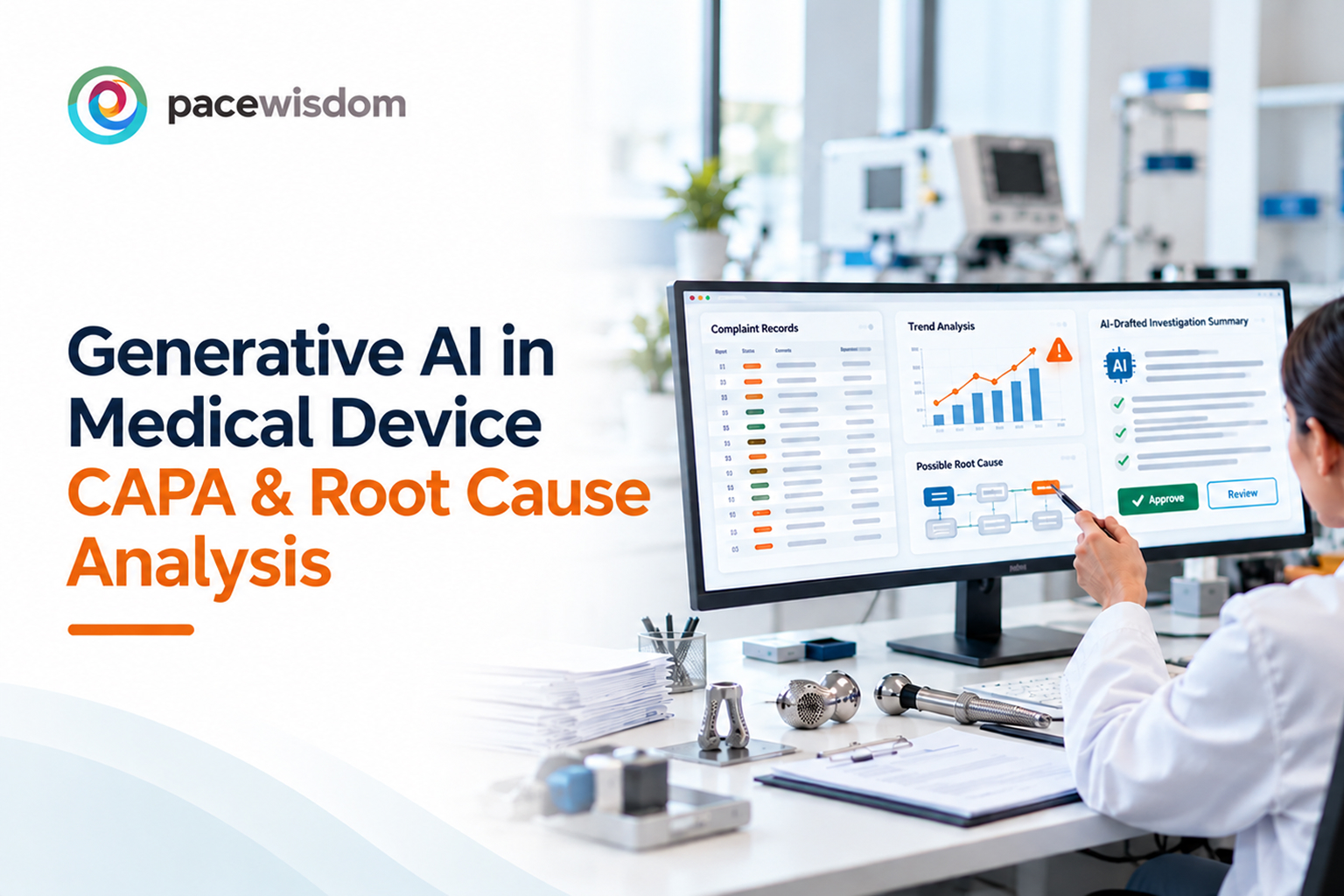
The life sciences industry has spent years piloting artificial intelligence. In 2026, the pilots ended. AI is now in production across the value chain, shapinghow:
- New drugs are discovered
- Clinical trials run
- Medical devices diagnose
- Medicines are manufactured and monitored
The reason the shift stuck this time is not just better models. It is a clearer operating principle: AI in life sciences works because it augments expert judgement rather than replacing it.
In an industry where a wrong decision affects patient safety and carries regulatory weight, that human-in-the-loop design is what turned AI from a promising experiment into a dependable tool.
This guide covers:
- Where AI is delivering value acrosspharma, clinical trials, medical devices, and manufacturing
- What the market looks like in theUS and India
- How to adopt it responsibly
Our engineers will audit your workflow and estimate time-to-value at no cost.
Claim your free audit
What Does Artificial Intelligence in Life Sciences Mean?
The term covers a wide set of AI applications in life sciences, but they share a common logic: the industry generates more data than humans can analyse manually, and AI closes that gap.
- Genomics: billions of data points per study
- Clinical trials: millions of data entries from a single trial
- Manufacturing: continuous sensor streams from production lines
AI turns this volume into decisions.
Why 2026 Is the Tipping Point
Three shifts converged:
- Regulatory acceptance. Regulators including the FDA and EMA now recognise AI-derived evidence and biomarkers as legitimate, removing a long-standing barrier.
- Lower compute costs. Compute costs for large-scale molecular simulation have dropped sharply through hyperscaler and pharma alliances.
- Federated data networks. These now let organisations train models on once-siloed clinical datasets without moving the data.
Together these turned AI from a research curiosity into an operational standard.
The AI in Life Sciences Market in 2026: US and India
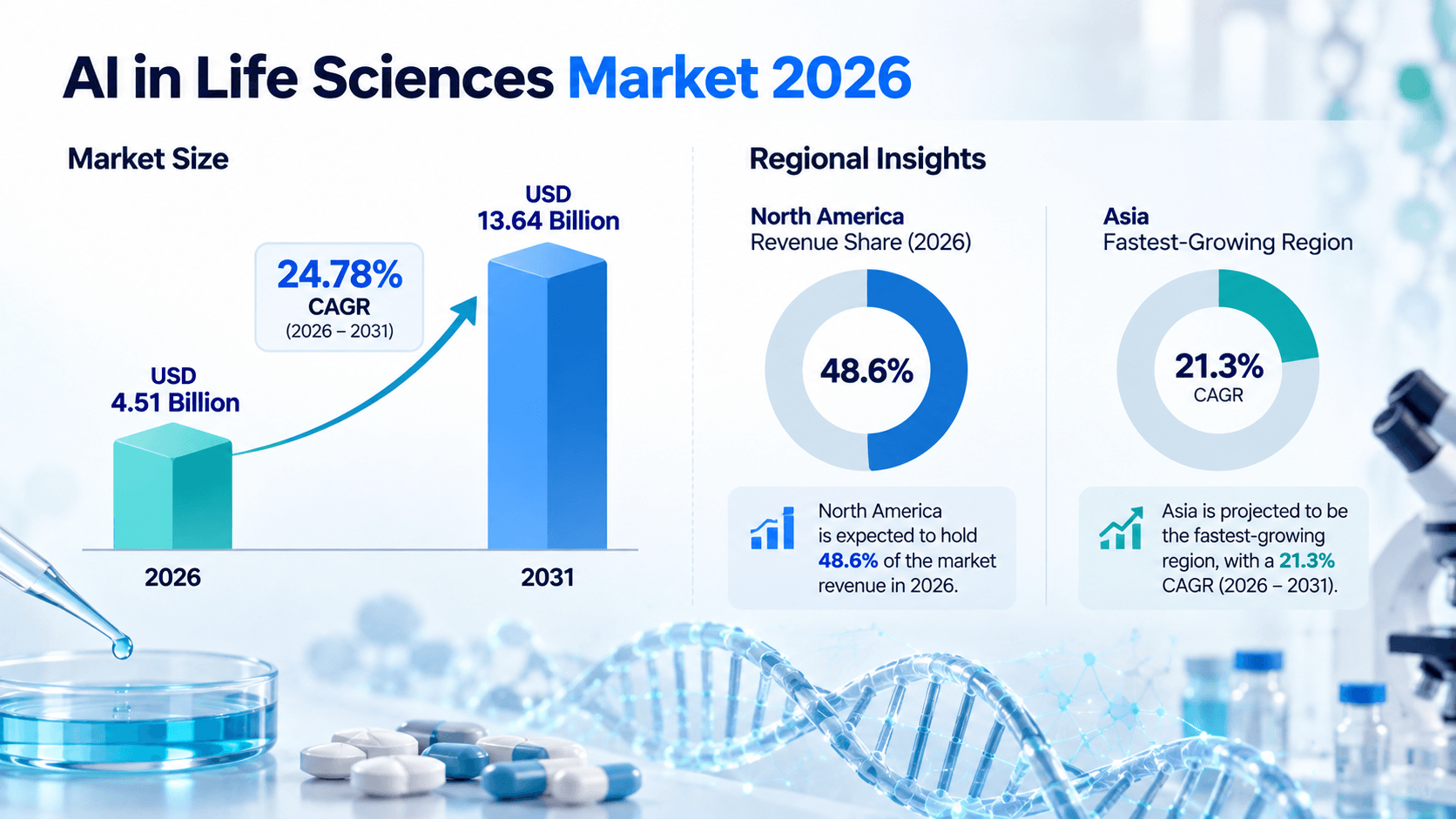
The market data confirms what practitioners are seeing on the ground: adoption is accelerating, and it is concentrated in two regions that matter most for global life sciences.
Why the US Leads
The United States holds nearly half of global market revenue. It combines:
- The world's largest pharmaceutical companies
- The deepest venture capital funding for AI-first drug discovery
- A regulatory environment that has moved early to define how AI evidence is used
US pharma and biotech firms drive the majority of production AI deployments in drug discovery and clinical development.
Why India Is the Fastest-Growing Region
India sits inside the Asia region posting the highest regional growth rate globally. Its advantage is a combination of:
- A large clinical research and CRO base
- A strong pharmaceutical manufacturing sector
- A fast-growing pool of AI and data engineering talent
For global life sciences companies, India is becoming both a delivery hub for AI development and a growth market in its own right.
AI Use Cases in Life Sciences
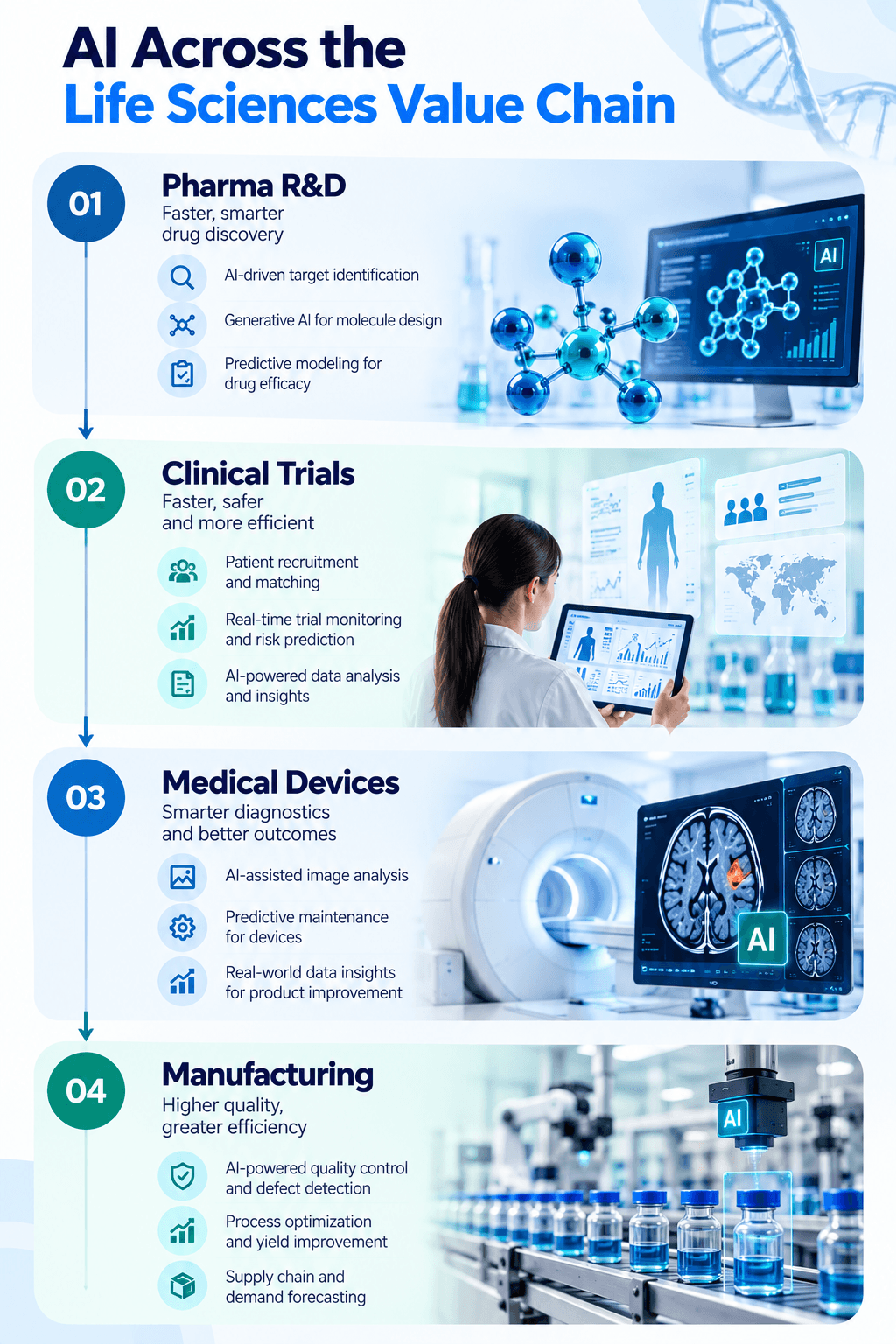
The clearest way to understand the transformation is by domain. The table below maps the leading AI use cases in life sciences, followed by a closer look at each.
AI in the Pharmaceutical Industry
- Machine learning identifies drug targets and generates novel molecules
- Predictive models forecast efficacy and toxicity before lab testing begins
- Impact: compresses the earliest and most expensive stages of discovery, cutting years and cost from a process that traditionally takes over a decade
AI in Clinical Trials
- AI matches patients to trials and selects high-performing sites
- It cleans trial data and detects adverse events faster than manual review
- Impact: shorter timelines, better patient selection, and fewer late-stage failures, the costliest kind
AI in the Medical Device Industry
- AI powers diagnostic devices and imaging analysis
- It spots patterns in scans and signals that support faster, more accurate diagnosis
- In 2026: AI-driven models increasingly provide on-demand evidence of clinical and financial outcomes, helping manufacturers prove value to both clinicians and payers
AI in Pharma Manufacturing
- Computer vision inspects product quality on the line
- Predictive models flag batch-quality risks before they become failures
- AI-driven pharmacovigilance monitors safety signals after products reach the market
- Impact: higher quality and lower recall risk
The pharma R&D use case is the most mature of the four. For a deeper look at how generative AI designs molecules and accelerates discovery, AI in drug development covers the target identification, virtual screening, and de novo design pipeline in detail.
AI in Clinical Trials and Clinical Research
AI in clinical trials deserves a closer look because it is where the industry is investing fastest and where the operational gains are most measurable.
Trials are the longest, most expensive stage of bringing a therapy to market, so even small efficiency gains produce large returns.
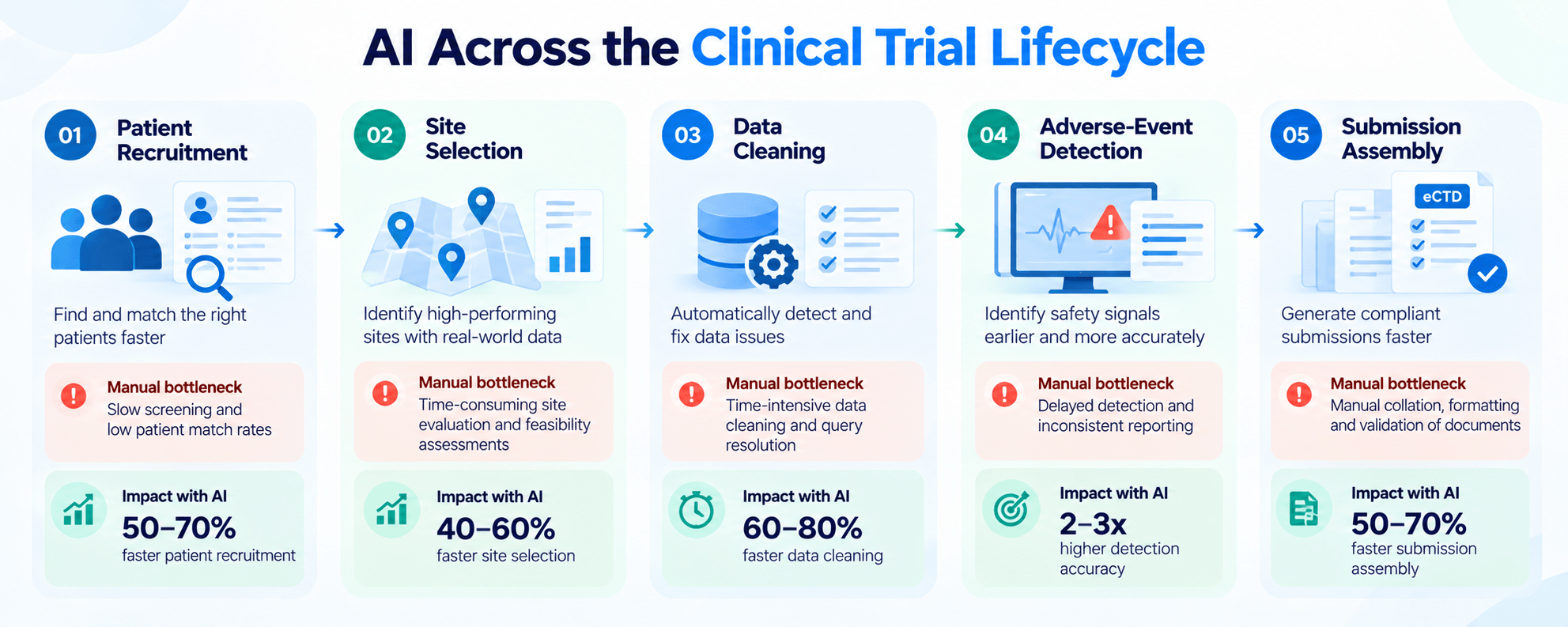
Patient Recruitment and Site Selection
Recruiting the right patients is the most common cause of trial delays. To identify eligible patients and predict which sites will enrol them fastest, AI models analyse:
- Electronic health records
- Genomic profiles
- Prior trial data
This shortens the slowest phase of most trials.
Data Operations and Adverse-Event Detection
A major back-office opportunity in AI in clinical research is data operations. AI automates:
- Data cleaning
- Anomaly detection
- Statistical modelling
This increases the speed and precision of trial data analysis and regulatory submission assembly.
Natural language processing extracts adverse events from unstructured clinical notes, improving safety monitoring.
Human in the Loop AI and Governance
There is one principle that separates AI in life sciences from AI in most other industries: it is almost never fully autonomous. The stakes make human oversight non-negotiable:
- Patient safety
- Regulatory accountability
What Governance Requires
The FDA and EMA have both issued AI guidance that shapes what life sciences organisations must be able to show:
- Explainability: models are explainable
- Traceability: their decisions can be traced and audited
- Data documentation: training data is documented
- Accountability: a human remains accountable for outcomes
Vendors increasingly differentiate through explainability modules that document model lineage for auditors.
Any AI deployment in this sector has to be built with that documentation and oversight from the start, not added afterward.
How to Adopt AI in Life Sciences
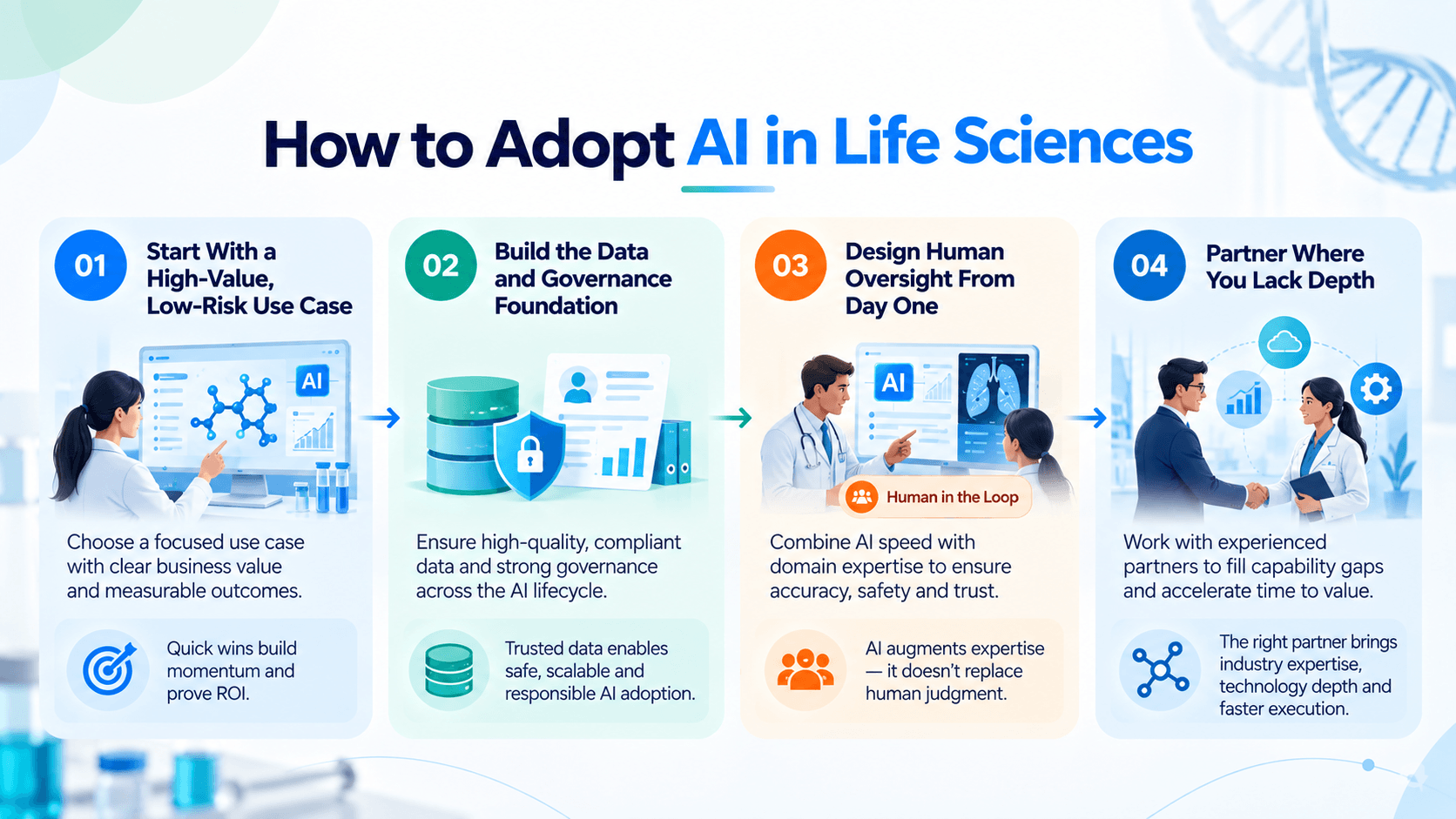
For life sciences organisations moving from interest to deployment, the sequence that works is consistent. Start narrow, build the foundation, and design oversight from day one.
- Start with a high-value, low-risk use case.
Pick a function where AI has proven ROI and low patient-safety exposure, such as clinical trial data cleaning, manufacturing visual inspection, or literature review. Prove the value before touching higher-risk decisions. - Build the data and governance foundation.
AI is only as good as the data it trains on. Invest in data quality, standardisation, and access controls, and define your model governance and audit approach before scaling. - Design human oversight from day one.
Build the human-in-the-loop checkpoints into the workflow, not as an afterthought. Define which decisions require human approval and document the accountability chain. - Partner where you lack depth.
Few organisations have life sciences domain knowledge, AI engineering, and regulatory experience in-house. Partnering closes that gap faster than building all three from scratch.
For organisations building the technical and governance foundation for these deployments, AI solutions for life sciences combine domain knowledge, AI engineering, and regulated-industry experience to move from use case to production responsibly.
Key Takeaways
Conclusion
AI in life sciences is no longer a question of if, but of how well. The organisations pulling ahead in 2026 are not the ones deploying the most AI. They are the ones deploying it responsibly:
- On the right use cases
- On a solid data foundation
- With human expertise firmly in theloop
The technology is proven, the market is growing fast on both sides of the Pacific, and the regulatory path is clearer than ever.
The advantage now goes to organisations that combine life sciences depth with disciplined, well-governed AI adoption.
We'll map the exact workflows from this article to your business - free, in 30 minutes.
Frequently Asked Questions
1. What is AI in life sciences?
AI in life sciences is the use of machine learning, generative AI, and computer vision across drug discovery, clinical trials, medical devices, and pharmaceutical manufacturing. It analyses the large, complex datasets these functions produce to makere search faster, decisions sharper, and processes more reliable, under human oversight.
2. What are the main AI use cases in life sciences?
The leading AI use cases in life sciences span four domains:
- Pharma R&D: drug target identification and molecule design
- Clinical trials: patient recruitment and data operations
- Medical devices: diagnostics and imaging analysis
- Manufacturing: visual inspection and pharmacovigilance
3. How is AI used in the pharmaceutical industry?
AI in the pharmaceutical industry is used to:
- Identify drug targets
- Generate novel molecules
- Predict drug efficacy and toxicity before lab testing
This compresses the earliest, most expensive stages of drug discovery, cutting both time and cost from a process that traditionally takes more than a decade.
4. How is AI used in clinical trials?
AI in clinical trials handles four core tasks:
- Matches patients to trials
- Selects high-performing sites
- Automates data cleaning and anomaly detection
- Extracts adverse events from clinical notes
This shortens timelines, improves patient selection, and reduces the risk of costly late-stage trial failures.
5. What is human-in-the-loop AI in life sciences?
Human in the loop AI means a qualified expert reviews and approves AI outputs before they affect:
- A patient
- A regulatory submission
- A released product
In a regulated, safety-critical industry, this oversight is a requirement, not an option. It is what makes AI adoption defensible to the FDA and EMA.
6. How does a life sciences company start adopting AI?
A life sciences company can start adopting AI in four steps:
- Start with a high-value, low-risk use case, such as clinical trial data cleaning or manufacturing inspection, where ROI is proven and patient-safety exposure is low.
- Build the foundation for data quality and governance.
- Design human oversight into the workflow from the start.
- Partner where you lack domain, AI, or regulatory depth in-house.
You may also want to read