Every day, a mid-sized carrier makes thousands of decisions. Which truck takes which load. Which route avoids the closed highway. Which shipment gets reassigned when a driver calls in sick. For decades, dispatchers made these calls by hand, helped by static software and years of experience.
That model is hitting its limit. Data now moves faster than any dispatcher can process. Orders change by the minute. Traffic, weather, and fuel prices shift in real time.
AI agents for logistics operations close this gap. They read live data, decide, and act across dispatch and routing without waiting for human approval at each step. And the most capable systems do not use one agent. They use many, working together. This guide explains how multi-agent systems run modern logistics, where they deliver the most value, and how to deploy them.
Our engineers will audit your workflow and estimate time-to-value at no cost.
Claim your free audit
What Are AI Agents in Logistics?
Before covering multi-agent systems, it helps to define the building block. AI agents in logistics are not chatbots and not fixed automation scripts. They are decision-makers.
Agents vs Traditional Logistics Software
The difference shows up fastest during live operations:
- Traditional TMS plans routes once, then waits for a human to change them.
- A routing API calculates a path when asked, but does not act on its own.
- An AI agent watches conditions all day and reroutes, reassigns, and escalates without being prompted.
How Multi-Agent AI Systems for Logistics Work
A single agent can optimise one task. Real logistics needs many tasks handled at once. This is why multi-agent AI systems for logistics have become the leading model in 2026. Specialised agents each own one job and hand work to each other under an orchestrator, with no human needed for routine decisions.
A typical logistics multi-agent system includes five roles:
- Routing Agent
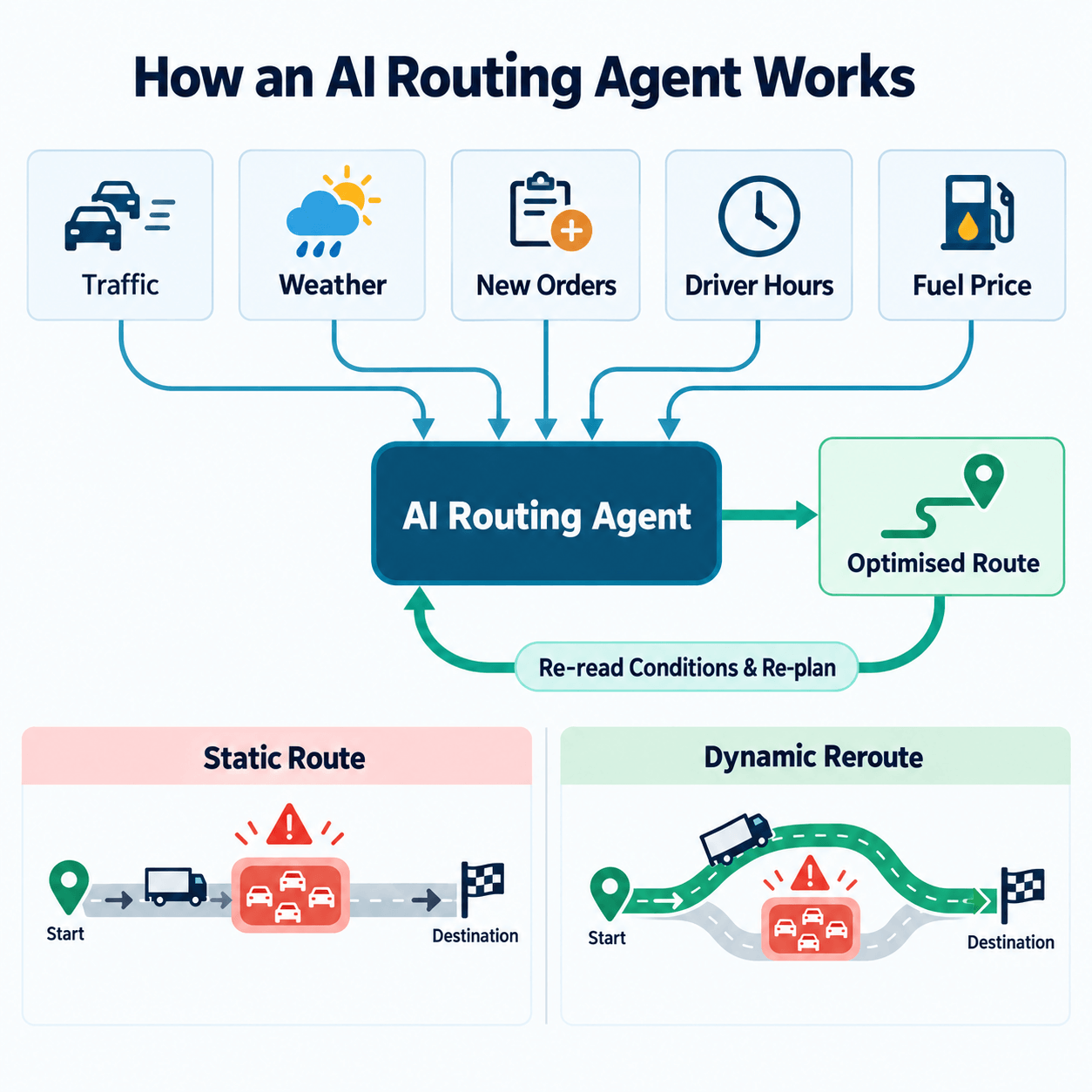
Plans and continuously re-plans delivery routes. Balances distance, fuel, driver hours, and delivery windows. Reroutes live when traffic or weather changes. - Dispatch Agent
Assigns loads to vehicles and drivers. Matches capacity to demand and rebalances when a vehicle goes offline or a new order arrives. - Carrier Agent
Scores and selects carriers in real time on cost, capacity, and past performance. Replaces habit-based manual selection. - Exception Agent
Watches for disruptions: delays, breakdowns, failed deliveries. Detects the problem and starts a fix before it cascades. - Orchestrator
Coordinates all agents, resolves conflicts between them, and decides when to escalate to a human dispatcher.
This structure is what enables true multi-agent orchestration in logistics. Each agent is simple and focused. The intelligence comes from how they coordinate.

AI Route Optimization in Dispatch
The gain from AI-powered logistics dispatch is not a one-time efficiency bump. It compounds. Every rerouted shipment saves fuel. Every avoided delay protects a delivery window. Every optimised load cuts empty miles. Across a full fleet over a year, these add up to a structural cost advantage.
Real-time inputs a routing agent processes include live traffic, weather, road closures, delivery-window changes, vehicle capacity, driver hours-of-service limits, and fuel prices. No human dispatcher can weigh all of these at once, for every vehicle, continuously. An agent can.
Route optimisation also depends on accurate demand and disruption forecasts. For how predictive models feed better routing and cut delays upstream, AI in supply chain covers the forecasting layer that makes dispatch decisions sharper.
We'll map the exact workflows from this article to your business - free, in 30 minutes.
Traditional vs Autonomous Dispatch Systems
The clearest way to see the value of AI-powered logistics dispatch is to compare it directly with the traditional model, operation by operation.
The single biggest operational shift is dispatcher leverage. With agent-assisted operations, one dispatcher can oversee up to three times more vehicles than under fully manual coordination, because the agents handle routine decisions and surface only the exceptions that need human judgement.
AI in Fleet Management and Operations
Dispatch and routing are where agents start, but AI in fleet management extends the same model across the whole operation. The agents that route today's loads also generate the data that improves tomorrow's decisions.
Predictive Maintenance
Fleet agents read vehicle telemetry to predict component failures before they happen. A breakdown avoided is a delivery saved and an emergency repair cost eliminated.
Load Pooling and Backhaul Matching
Empty miles are pure loss. Agents match return trips with available loads across the network, cutting the deadhead miles that manual planning struggles to eliminate.
Continuous Learning
This is the foundation of intelligent transportation management: every completed route feeds back into the system. The agents get better at predicting traffic patterns, delivery times, and disruption risk with each cycle.

How to Deploy AI Agents for Logistics Operations
Deploying AI agents for logistics operations works best as a staged rollout, not a single switch. The teams that succeed start narrow, prove value, then expand. Follow four steps.
- Start with routing on one lane or region.
Routing has the clearest, fastest ROI. Deploy one routing agent on a defined set of routes and measure fuel, on-time rate, and empty miles against your baseline. - Connect your live data sources.
Agents need real-time feeds: GPS, TMS, order systems, traffic and weather APIs. The quality of these feeds sets the ceiling on agent performance. Fix data gaps before scaling. - Add specialist agents and an orchestrator.
Once routing is proven, add dispatch, carrier, and exception agents under an orchestrator. This is where multi-agent value compounds. - Keep humans in the loop for high-stakes calls.
Let agents handle routine decisions autonomously. Route major exceptions, like a full reroute of a high-value shipment, to a dispatcher for approval.

For organisations building the technical foundation to run these systems in production, logistics software development services that combine transportation domain knowledge with multi-agent AI architecture are the most direct path to a deployment that scales.
Key Takeaways
Conclusion
Logistics has always been a coordination problem at massive scale. AI agents for logistics operations solve it in a way manual dispatch never could: continuously, across the whole network, in real time. The shift to AI-driven logistics operations is not about replacing dispatchers. It is about giving them a system that handles the routine so they can focus on the exceptions that need judgement.
The carriers and 3PLs that build this capability now will set the cost and service benchmark the rest of the market is measured against. The technology is proven. The question is how fast you deploy it.
Frequently Asked Questions
1. What are AI agents for logistics operations?
AI agents for logistics operations are autonomous software systems that make and act on dispatch, routing, and fleet decisions in real time. They read live data, reason about the best action under current constraints, and execute, rerouting shipments or reassigning loads without a human approving each step.
2. How do multi-agent AI systems work in logistics?
Multi-agent AI systems for logistics use several specialised agents, each owning one job such as routing, carrier selection, or exception handling. An orchestrator agent coordinates them and resolves conflicts. This lets the system handle many operational decisions at once, without human involvement in routine cases.
3. How much can AI route optimization save?
According to McKinsey, AI route optimization and broader supply chain AI deliver 10 to 15 percent lower fuel costs, 15 to 20 percent faster deliveries, and around 30 percent fewer late shipments. Gartner adds that AI network optimisation cuts transportation costs by about 15 percent.
4. Do AI agents replace human dispatchers?
No. They change the dispatcher's role. Agents handle routine decisions automatically and surface only the exceptions that need human judgement. In practice, one dispatcher can oversee up to three times more vehicles with agent support, focusing on the high-stakes calls rather than manual recalculation.
5. What data do AI agents need to run logistics operations?
AI in fleet management and dispatch agents need real-time feeds: GPS and vehicle telemetry, TMS and order data, and traffic and weather APIs. The quality of these feeds sets the ceiling on performance, so closing data gaps is the first step before scaling.
6. How do I start deploying autonomous dispatch systems?
Start narrow. Deploy one routing agent on a single lane or region, connect your live data sources, and measure results against your baseline. Once proven, add dispatch, carrier, and exception agents under an orchestrator. This staged approach to autonomous dispatch systems avoids the most common failure of automating everything at once.
You may also want to read