Setting up a Global Capability Center in India is one of the highest-return decisions a global company can make, and one of the easiest to get wrong. The entry model you choose shapes your cost, your risk, and how fast you reach full operation. Among the options, the build operate transfer model has become the de-risked middle path.
It gives you a partner to carry the hard early work of building and running the center, with a clear route to owning it outright later. This guide explains how the model works, what it costs, how it compares to the alternatives, and when global capability centers should actually choose it.
Our engineers will audit your workflow and estimate time-to-value at no cost.
Claim your free audit
What Is the Build Operate Transfer Model?
Understanding the build operate transfer meaning is the first step, because the name describes the model exactly. It is three sequential stages, each with a clear owner and a clear handover point.
So what is build operate and transfer in practice? It is a way to get a captive center without the captive-center learning curve. The partner takes on entity registration, office setup, IT infrastructure, hiring, and compliance with central and state labour laws. You get a working, proven operation, then take the keys once it is running well.
This is why the model suits GCC setup in India so well. India's regulatory environment, labour codes, and tax rules are complex for a first-time entrant. The BOT model lets an experienced partner absorb that complexity during the riskiest phase, then hands you a stable, compliant center to own.
How the Build Operate Transfer Model Works: The 3 Phases
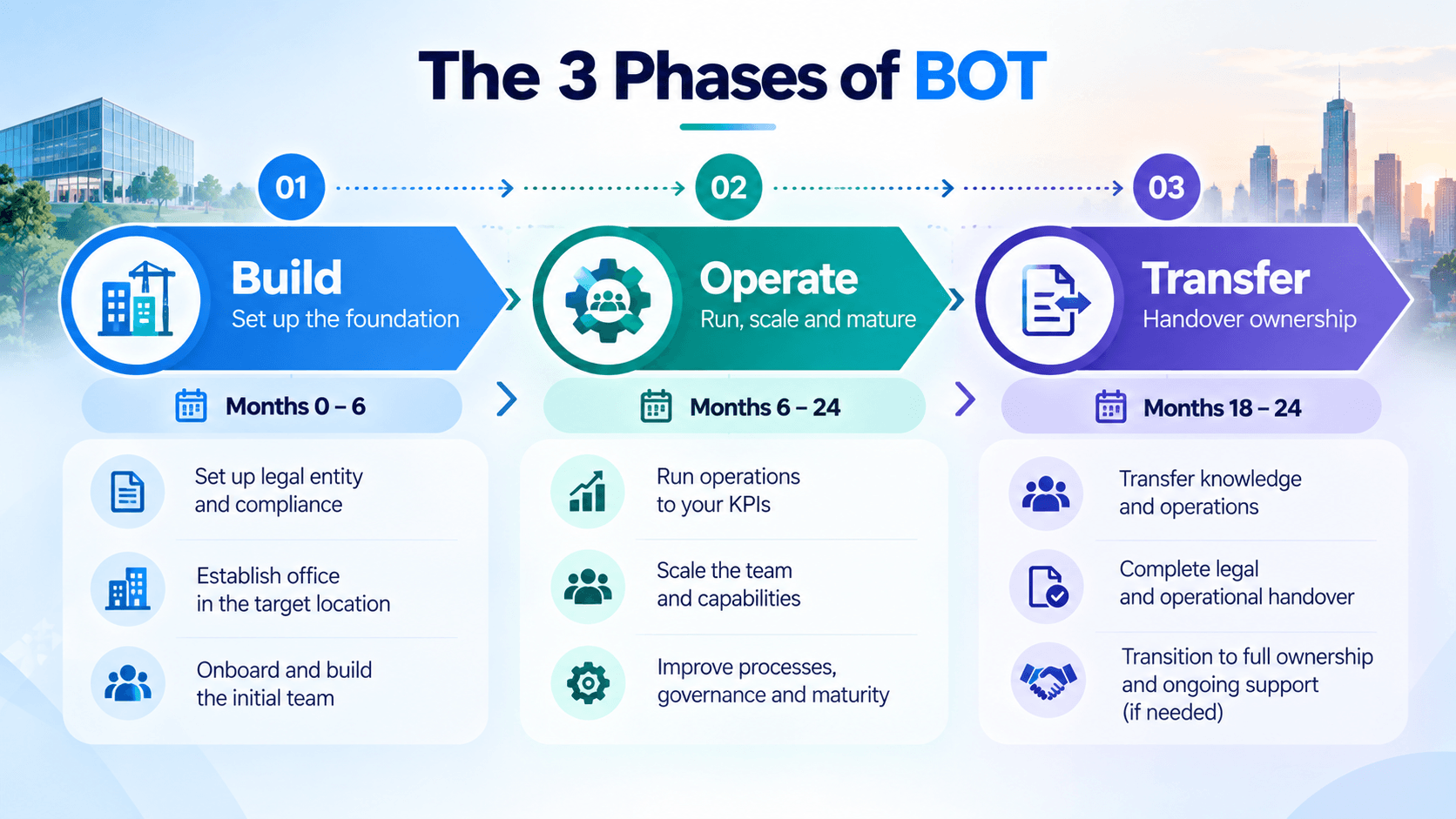
Every BOT model GCC engagement runs through the same three phases. The timelines below reflect what most organisations are choosing in 2026 and 2027.
Build
The partner incorporates the Indian entity, secures office space, procures IT infrastructure, handles all regulatory registrations, and recruits the founding team. Entity registration under the Companies Act typically takes 4 to 7 weeks. The best partners have a team sitting in a working office within about 90 days of engagement.
Operate
The partner runs the center to your specifications: your KPIs, SLAs, governance, and reporting cadence. The team scales, processes mature, and your internal leaders build the operational knowledge they will need to run it independently. This is the phase where the center is proven before you commit to owning it.
Transfer
Ownership of the entity, employment contracts, intellectual property, and infrastructure transfers to you, creating a fully owned captive center. The transfer involves entity structuring, employee migration, IP assignment, and valuation, each needing careful legal and tax handling.
Most organisations trigger the transfer somewhere between month 18 and month 24, once the operate phase has proven the center can perform at target quality and attrition levels.
The BOT Model and GCC Setup in India
India is the default destination for this model, and for good reason. It hosts the largest global capability centers ecosystem in the world, which gives a BOT engagement a deep bench of experienced partners, mature office and IT infrastructure, and a proven talent pool across engineering, analytics, and operations.
For a first-time entrant, though, India is also genuinely complex to set up in alone. Entity registration under the Companies Act, SEZ or STPI classification, transfer pricing structure, DPDPA data-protection compliance, and labour-law categorisation across central and state rules all require specialised local expertise. These are exactly the areas where first-time captive setups lose time and money.
This is what makes the BOT model such a natural fit for GCC setup in India. The partner absorbs the regulatory and operational complexity during the build and operate phases, when the risk is highest, and hands over a stable, compliant, running center once that risk has passed. You get the India advantage without the India learning curve.
Build Operate Transfer Cost in India
The build operate transfer cost depends on team size, city, function type, and the seniority of the roles. The ranges below reflect typical 2026 engagements in India.
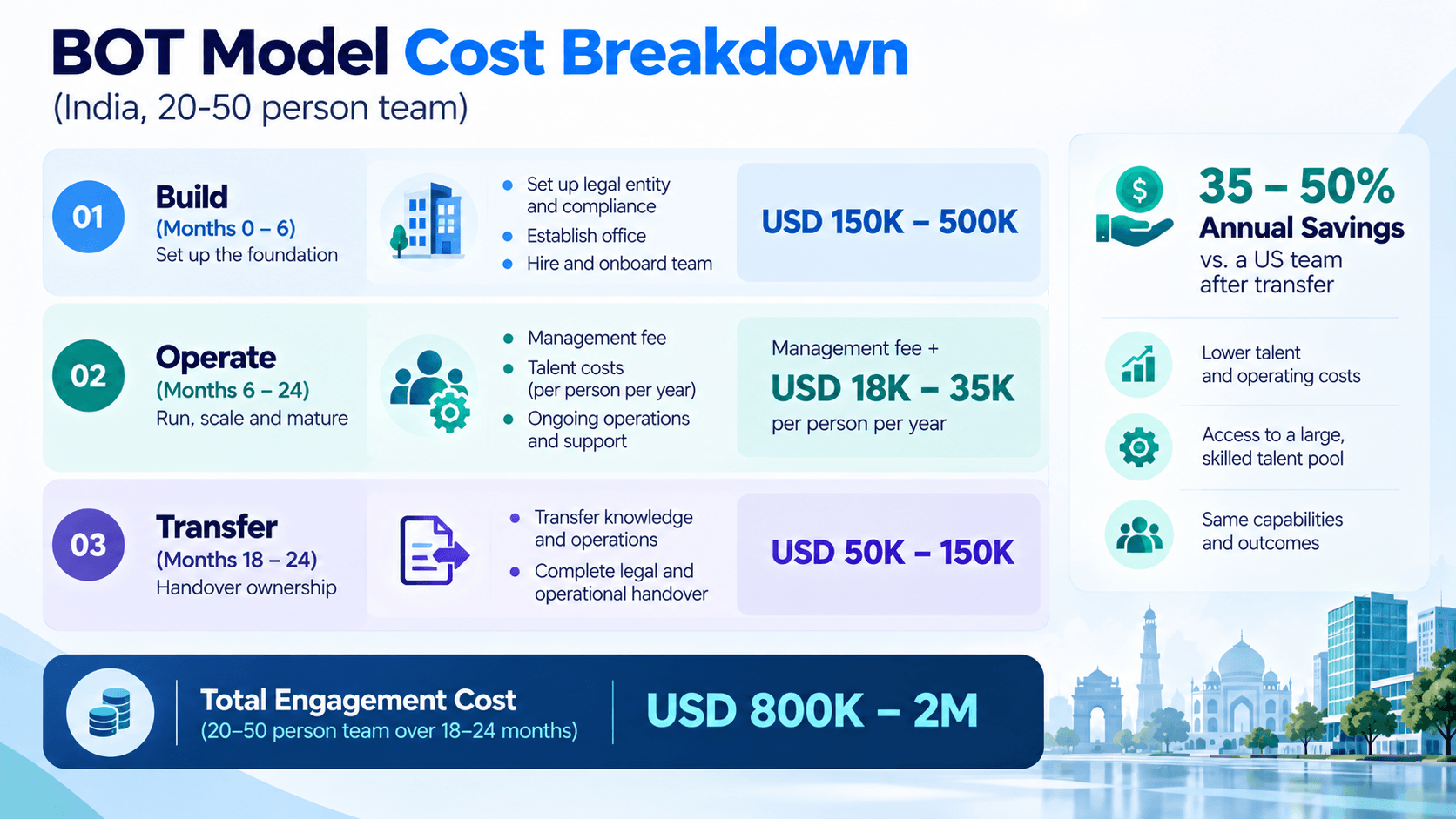
- Overall engagement: USD 800,000 to USD 2 million over an 18 to 24 month concession period for a 20 to 50 person captive center.
- Build phase: USD 150,000 to USD 500,000, covering entity registration, office, IT infrastructure, initial recruitment, and legal compliance.
- Operate phase: an ongoing management fee plus the fully loaded cost of the team, which in India runs roughly USD 18,000 to USD 35,000 per person per year depending on role.
- Transfer phase: USD 50,000 to USD 150,000, covering entity structuring, contract restructuring, IP transfer, and post-handover advisory.
The reason the model is financially attractive is what happens after transfer. Once the vendor margin falls away and you own the center directly, the economics shift to a captive cost base.
Benefits of the BOT Model
The BOT model has become popular because it solves several problems at once. Its main benefits:
- Low early-stage risk: the partner carries the entity, compliance, and hiring risk during the build phase, when mistakes are most expensive.
- Faster time to operation: an experienced partner can have a team working in a live office within about 90 days, far quicker than a first-time captive build.
- Eventual full ownership: unlike pure outsourcing, BOT ends with you owning the center, team, and IP outright.
- Proven before you commit: the operate phase lets you validate quality, attrition, and delivery before taking on ownership and capital.
- Long-term cost control: once the vendor margin falls away after transfer, the center runs 35 to 50 percent cheaper per year than an equivalent US team.
Risks and Challenges of the BOT Model
BOT is lower-risk than a first-time captive, but it is not risk-free. Know these before signing:
- The transfer event is complex: entity valuation, transfer pricing, IP assignment, and employee migration all need careful legal and tax handling, and poor paperwork here is the most common failure point.
- Vendor margin during operate: you pay a management fee through the operate phase, so BOT costs more than a direct captive over a three to five year horizon.
- Post-transfer attrition: some staff may not want to move to your payroll at handover, so retention terms must be designed into the agreement early.
- Partner dependency: the center's quality depends heavily on the partner during build and operate, so partner selection is the single highest-stakes decision.
- Misaligned transfer terms: if the transfer trigger, price, and timeline are vague in the contract, the handover can stall. Nail these down upfront.
Other GCC Operating Models: BOT vs Captive vs GCC-as-a-Service
Choosing between GCC operating models comes down to how much risk, control, and ownership you want, and when. The table below compares the three most common options.
The BOT vs captive GCC trade-off is the one most companies weigh. A captive built directly has the lowest long-term cost because there is no vendor margin, but it carries all the early-stage risk and the India learning curve. BOT costs a little more over a three to five year horizon, but it removes that early riska and still ends in full ownership.
When to Choose the BOT Model
The BOT model is not the right answer for every organisation. It fits a specific profile well and is the wrong choice for others. Here is how to tell which side you are on.
BOT is the right choice when:
- You want to own a captive center eventually, but lack India entity experience to build one safely now
- Your board wants results within a couple of quarters and cannot absorb a long, uncertain setup
- You are planning a team of roughly 20 or more roles, where the programme fee amortises well
- You want to prove the operating model works before committing full ownership and capital
BOT is the wrong choice when:
- You already have India experience and in-house entity capability, where a direct captive is cheaper
- Your team will stay small and short-lived, where an Employer of Record is faster and cheaper
- You never intend to own the center, where GCC-as-a-Service avoids the transfer complexity entirely
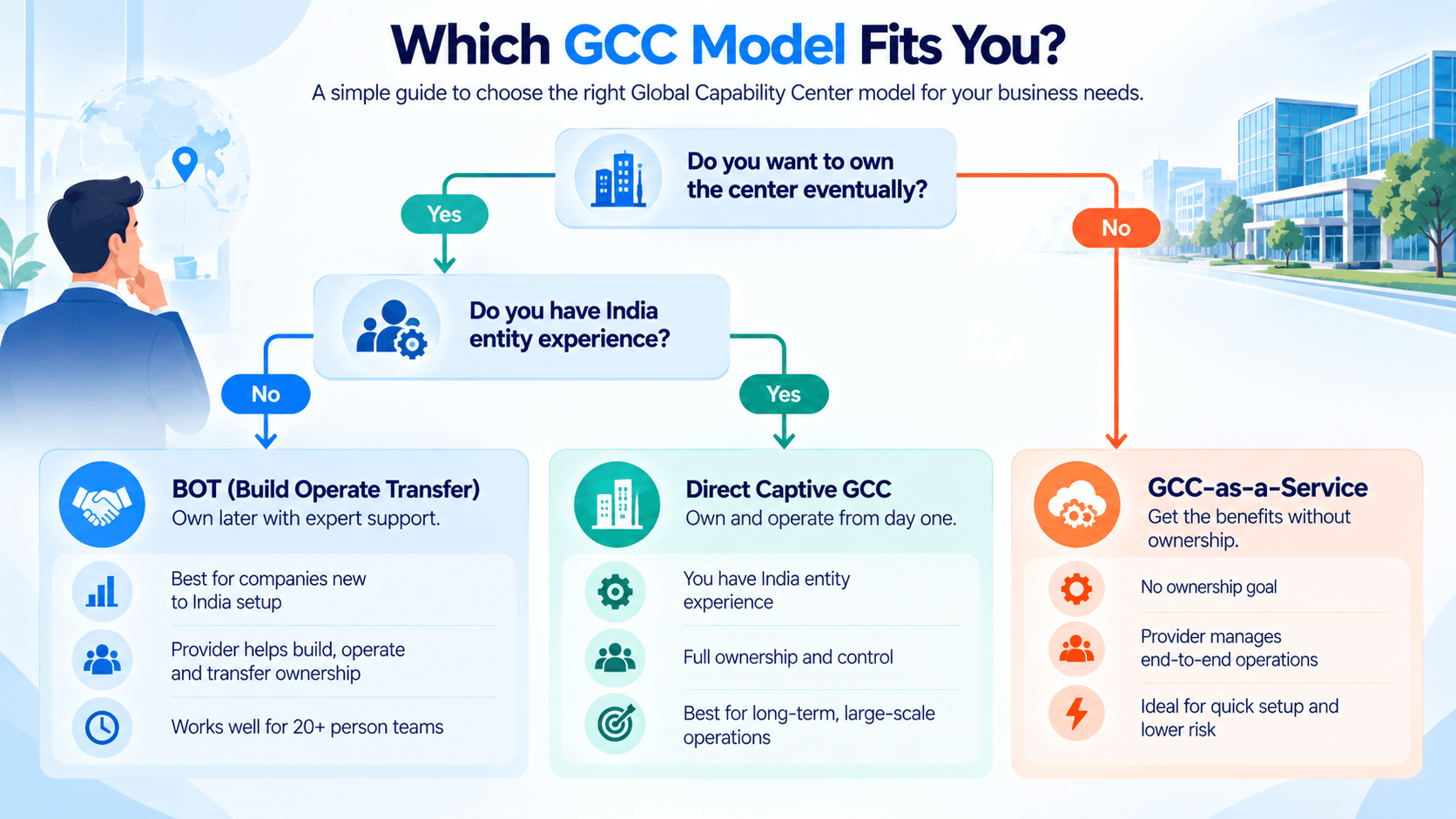
If ongoing managed operations suit you better than eventual ownership, Pace Wisdom provides GCC as a Service, where the partner builds and keeps running the center for you, with no transfer event to plan or fund.
BOT Readiness Checklist
Before you approach a BOT partner, confirm you can answer yes to most of these. They are the signals that a BOT engagement will go smoothly.
Key Takeaways
Conclusion
The build operate transfer model earns its popularity by solving the hardest part of GCC setup: getting a compliant, high-performing center running in an unfamiliar market without betting everything on day one. It trades a modest premium over a direct captive for a large reduction in early-stage risk, and still ends with you owning the center.
For companies that want a captive future without a captive learning curve, BOT is usually the smartest way in. The key is choosinga partner with a proven build, a disciplined operate phase, and a clean transfer. If you are still comparing entry routes, this guide to GCC setup in India walks through every model, timeline, and cost so you can place BOT against the full set of options.
We'll map the exact workflows from this article to your business - free, in 30 minutes.
Frequently Asked Questions
1. What is the build operate transfer model?
The build operate transfer model is a phased arrangement where a partner builds an offshore operation, runs it for a set period (usually 18 to 24 months), and then transfers full ownership of the entity, team, and infrastructure to you. In the GCC context, the end state is a fully owned captive center.
2. What are the three phases of the BOT model?
Build (months 0-6): entity formation, office setup, IT infrastructure, and hiring. Operate (months 6-24): the partner runs the center to your KPIs while it scales and matures. Transfer (months 18-24): ownership of the entity, contracts, and IP moves to you, creating a captive center.
3. How much does the BOT model cost in India?
A typical build operate transfer cost for a 20 to 50 person team is USD 800,000 to USD 2 million over an 18 to 24 month concession period. This covers the build phase, operate-phase management fees, and transfer structuring. After transfer, the center runs 35 to 50 percent cheaper per year than an equivalent US team.
4. How long does a BOT engagement take?
Most BOT programmes run 18 to 24 months from build to transfer, with the first 3 to 6 months spent standing up the entity, office, and founding team. Organisations typically trigger the transfer once the operate phase proves the center performs at target quality and attrition levels.
5. What is the difference between BOT and a captive GCC?
With a captive, you build and own the center yourself from day one: lowest long-term cost, but all the early risk and the India learning curve. With the BOT vs captive GCC choice, BOT has a partner carry the early build and operate risk, costs slightly more over 3 to 5 years, and still ends in full ownership
6. Who should choose the BOT model?
BOT suits organisations that want to own a captive global capability center India eventually but lack local entity experience, need results within a couple of quarters, and are building a team of roughly 20 or more roles. It is less suitable for very small teams or companies that never intend to own the center.
7. What are the main benefits and risks of the BOT model?
The main benefits are low early-stage risk, fast time to operation, eventual full ownership, and strong long-term cost control after transfer. The main risks are a complex transfer event, vendor margin paid through the operate phase, potential post-transfer attrition, and heavy dependence on the partner, which makes partner selection the highest-stakes decision.
8. How is the BOT model different from GCC-as-a-Service?
With BOT, ownership of the center transfers to you after the operate phase, ending in a captive you control. With GCC operating models like GCC-as-a-Service, the partner builds and keeps running the center for you indefinitely, with no transfer and ongoing management fees. Choose BOT if you want eventual ownership; choose GCC-as-a-Service if you want managed operations without owning the entity.
You may also want to read
What Is a Cloud Transformation Assessment? A Guide for Enterprises