India is the GCC capital of the world, home to the largest and most mature Global Capability Center ecosystem globally. For US enterprises evaluating a GCC setup in India, the question is no longer why India. It is how to execute without the costly mistakes that derail first-time setups.
This guide walks through every phase of the GCC setup process in India: from choosing the right operating model and location, through entity incorporation and compliance, to hiring the leadership that determines whether your GCC succeeds or stalls. Every step is based on 2026 regulatory and market data.
Our engineers will audit your workflow and estimate time-to-value at no cost.
Claim your free audit
What Is a GCC and Why India in 2026?
The distinction from outsourcing is the most important framing for any enterprise leadership team evaluating GCC establishment in India. With a GCC, you own the code, the data, the relationships, and the institutional knowledge. With outsourcing, you own a contract. That difference drives the strategic case for GCCs at companies that have tried outsourcing and found the knowledge and quality ceiling.
India's specific advantages in 2026 go beyond cost. The country contributes 40 percent of the global GCC workforce, has a policy environment that actively incentivises GCC formation, and is the only location globally with the talent depth to support rapid scaling across engineering, AI, analytics, BFSI, and ER&D simultaneously.
Choose Your GCC Setup Model
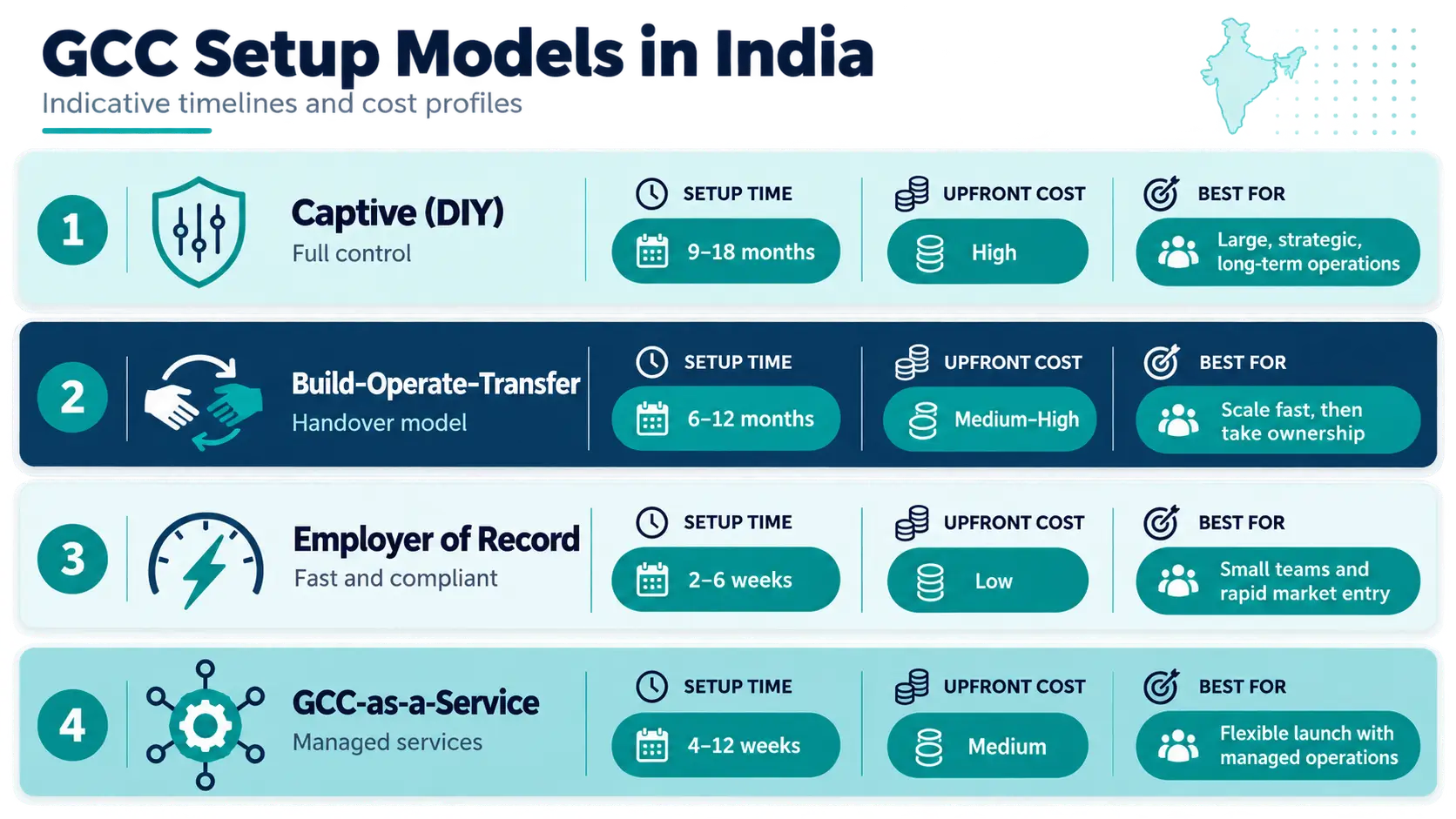
The most consequential early decision in any GCC setup in India is which operating model to use. The model determines your timeline, upfront capital requirement, risk profile, and how quickly you can start hiring.
The Modern Approach: Hire First, Incorporate in Parallel
The traditional model of incorporating first and then hiring is being displaced by a faster pattern. Start 5 to 15 employees under an Employer of Record within days of decision, prove the operating model and team quality, then transfer employees to your own entity once the incorporation is complete and the model is validated. This approach eliminates the 10 to 16 week dead zone between decision and first hire, and lets you validate India execution before committing full setup capital.
GCC Location Selection in India: Where to Set Up
The GCC location selection in India decision is driven by four variables: the function your GCC will perform, the talent depth required, cost tolerance, and attrition risk. Bengaluru defaults are common but not always optimal.
Hyderabad is the fastest-growing Tier-1 city for new GCC setups in 2026, driven by Karnataka-style government incentives from Telangana and lower attrition rates than Bengaluru. Pune offers the strongest combination of engineering talent and cost efficiency for ER&D and manufacturing-adjacent functions. Tier-2 cities such as Coimbatore, Kochi, and Ahmedabad are increasingly viable for scaled operations at roughly 50 percent of Bengaluru's office cost.
The 8-Step GCC Setup Process in India
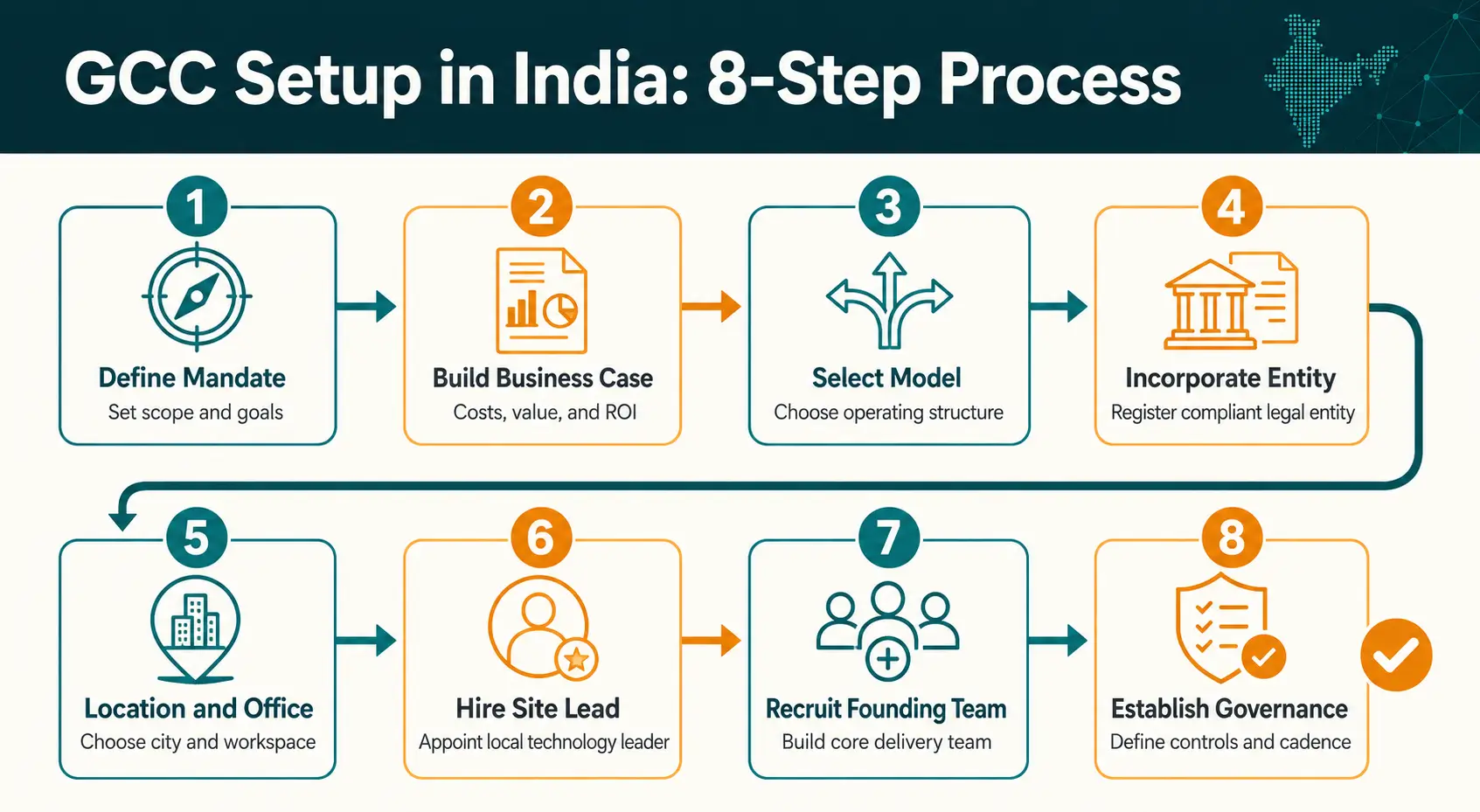
The following GCC setup process in India reflects the sequence that well-executed first GCCs follow in 2026. Skipping or compressing steps is the primary source of the cost overruns and timeline slippage that derail first-time setups.
- Define Your GCC Mandate and Functions
Specify which functions the GCC will own: product engineering, AI/ML, shared services, analytics, ER&D, or a combination. Define the headcount target for year 1, year 2, and year 3. Establish which functions will transfer from the parent versus which will be new hires. Without a clear mandate, location, hiring, and governance decisions cannot be made correctly. - Build the Business Case and Secure Board Approval
A GCC business case in 2026 should quantify the 5-year cost savings against a defined counterfactual: equivalent headcount at headquarters or through a third-party vendor. It should include the one-time setup investment, projected annual operating savings, the strategic value of IP ownership and talent access, and the break-even timeline. The Union Budget 2026 transfer pricing safe harbour simplifies one of the historically uncertain variables in GCC financial modelling. - Select Setup Model and Partner
Choose between captive, BOT, EOR, or GCC-as-a-service based on your headcount target, timeline, risk tolerance, and internal India expertise. If this is your first GCC, partnering with an experienced setup partner dramatically reduces the compliance, recruitment, and real estate risks that first-time setups consistently underestimate. - Entity Incorporation and Registrations
For a captive GCC, the standard structure is a Private Limited Company under the Companies Act 2013. Incorporation takes 10 to 16 weeks and requires: DSC and DIN for directors, MCA21 company registration, PAN and TAN, GST registration, professional tax registration per state, Shops and Establishments Act registration, and EPF and ESI registration. India's four Labour Codes came into force on November 21, 2025, consolidating 29 prior central laws. Any incorporation after that date must reflect the new Code requirements from day one. - GCC Location Selection and Office Setup
Run the location audit using the function, talent, and cost framework from Section 3. For office setup, most first GCCs in the 25 to 75 person range use managed workspace or co-working initially, transitioning to dedicated office once headcount and culture are established. Enterprise-grade managed offices in Bengaluru, Hyderabad, and Pune are available with short lead times and flexible lease structures. - Hire India Site Leadership
The India site lead is the single most consequential hire in the GCC setup. This person must credibly represent the parent organisation to Indian talent, have the seniority to make real decisions, and be respected by both the Indian team and the parent's leadership. Hiring too junior here, or relying on a recruiting agency to source this role, is the most common and most expensive mistake in GCC setup. Allocate time and senior leadership attention to this hire before any other recruitment begins. - Recruit and Onboard the Founding Team
The founding team culture sets the GCC's trajectory for years. These are not simply skilled individuals; they are culture carriers who will define what working at your India centre means. Prioritise attitude, ownership, and alignment over resume credentials for the first 15 to 20 hires. Use structured onboarding that connects the India team to the parent's mission, product, and working culture from day one, not as an afterthought after the first quarter. - Establish Governance and Transition Model
Define the reporting structure, KPI framework, communication cadence between India and the parent, and the escalation path for decisions. Establish which decisions the India site lead makes independently and which require parent approval. Build the IP assignment and work-for-hire framework into employment contracts from the first hire. Plan the transition from initial delivery mode to steady-state operating model before the GCC launches, not after it is running.
We'll map the exact workflows from this article to your business - free, in 30 minutes.
GCC Setup Cost in India: What to Budget
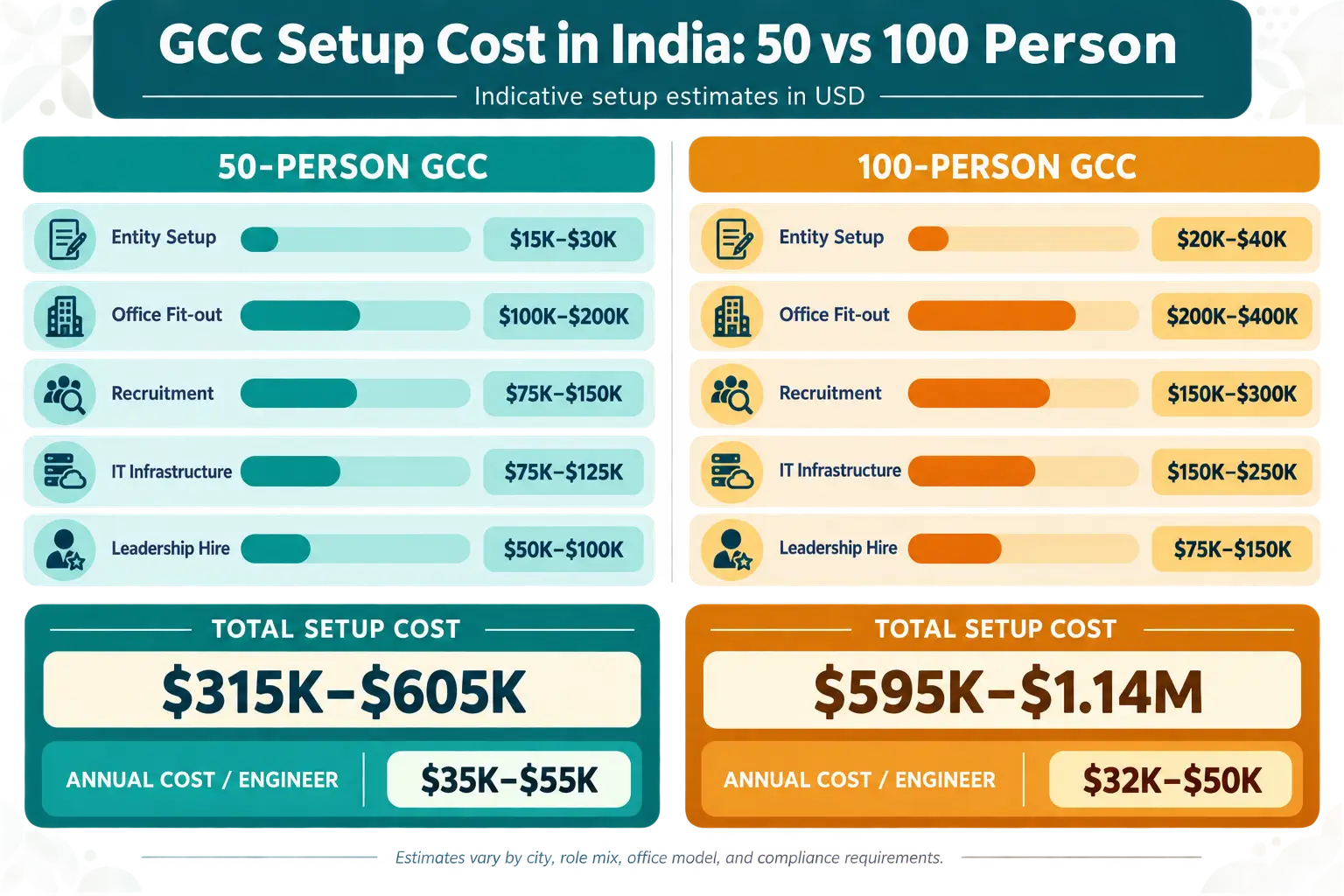
Understanding GCC setup cost in India requires separating one-time setup investment from ongoing annual operating costs. Most vendor quotes understate both the recruitment line and the site leadership cost, which are typically the two largest variables in first-year spend.
Common Cost Underestimation Traps
- Recruitment: vendor models often assume 8 to 10 percent of first-year salary. Realistic cost for quality hires in competitive roles is 12 to 20 percent of CTC, higher for senior hires
- Site leadership: a credible India site lead costs $100,000 to $200,000 annually all-in, and is often excluded from initial vendor models entirely
- Transfer pricing: without the new 15.5 percent safe harbour, transfer pricing uncertainty can add material compliance cost and audit risk to the ongoing operating model
- Salary inflation: India tech salary inflation runs 8 to 12 percent annually, and year 2 and year 3 cost models must reflect this, not hold year 1 rates flat
Legal, Compliance, and Tax Framework
The India compliance environment for GCCs changed materially in 2025 and 2026. Any enterprise planning GCC setup in India must ensure its legal, HR, and payroll structures reflect the current framework, not the legacy one.
Entity Structure
The Private Limited Company (Pvt. Ltd.) under the Companies Act 2013 is the standard structure for GCCs. It allows FDI under the automatic route for most GCC functions, provides clear IP ownership, and is the structure regulators and talent expect. Branch offices and LLPs are viable for specific use cases but carry limitations on profit repatriation and talent credibility respectively.
The Four Labour Codes (November 21, 2025)
India's four Labour Codes consolidating 29 prior central laws came into force on November 21, 2025. GCCs incorporating after this date must structure employment contracts, payroll, PF and ESI calculations, and wage definitions under the new Codes. The Code on Wages defines wages as at least 50 percent of total remuneration, which raises PF and gratuity provisioning for common allowance-heavy pay structures used in India.
Transfer Pricing: 15.5% Safe Harbour (Union Budget 2026)
The Union Budget 2026 introduced a uniform 15.5 percent safe harbour margin for transfer pricing, covering approximately 80 percent of financial-services GCCs under the revised threshold. This is the single largest transfer pricing simplification for GCCs in a decade and should be reflected in every business case built after April 2026.
Building the Right Team for Your GCC
Talent is both India's primary GCC advantage and the most common source of first-year underperformance. The talent pool is deep and growing, but competition for the right profiles is intense. GCCs that treat India hiring as a volume exercise consistently underperform those that treat it as a strategic capability build.
The Site Lead Is the Highest-Leverage Hire
The India site lead determines the GCC's culture, the quality of the talent pipeline, and the quality of the parent-India relationship. This person must be senior enough to make real decisions, credible enough to attract top Indian talent who have many options, and aligned enough with the parent's culture to carry it authentically. No other hire has more impact on first-year GCC outcomes.
Talent Strategy for the Founding Team
- Campus hiring for junior roles: 64 percent of GCCs foresee up to 20 percent fresher intake in 2025-2026, often via hackathons and specialised internship pipelines
- Experienced lateral hires for senior individual contributors: GCCs offer a 12 to 20 percent salary premium over traditional IT service firms, making them competitive for the profiles that matter most
- Leadership pipeline from Day 1: define a 3-year succession plan for key roles before the founding team is hired, not after a crisis forces the conversation
India's GCC workforce is growing at 18 to 27 percent annually. The enterprises that build strong India employer brands early, through transparent culture, genuine ownership, and a compelling mission, will consistently access better talent than those that rely on compensation alone.
Governance, IP Protection, and Long-Term GCC Setup Strategy
The GCC implementation in India that succeeds long-term is the one where governance is designed before the GCC launches, not improvised after it is running.
Governance Framework
- Define reporting lines clearly: does the India site lead report to a global function head or directly to the CEO? Ambiguity here is costly
- Establish a monthly operating review between India leadership and the parent with structured KPIs: delivery velocity, team health, attrition rate, and cost per output
- Build an escalation path for decisions that the India team cannot make independently, and be explicit about which decisions those are
IP Protection
Every employment agreement must include IP assignment clauses, work-for-hire provisions, and non-disclosure obligations that are enforceable under Indian law. Review these with Indian counsel before the first hire, not before the first exit.
From Execution Centre to Innovation Hub
The most successful GCCs evolve from execution centres to innovation hubs within 3 to 5 years. This transition requires deliberate investment in senior leadership capability, R&D mandates, and the autonomy to own product decisions rather than just execute on them. Building the cultural and governance foundation for this transition from day one determines whether the GCC reaches that potential.
For enterprises at any stage of this journey, from initial feasibility through full GCC operation, a structured set of GCC consulting services covering strategy, setup, compliance, and talent can compress the learning curve and avoid the mistakes that derail first-time setups.
Conclusion
India is not a backup option for enterprise capability building. It is the primary destination for enterprises that want depth, scale, and cost advantage simultaneously. Executed correctly, a GCC setup in India delivers measurable cost savings, full IP ownership, and a talent base that grows into genuine innovation capability within 3 to 5 years. The difference between GCCs that deliver on that promise and those that stall is almost always the quality of the setup process, the first team built, and the governance put in place before the first hire.
Frequently Asked Questions
1. What is GCC setup in India?
GCC setup in India refers to the process of establishing a Global Capability Center, a wholly owned captive entity, in India to deliver technology, engineering, analytics, or operations functions for a parent company. Unlike outsourcing, a GCC gives the parent full IP ownership and direct talent control.
2. How long does it take to set up a GCC in India?
Full entity incorporation takes 10 to 16 weeks. Using an Employer of Record, your first hire can start within 48 hours while the entity registers in parallel. The GCC setup process in India from initial decision to an operational founding team of 15 to 20 people typically runs 3 to 6 months end-to-end.
3. What does GCC setup cost in India?
A 50-person GCC setup cost in India depends on size, model, and location. See the cost breakdown table in Section 5 of this guide for a detailed itemised view. The main cost components are entity setup and registrations, office fit-out, recruitment, IT infrastructure, and site leadership. Annual operating costs are significantly below equivalent US teams, and break-even against the parent-country counterfactual typically runs within the first year for mid-sized GCCs.
4. Which city is best for a GCC in India?
It depends on function. For AI, product engineering, and tech: Bengaluru. For BFSI, analytics, and shared services: Hyderabad, Pune, or Chennai. For cost-optimised scaling: Tier-2 cities. Always run a GCC location selection in India audit against your specific function mix before defaulting to Bengaluru.
5. What is the difference between a BOT and captive GCC model?
A captive GCC is built and operated directly by the parent from day one, with full control and IP ownership. A Build-Operate-Transfer model is set up and operated by a partner for a defined period (typically 2 to 4 years) before transferring ownership to the parent. BOT reduces first-year execution risk but adds transition complexity and partner dependency.
6. How do I get started with GCC setup in India?
Start with a GCC feasibility study: define the functions, headcount target, location options, and cost model. Then select a setup model based on your timeline and risk tolerance. Working with experienced GCC setup services in India that cover entity incorporation, compliance, talent, and real estate significantly reduces the execution risk that derails first-time setups.
You may also want to read