Healthcare has always been data-rich but insight-poor. Clinicians spend hours on documentation. Patients wait days for answers that a well-trained model could surface in seconds. That gap is exactly where generative AI in healthcare is making its mark.
Unlike traditional AI that classifies or predicts based on fixed rules, generative AI creates. It synthesises clinical notes, generates personalised care plans, and produces diagnostic summaries from fragmented data. The result is a technology that does not just assist providers but actively reshapes the way care is delivered.
This blog breaks down the most impactful generative AI healthcare use cases across patient engagement, clinical decision-making, workflow automation, and EHR management, with real-world context on what is working right now.
What Is Gen AI in Healthcare?
Gen AI in healthcare refers to the application of large language models (LLMs), multimodal AI, and generative neural networks to clinical and administrative healthcare workflows. These models, trained on vast datasets of medical literature, EHR records, imaging data, and clinical guidelines, can generate human-quality text, images, and structured data outputs.
The distinction from traditional healthcare AI matters. Rule-based systems flag anomalies or classify images. Generative AI reasons, synthesises, and creates: drafting a discharge summary, explaining a diagnosis in plain language, or generating a differential diagnosis list for a physician to review.
How Generative AI Is Transforming Patient Engagement?
Patient engagement is one of the clearest early wins for AI-powered healthcare. Generative AI enables health systems to communicate with patients at scale, personally, accurately, and in real time, without proportionally scaling their workforce.
AI-Powered Chatbots and Virtual Health Assistants
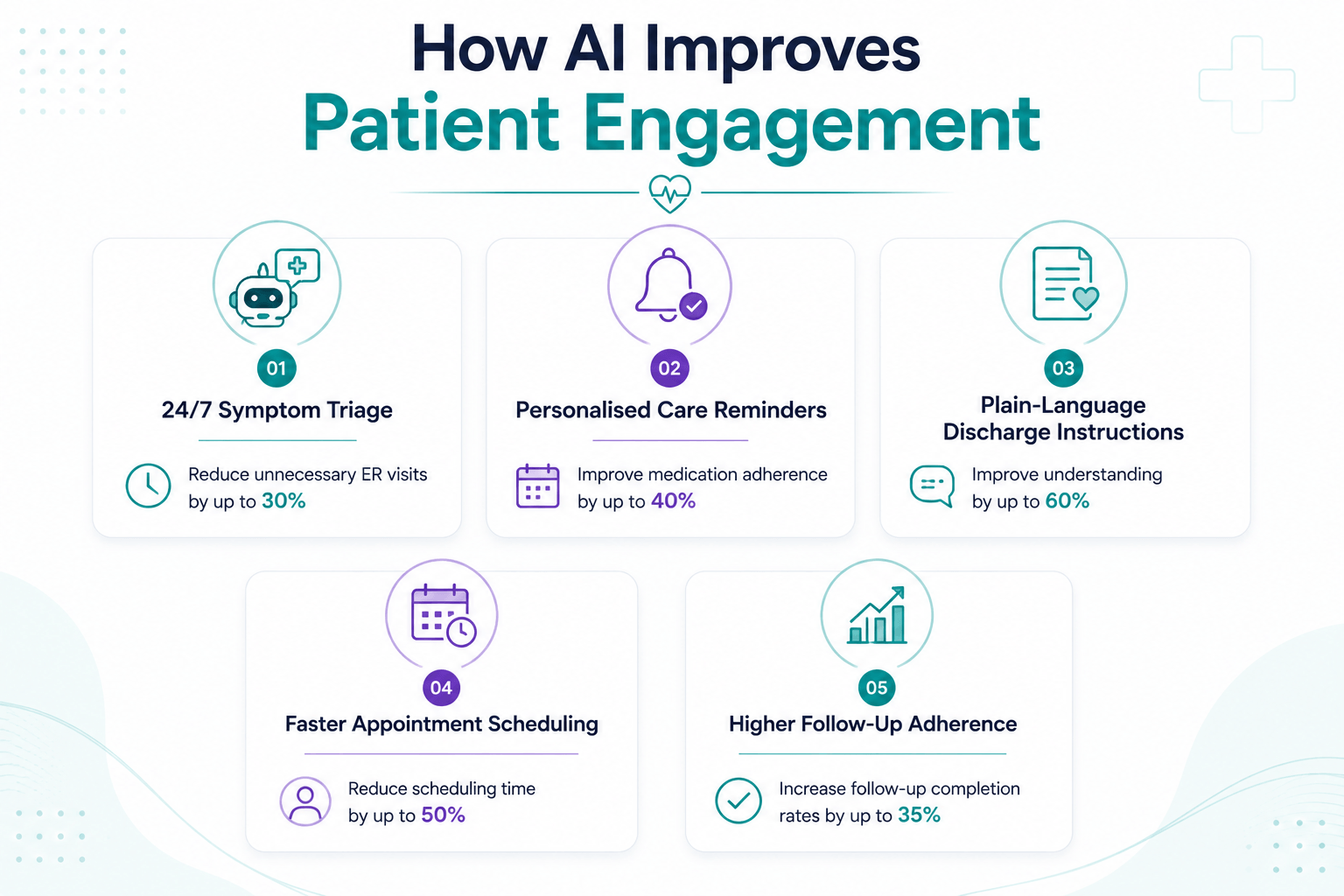
LLM-powered virtual assistants now handle appointment scheduling, medication reminders, symptom triage, and post-discharge follow-up. Unlike older rule-based chatbots, these systems hold context across a conversation, adapt to patient inputs, and escalate to human clinicians when needed.
The impact on AI patient engagement is measurable. Patients get faster responses. Care teams spend less time on repetitive queries. And health systems see improved adherence to follow-up care.
Personalised Patient Education
Generative AI translates complex discharge instructions into plain language tailored to a patient's literacy level, language, and condition. This supports personalized patient care by ensuring patients genuinely understand their care plan, reducing readmissions driven by confusion or non-adherence.
Our engineers will audit your workflow and estimate time-to-value at no cost.
Claim your free audit
Clinical Decision-Making AI: Supporting Physicians at the Point of Care
Perhaps the most consequential application of generative AI in healthcare is at the clinical decision-support layer, where AI assists physicians in diagnosis, treatment planning, and risk stratification.
Differential Diagnosis and Clinical Summarisation
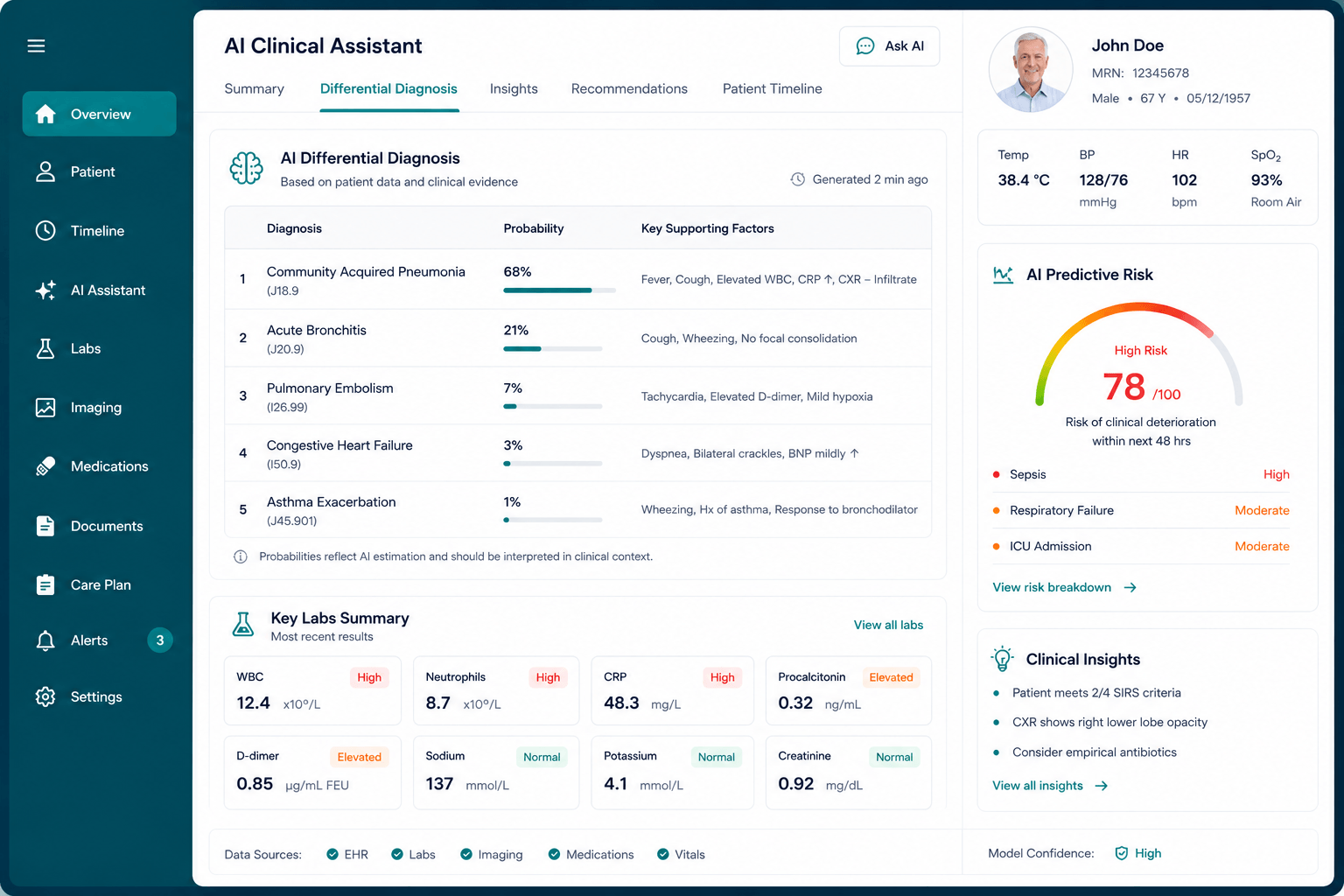
Generative AI models analyse a patient's symptoms, history, lab values, and imaging findings to surface a ranked list of differential diagnoses. This does not replace physician judgement; it augments it, reducing cognitive load on clinicians managing complex cases.
Early generative ai in healthcare examples include ambient AI scribes that auto-generate structured clinical notes from physician-patient conversations in real time. A 2025 study published in JAMA Network Open found that clinicians using ambient AI tools spent 8.5% less total time in the EHR, with a 15% reduction in time spent composing notes specifically. Physician burnout dropped from 52% to 39% in the same cohort.
Predictive Risk Scoring
AI models analyse longitudinal patient data to flag high-risk patients before a crisis occurs. Clinical decision-making AI tools now predict sepsis onset, readmission risk, and medication non-adherence, giving care teams time to intervene proactively rather than reactively.
Radiology and Pathology Support
Multimodal generative AI models analyse medical images and generate structured radiology or pathology reports with flagged anomalies. Radiologists review and approve rather than dictate from scratch, cutting reporting time significantly while maintaining clinical accuracy.
Healthcare Workflow Automation with Generative AI
Administrative overhead is one of the largest cost centres in healthcare. Healthcare workflow automation powered by generative AI is addressing this directly, eliminating repetitive manual tasks that consume clinical and administrative staff time.
Automated Clinical Documentation
Ambient AI listening tools transcribe physician-patient conversations in real time and generate structured SOAP notes, referral letters, and prior authorisation requests. The Permanente Medical Group's analysis published in NEJM Catalyst found that AI scribes saved physicians an estimated 15,791 hours of documentation time, equivalent to 1,794 eight-hour workdays, across a single health system.
Revenue Cycle Management
Generative AI models handle insurance pre-authorisations, claims drafting, and denial management. AI-generated appeals are faster and more complete than manually drafted ones, directly reducing revenue leakage.
Staff Scheduling and Operational Planning
AI models analyse historical patient flow, seasonal demand, and staff availability to generate optimised shift schedules, reducing both understaffing and overtime costs.
For healthcare organisations exploring the cloud infrastructure that underpins these AI deployments, Pace Wisdom's guide on healthcare cloud migration for security, scalability and AI integration covers the foundational architecture decisions in depth.
We'll map the exact workflows from this article to your business - free, in 30 minutes.
Electronic Health Records (EHR) AI: Making Patient Data Work Harder
Electronic health records hold enormous clinical value, but most of it is locked inside unstructured free text, scanned documents, and siloed systems. Electronic Health Records (EHR) AI is changing that.
Generative AI extracts structured insights from unstructured EHR data, identifying care gaps, surfacing relevant patient history before a consultation, and generating population health reports. Natural language interfaces let clinicians query patient records conversationally rather than navigating complex EHR menus.
Kaiser Permanente expanded its ambient GenAI documentation rollout across 600 medical offices and 40 hospitals by 2025, representing one of the most visible industry shifts from pilot to full production deployment.
Healthcare Digital Transformation: Where Generative AI Fits
Healthcare digital transformation is not a single project. It is a continuous shift in how health systems operate, deliver care, and compete for patients. Generative AI sits at the centre of this shift.
Health systems that treat AI as a point solution will see limited returns. The organisations extracting the most value are those integrating AI across the care continuum: from patient acquisition and engagement, through clinical care, to billing and outcomes reporting.
This is where a technology partner with deep healthcare and pharma software development expertise matters. Building interoperable, HIPAA-compliant AI systems that connect EHRs, billing platforms, and patient-facing tools requires both clinical domain knowledge and engineering depth.
Key Generative AI Healthcare Use Cases at a Glance
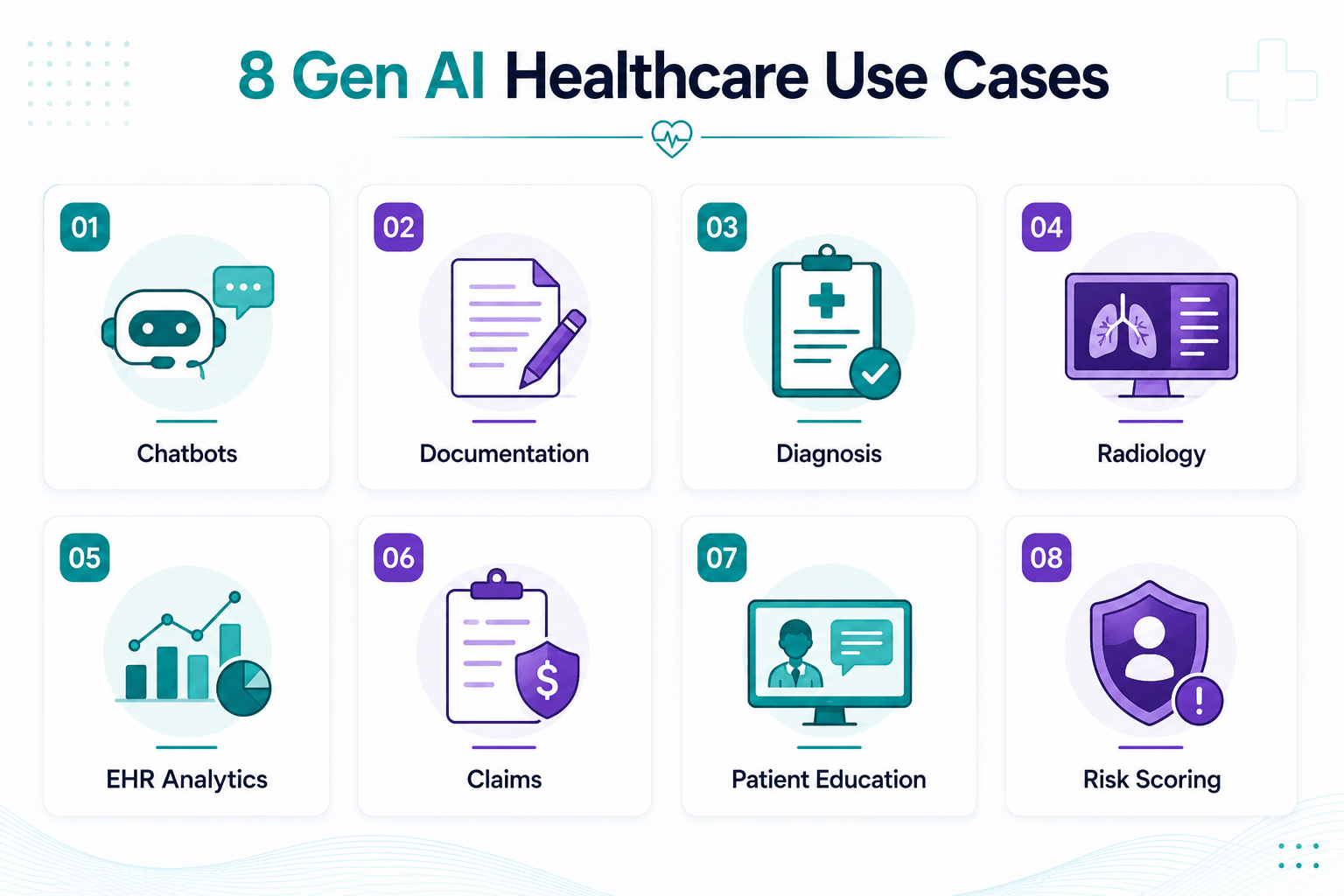
Here is a summary of the primary Healthcare AI Solutions being deployed in health systems today:
- Patient triage and symptom assessment via AI chatbots and virtual assistants
- Ambient clinical documentation: SOAP notes, discharge summaries, referral letters
- Differential diagnosis support and clinical decision tools for physicians
- Radiology and pathology report generation with anomaly flagging
- EHR data extraction, care gap identification, and population health analytics
- Prior authorisation and claims management automation
- Personalised patient education and care plan communication
- Predictive risk scoring for sepsis, readmission, and chronic disease management
Conclusion
Generative AI in healthcare is not a future promise. It is a present-day operational reality. Health systems that move now will build the data infrastructure, clinical workflows, and AI governance frameworks that compound into durable competitive advantages over time.
The technology is mature enough to deploy. The regulatory environment is clarifying. And patient expectations, shaped by AI experiences in every other sector, are rising fast.
The question for healthcare leaders is not whether to adopt gen AI in healthcare. It is which use cases to prioritise, which partners to work with, and how to build the clinical and technical foundation that makes AI a sustainable advantage rather than a one-time project.
FAQ
1. What is Gen AI in healthcare?
Generative AI in healthcare refers to AI systems built on large language models and generative architectures that create new clinical content: structured notes, diagnostic summaries, personalised care plans, and synthetic training data. Unlike traditional AI that classifies or predicts, generative AI produces original outputs, making it applicable across both clinical and administrative workflows.
2. How does generative AI improve patient engagement?
Generative AI powers intelligent virtual health assistants that handle patient queries, appointment scheduling, medication reminders, and symptom triage around the clock. These systems adapt to individual patient context, communicate in plain language, and escalate to human clinicians when needed, improving both access and experience without proportionally increasing staffing costs.
3. Can generative AI support clinical decision-making?
Generative AI assists physicians at the point of care by surfacing differential diagnoses, summarising patient history, generating radiology and pathology reports, and flagging high-risk patients through predictive scoring. It augments, rather than replaces, clinical judgement, reducing cognitive load and supporting faster, better-informed decisions.
4. What are the most common generative AI healthcare use cases?
The most widely deployed use cases include ambient clinical documentation, EHR data extraction, AI patient engagement chatbots, revenue cycle automation, radiology report generation, and predictive risk scoring. Health systems are increasingly integrating these across the care continuum rather than deploying isolated point solutions.
5. Is generative AI in healthcare safe and compliant?
Responsible deployment requires HIPAA compliance, robust data governance, model validation against clinical benchmarks, and human oversight for high-stakes decisions. Regulatory frameworks in the US and EU are actively evolving to address AI-specific risks, and leading health systems are embedding clinical governance into their AI rollout strategies.
6. How can a healthcare organisation get started with generative AI?
The most effective starting point is identifying high-volume, time-consuming workflows where AI delivers measurable productivity gains, such as clinical documentation or patient communication. From there, health systems need the right cloud infrastructure, data integration layers, and a technology partner with healthcare domain expertise. Pace Wisdom's healthcare and pharma software development practice helps organisations design and deploy production-ready AI systems that are secure, scalable, and aligned to clinical workflows.
You may also want to read