Healthcare has spent the past decade integrating AI into its workflows. But most of what passed for AI was narrow: a model that flagged a lab value, a tool that transcribed a note, a chatbot that answered FAQs. These tools improved specific tasks. They did not change the underlying architecture of how care is coordinated or how clinical decisions flow from data to action.
Agentic AI changes that architecture. AI agents in healthcare do not wait for a clinician to review an output and decide what to do next. They plan, act, monitor outcomes, and adapt, executing workflows that previously required human coordination at every step. The shift from AI as a tool to AI as an autonomous agent is the most significant change in healthcare technology since the adoption of the electronic health record.
This guide covers what agentic AI in healthcare actually means, how it is being deployed today, where the value is clearest, and what healthcare organisations need to consider before implementing it at scale.
What Is Agentic AI in Healthcare?
Traditional healthcare AI is advisory. A sepsis prediction model raises an alert. A diagnostic imaging AI flags a finding. A generative AI tool drafts a discharge summary. In every case, a human reads the output and decides what to do. Agentic AI applications in healthcare are actionary. When a patient's vitals cross a deterioration threshold, the agent does not just alert the nurse. It pages the rapid response team, pulls the patient's relevant history, updates the attending, and logs the intervention, all within seconds.
This distinction matters clinically and operationally. It determines liability,governance requirements, the integration depth needed, and the pace at which value accrues. Healthcare is one of the highest-stakes environments for agentic deployment precisely because the consequences of both action and inaction are severe
Our engineers will audit your workflow and estimate time-to-value at no cost.
Claim your free audit
How Is Agentic AI Being Used in Healthcare?
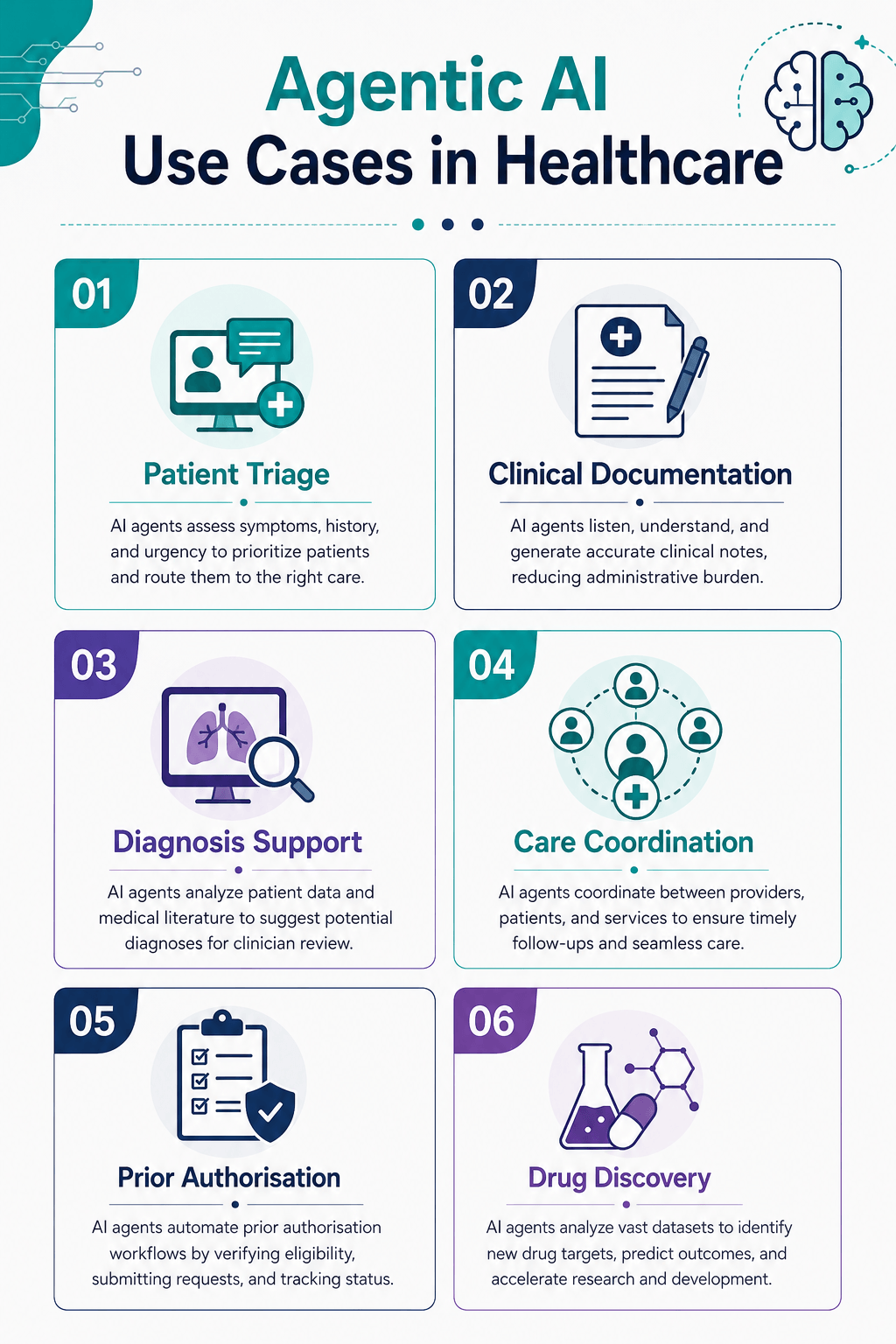
The agentic AI use cases in healthcare that are delivering measurable results in 2025 and 2026 fall into six primary categories. Each represents a workflow where autonomous multi-step execution produces faster, more consistent outcomes than human-mediated alternatives.
01. Intelligent Patient Triage and Assessment
AI agents collect symptom data, cross-reference patient history, apply clinical decision logic, and route patients to the appropriate care level, without a human manually reviewing each intake. This reduces wait times in both ED and outpatient settings and ensures high-acuity patients are identified before they deteriorate further.
02. Ambient Clinical Documentation
AI agents listen to physician-patient conversations, generate structured SOAP notes, draft referral letters, and update the EHR autonomously. The 2025 JAMA Network Open study found clinicians using ambient AI agents reduced EHR time by 8.5% with a 15% reduction in note-writing specifically, and reported burnout dropping from 52% to 39%.
03. Agentic AI in Healthcare Diagnosis and Treatment Support
Agents analyse symptom sets, lab values, imaging reports, and clinical guidelines to surface differential diagnoses and flag contraindications. Unlike a search-based clinical decision support tool, an agentic system actively updates its reasoning as new data arrives during a patient encounter.
04. Care Coordination and Follow-Up Automation
After discharge, AI agents schedule follow-up appointments, send personalised recovery instructions, monitor patient-reported outcomes, and escalate to the care team when recovery deviates from expected trajectory. This closes the post-discharge gap that accounts for a significant share of preventable readmissions.
05. Prior Authorisation and Revenue Cycle
AI agents retrieve clinical documentation, populate prior auth requests, submit to payer portals, track approval status, and manage appeals. A single well-governed agent can process hundreds of authorisations per day that would otherwise require manual staff time, reducing delays inpatient care and administrative cost simultaneously.
06. Drug Discovery and Clinical Trial Support
In life sciences, AI agents run literature searches, identify candidate molecules, map clinical trial eligibility criteria against patient registries, and coordinate protocol documentation, compressing timelines that previously took months into days.
Agentic AI in Healthcare Diagnosis and Treatment
Of all the examples of agentic AI in healthcare, the diagnostic and treatment support domain attracts the most attention and the most scrutiny. It is also where the distinction between advisory AI and agentic AI carries the greatest clinical and liability weight.
Differential Diagnosis Support
Diagnostic AI agents process structured and unstructured data simultaneously: lab values,vital signs, imaging findings, patient history, and real-time monitoring feeds. Rather than surfacing a static list of differentials, an agentic system updates its probability rankings continuously as new information becomes available during a patient encounter, functioning more like a reasoning partner than a lookup tool.
Real-Time Patient Monitoring and Deterioration Detection
AI agents monitoring ICU and step-down patients process thousands of data points per patient per hour. When an agent detects a deterioration pattern, it does not wait for the next nursing round. It initiates the rapid response protocol, notifies the appropriate clinical staff, and begins pulling the patient's relevant recent history for the responding team. This compresses the recognition-to-response window that accounts for a significant proportion of avoidable in-hospital mortality.
Drug Interaction and Contraindication Checking
Agents embedded in prescribing workflows check every new medication order against the patient's full medication list, allergy profile, renal and hepatic function, and relevant clinical guidelines in real time. Unlike static formulary checks, agentic systems can reason across complex multi-drug regimens and flag context-specific risks that rule-based systems miss.
The Human-in-the-Loop Requirement
Clinical governance for diagnostic agents requires that human oversight is built into the architecture, not added as an afterthought. For high-stakes diagnostic decisions, the current best practiceis a human-in-the-loop confirmation step before any agent-initiated clinical action. The agent surfaces the decision; the clinician approves it. This design captures the speed and analytical depth of agentic AI while maintaining the accountability required by regulatory frameworks and clinical standards of care.
We'll map the exact workflows from this article to your business - free, in 30 minutes.
Agentic AI Applications in Clinical Operations
Beyond the bedside, agentic AI applications in healthcare are transforming the operational layer of health systems: the administrative, logistical, and financial processes that consume a disproportionate share of healthcare resources relative to their direct patient impact.
Prior Authorisation Automation
Prior authorisation is one of healthcare's most damaging administrative bottlenecks: slow, labour-intensive, and a direct cause of care delays. AI agents that integrate with payer portals and EHR systems can submit, track, and appeal prior auth requests autonomously, processing in minutes what manual workflows take days. The 2025 Gartner data on health plans shows 99% of clinicians and96% of office administrators are comfortable with AI handling prior authdecisions when appropriate safeguards are in place.
Staff Scheduling and Capacity Planning
AIagents that analyse historical patient flow patterns, seasonal demand curves,and real-time occupancy data generate optimised staffing schedules that reduceboth understaffing during peak periods and overstaffing during slower ones,directly reducing agency and overtime costs.
Supply Chain and Inventory Management
Agents monitor supply consumption against patient census, project near-term demand, and initiate reorder requests autonomously. In settings where supply shortages have direct patient safety implications, this kind of continuous agentic oversight is more reliable than periodic manual audits.
Billing and Coding Accuracy
AI agents that review clinical documentation against billing codes before submission identify documentation gaps, suggest appropriate codes, and flag audit risk, reducing claim denials and improving revenue capture without increasing the compliance team headcount.
Benefits of Agentic AI in Healthcare
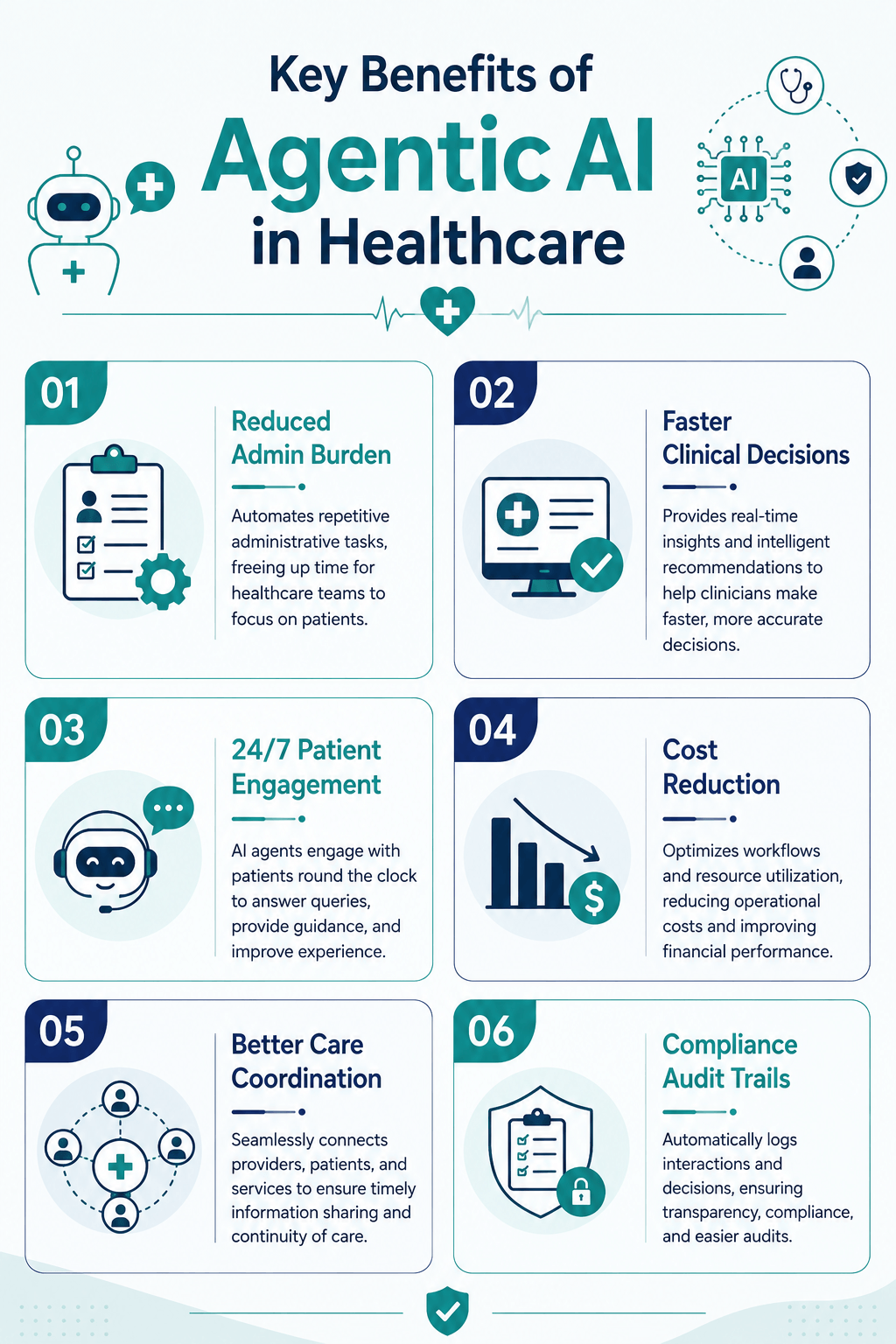
The benefits of agentic AI in healthcare span clinical, operational, and financial dimensions. The following scorecard summarises the primary value drivers across health systems deploying AI agents at scale.
1. Reduced Clinician Administrative Burden
Ambient AI agents handle documentation, prior auth, and scheduling, returning clinical time to direct patient care. Studies show clinicians using agentic documentation tools save 40-60 minutes per day on documentation alone.
2. Faster and More Consistent Clinical Decisions
Agents process multi-source patient data continuously, surfacing relevant insights at the point of care without requiring the clinician to navigate multiple systems or manually reconcile data.
3. 24/7 Patient Engagement Without Staffing Cost
Agentic patient engagement systems handle post-discharge follow-up, symptom monitoring, and care plan adherence support around the clock, at a scale that human care teams cannot match.
4. Operational Cost Reduction
Automated prior auth, revenue cycle management, and supply chain agents reduce administrative staffing costs and claim denial rates. Gartner projects 30% operational cost reduction as agentic AI matures in healthcare settings.
5. Improved Care Coordination
Agents that monitor care plans across departments and surface coordination gaps reduce the fragmentation that drives preventable readmissions and adverse events.
6. Audit Trails and Compliance
Agentic systems log every action, decision input, and outcome, providing the audit trail that manual workflows cannot reliably produce, and that regulators increasingly require.
Implementing Agentic AI in Healthcare
The path to successful implementing agentic AI in healthcare is narrower than in most industries because the consequences of getting it wrong are not just financial. The following four-step framework reflects what organisations with successful deployments have in common.
1. Define the use case with precision: Do not deploy a general-purpose agent. Start with one specific, high-volume workflow with clear success metrics: prior auth turnaround time, documentation time per encounter, or patient follow-up completion rate. Narrow scope produces faster value and cleaner governance.
2. Audit data and integration readiness: Agentic systems require clean, accessible data and deep EHR integration. Before building an agent, map which systems it needs to read from and write to, identify API availability, and resolve data quality gaps. Most deployment failures trace back to integration problems, not model problems.
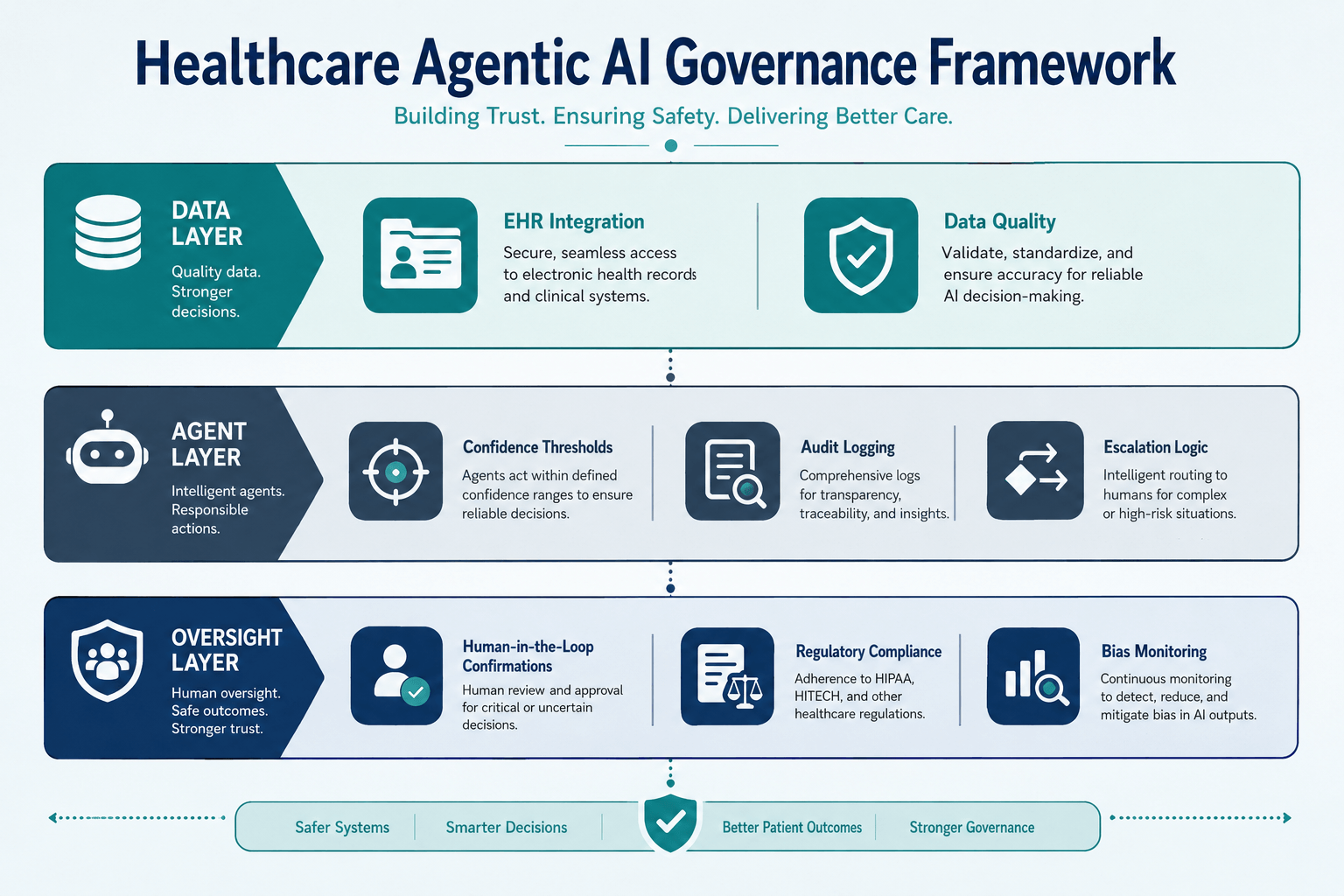
3. Design governance and human oversight architecture: Define the confidence thresholds at which an agent acts autonomously versus escalates. Build audit logging into every action. Map the regulatory requirements that apply: HIPAA for data handling, FDA AI/ML guidelines for clinical decision support, and any relevant state-level telehealth or AI regulations.
4. Run a controlled pilot before scaling: Deploy to a single department, a single use case, and a defined patient or transaction volume. Measure against your pre-defined success metrics for 60 to 90 days. Use the pilot data to refine the agent, improve escalation logic, and build clinical staff trust before expanding.
Challenges and Governance Considerations
The same capability that makes agentic AI powerful in healthcare, its ability to take autonomous action, is the source of its most significant governance challenges. Understanding these challenges before deployment is not pessimism; it is the prerequisite for responsible scaling.
Clinical Liability for Autonomous Actions
When an AI agent takes a clinical action that causes or fails to prevent harm, the question of liability is not yet fully settled in most jurisdictions. Health systems deploying agentic AI need legal frameworks that clearly define the boundaries of agent authority, the conditions under which human confirmation is required, and the documentation trail that establishes accountability.
Data Quality and Interoperability
An AI agent is only as reliable as the data it acts on. Fragmented EHRs, inconsistent data entry practices, and poor interoperability between hospital systems and payer platforms are the primary operational blockers to effective agentic deployment. These are infrastructure problems that need to be solved at the data layer before they can be solved at the AI layer.
Bias in Training Data
AI agents trained on historical clinical data inherit the biases in that data. Diagnostic agents trained predominantly on data from certain demographic groups may underperform for underrepresented populations. Governance frameworks must include ongoing bias monitoring and model validation against diverse patient cohorts.
Building Clinical Staff Trust
Clinician adoption is the rate-limiting factor in most healthcare AI deployments. Staff who do not trust an agent will override it consistently, eliminating the efficiency gains. Building trust requires transparency about how the agent makes decisions, visible evidence of its accuracy overtime, and a clear escalation path when clinicians disagree with an agent-initiated action.
For a broader view of how autonomous AI is reshaping healthcare as part of a larger digital strategy, the discussion on how agentic AI is redefining digital transformation in healthcare covers the organisational and technology transformation dimensions in depth.
Conclusion
The role of agentic AI in healthcare is shifting from optional to foundational. Organisations that are still treating AI as a collection of point tools are already operating at a disadvantage relative to health systems that have begun deploying agents across clinical and administrative workflows. The productivity gap, the quality gap, and the cost gap between these two groups will widen as agentic capabilities mature.
The imperative now is not to wait for the technology to stabilise further, it is ready, but to build the governance, data infrastructure, and clinical change management foundations that allow agentic systems to deliver value without creating new risks. Agentic AI in healthcare is not a future proposition. It is a present-day operational decision. Getting the foundation right is what separates organisations that scale it successfully from those that cancel projects after the pilot.
For organisations planning the broader infrastructure and digital strategy that underpins sustainable agentic AI deployment, a structured approach to healthcare digital transformation covering technology, operations, and governance is the right starting point.
Frequently Asked Questions
1. What is agentic AI in healthcare?
Agentic AI in healthcare refers to autonomous AI systems that plan and execute multi-step clinical and administrative workflows without human instruction at each step. Unlike traditional AI tools that produce outputs for humans to act on, agentic systems take action: scheduling follow-ups, coordinating care, processing authorisations, and flagging patient deterioration in real time.
2. What are the main agentic AI use cases in healthcare?
The leading agentic AI use cases in healthcare include intelligent patient triage, ambient clinical documentation, diagnosis and treatment decision support, post-discharge care coordination, prior authorisation automation, and operational functions such as staffing, supply chain management, and billing accuracy.
3. How does agentic AI differ from traditional healthcare AI?
Traditional healthcare AI is advisory: it generates an output and waits for a human to decide what to do. Agentic AI is actionary: it takes the next step autonomously. A diagnostic model flags a finding; an agentic system flags it, notifies the relevant clinician, pulls supporting data, and updates the patient record, all without a human initiating each step.
4. What are the risks of implementing agentic AI in healthcare?
The primary risks are clinical liability for autonomous actions, data quality failures that cause agents to act on incorrect information, bias in training data affecting diagnostic accuracy, and compliance gaps in regulated environments such as HIPAA and FDA AI/ML guidelines. All are manageable with proper governance architecture, human oversight design, and a phased deployment approach.
5. How do I start implementing agentic AI in a healthcare organisation?
Start with one specific high-volume workflow, audit your data and EHR integration readiness, design a human-in-the-loop governance model before deploying, and run a 60 to 90 day controlled pilot before scaling. The organisations that scale agentic AI successfully are those that treat the first deployment as a governed learning exercise rather than a broad rollout.
You may also want to read
What Is a Cloud Transformation Assessment? A Guide for Enterprises