The enterprises winning today are not just using AI. They are being run by it. Here is what C-suite leaders need to know about the agentic AI shift.
The conversation around AI digital transformation has shifted. A year ago, executives asked, "Should we adopt AI?" Today, the question is, "Why are our competitors moving faster?"
According to McKinsey's latest research, 65% of organizations now use generative AI in at least one business function. That is nearly double the adoption rate from 2023.
But adoption is not the same as results. Most of that 65% bolted ChatGPT onto existing workflows and called it transformation. The organizations seeing real returns? They rebuilt their operations around AI from the ground up.
Welcome to the age of agentic AI.
The Shift from AI Tools to AI Agents
For most of the past decade, AI in the enterprise meant one thing: tools. Smart tools like recommendation engines, chatbots, and predictive models. But tools all the same. Humans remained in the driver's seat, using AI to help with specific tasks.
That model is breaking down.
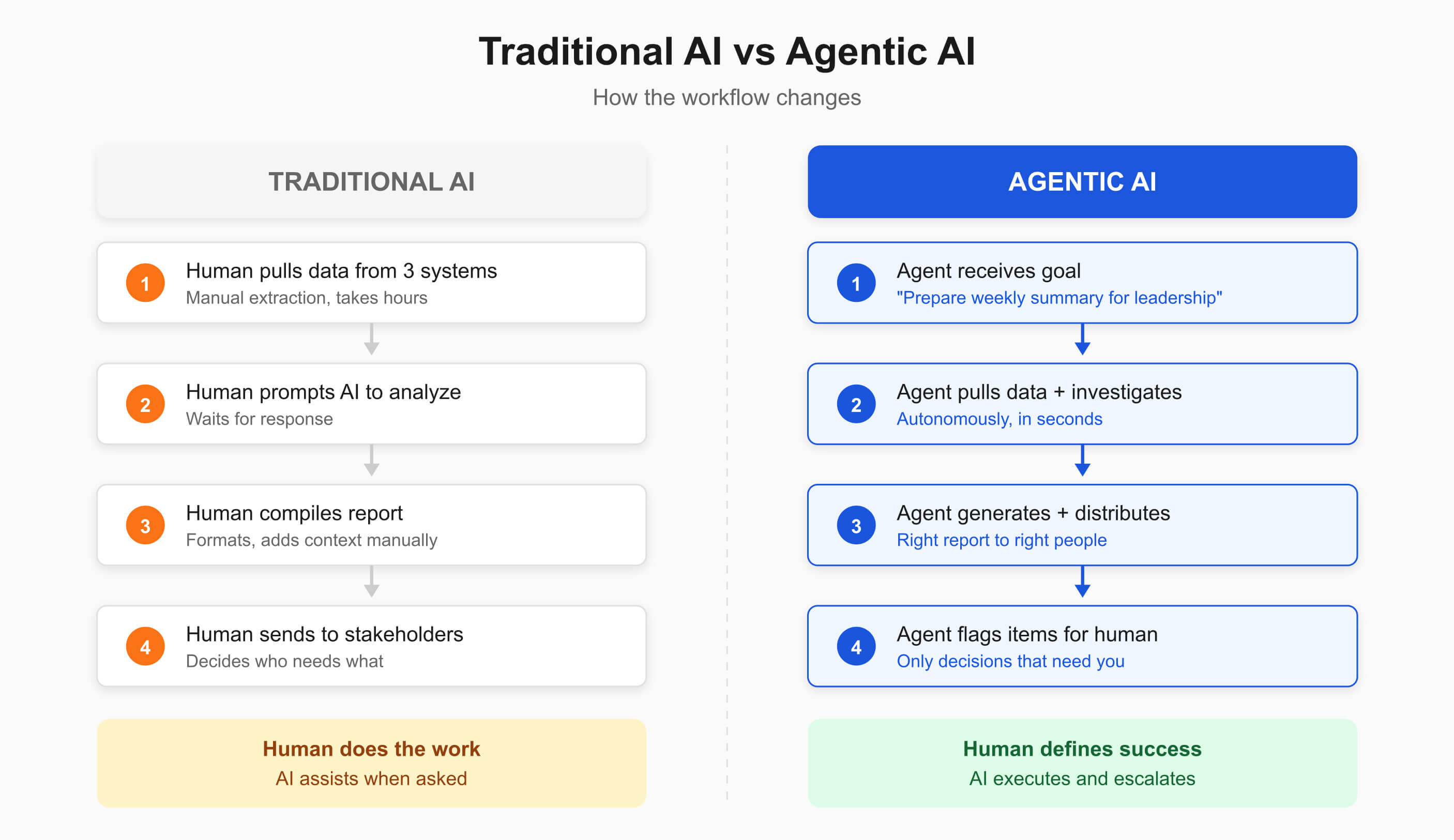
Agentic AI is a major shift from the old approach. Instead of AI that waits for prompts, agentic systems take initiative. They plan. They reason. They run multi-step workflows on their own. And increasingly, they work together in coordinated teams.
Gartner predicts that by 2028, 33% of enterprise software applications will include agentic AI, up from less than 1% today. What that means operationally: within three years, a third of your software stack could be making decisions without waiting for you to click a button.
The real shift is not technological. It is organizational.
Our engineers will audit your workflow and estimate time-to-value at no cost.
Claim your free audit
What Makes Agentic AI Different
Multi-Agent Systems: When AI Teams Up
The next evolution is already here. Rather than single agents working alone, organizations are deploying coordinated teams of specialized AI agents: one researches, one analyzes, one plans, one executes, one monitors. They communicate, divide work, and check each other.
What does this mean in practice? Processes that used to require five departments and three weeks of email chains now run in minutes. That is not incremental improvement. That is a different way of operating.
Industry Applications: Where Agentic AI Delivers Results
The agentic AI transformation is not theoretical. Organizations across industries are already deploying these systems to solve real operational challenges.
Healthcare: From Administrative Burden to Patient Focus
Healthcare organizations lose an estimated 30% of physician time to administrative tasks. Documentation, prior authorizations, care coordination. Necessary work that pulls clinicians away from patients.
Agentic AI is changing that equation.
Leading health systems are deploying agent networks that handle the administrative complexity on their own. A patient scheduling agent coordinates with an insurance verification agent, which communicates with a prior authorization agent, which updates the clinical documentation agent. The physician sees a streamlined summary and makes clinical decisions. The paperwork handles itself.
One academic medical center reduced prior authorization processing time from 14 days to 36 hours using an agentic approach. More importantly, clinicians report spending 40% more time in direct patient interaction. That is what the stat actually means: doctors doing doctor work instead of paperwork.
Clinical research is seeing the same shift. Agentic systems monitor trial protocols, flag adverse events, and adjust recruitment strategies on the fly. Drug development timelines that once stretched years are compressing into months.
FinTech: Real-Time Risk in a Real-Time World
Financial services have used AI for fraud detection for years. The problem: traditional systems could flag suspicious activity, but humans still had to investigate and act. By then, the money was gone.
Agentic AI closes that gap. Modern fraud agents do not just flag anomalies. They investigate: pulling account history, checking device fingerprints, verifying merchant patterns. Decision in milliseconds. Action taken before the fraudster finishes typing.
Lending is shifting too. Credit decisions that required manual underwriter review now flow through agent networks. Pull data, verify employment, assess property, structure terms. Banks report 60% lower operational costs for routine decisions, no increase in defaults.
The human underwriters still exist. They just stopped wasting time on obvious approvals.
Logistics: Orchestrating Complexity at Scale
Supply chain operations involve thousands of interdependent decisions daily. Which routes to prioritize. How to allocate warehouse capacity. When to reorder inventory. How to respond when a shipment is delayed.
Traditional optimization software handles these decisions fine when everything goes according to plan. When does everything go according to plan? Never.
Agentic AI brings adaptability to supply chain operations. Instead of optimizing for a single scenario, agent networks continuously monitor conditions and adjust in real-time.
When a port delay affects inbound shipments, the logistics agent network responds on its own: rerouting downstream deliveries, adjusting production schedules, notifying affected customers, rebooking carrier capacity, and updating financial forecasts. Actions that once required emergency conference calls and manual coordination happen automatically, often before human operators are aware of the disruption.
A global manufacturing company implemented an agentic supply chain system and reduced stockouts by 34% while simultaneously cutting inventory carrying costs by 21%. The agents did not just optimize. They learned. Each disruption made the system smarter about predicting and preventing the next one.
We'll map the exact workflows from this article to your business - free, in 30 minutes.
The Implementation Reality: What Actually Works
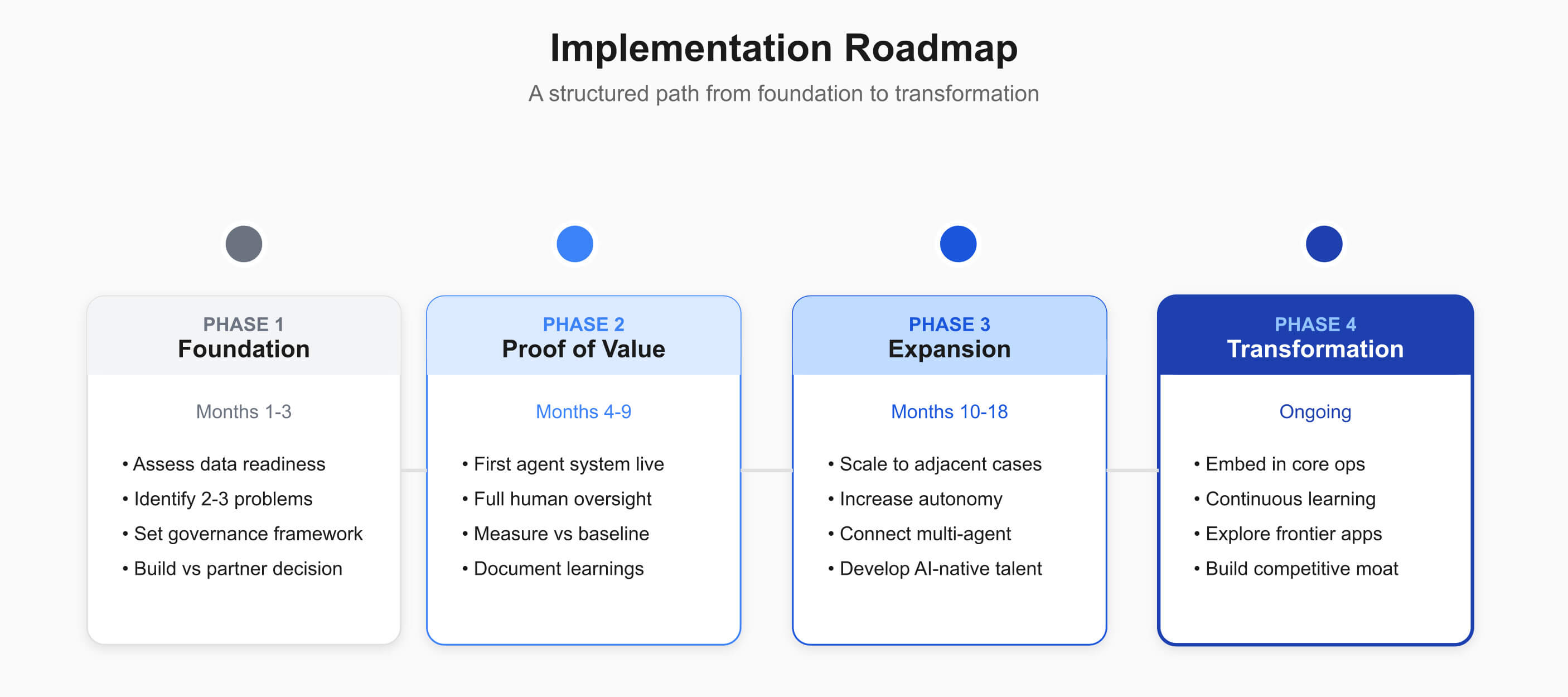
The Build vs. Partner Decision
Every executive facing AI transformation confronts the same question: should we build this capability internally or partner with specialists?
The honest answer depends on your situation.
Internal teams bring irreplaceable advantages: deep understanding of business context and constraints, existing relationships with stakeholders, long-term commitment to the organization's success, and accumulated institutional knowledge. For AI applications that are core to competitive differentiation, internal development often makes sense.
Partners address real limitations that internal teams face: AI talent is scarce and expensive to recruit, technology evolves faster than hiring cycles, initial implementations require experience that does not exist yet, and there is real opportunity cost in learning curves. Partners who have implemented agentic systems across multiple organizations bring pattern recognition that accelerates deployment. They have seen what works, what fails, and why. They can anticipate problems that would blindside a first- time implementation.
But not all partners are equal. Many consultancies and dev shops have added "AI capabilities" to their pitch decks. Look closer and you often find machine learning grafted onto the same old approaches.
AI-native is different. These firms build with AI as the foundation, not the afterthought. Their architectures assume agentic capabilities from the start. Their teams have broken things, fixed things, and shipped things that actually run in production.
When evaluating partners, the questions that matter:
- How long have you been building agentic systems specifically?
- What is your approach to human-AI collaboration design?
- How do you handle AI governance and risk management?
- Can you show me systems you have built that are actually running in production?
The answers reveal whether you are talking to a firm that does AI or a firm that is AI.
The Cost of Waiting
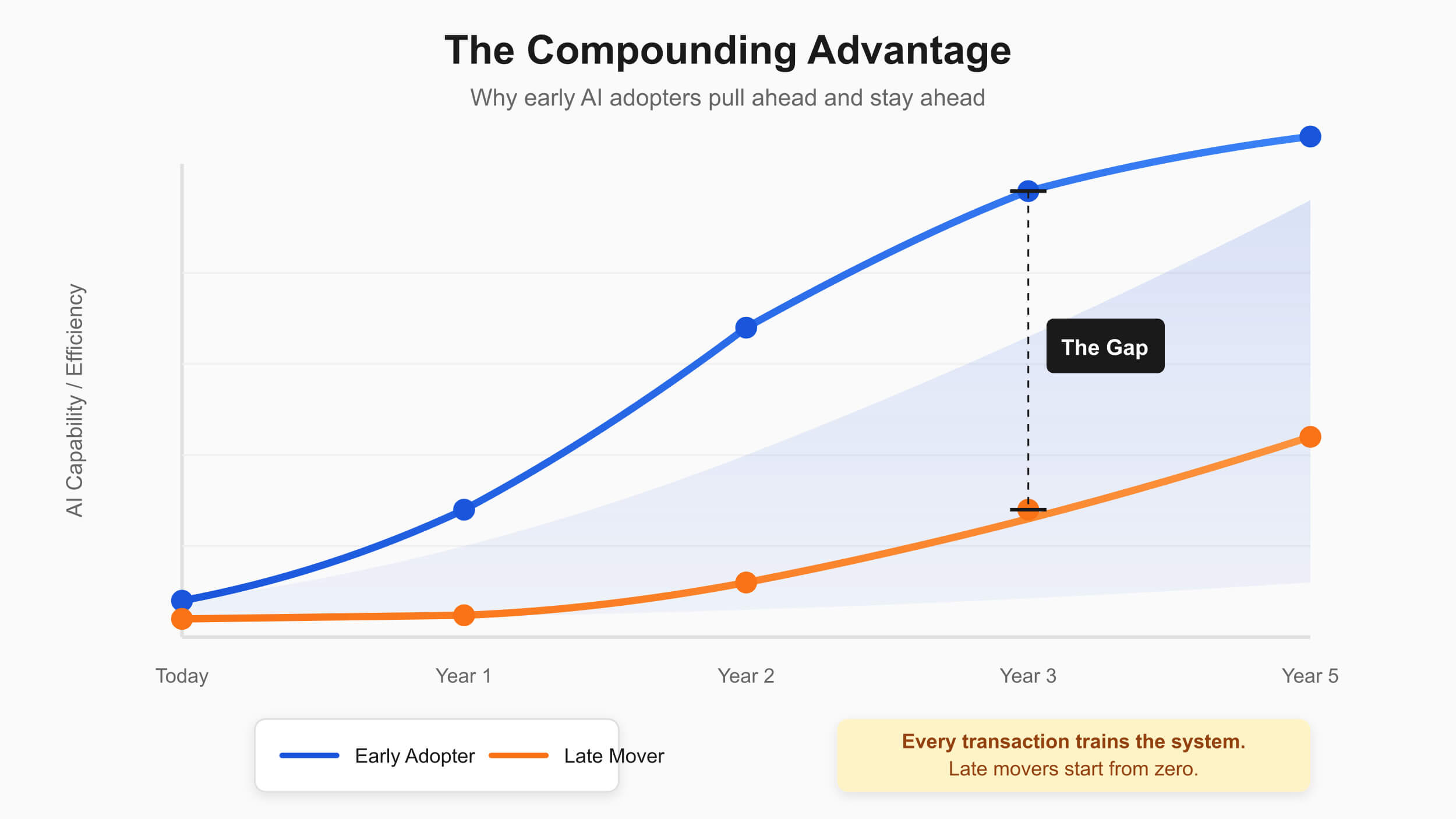
ERP systems are commodities. If your competitor implements one, you can catch up.
AI is different. Agentic systems learn from every transaction, every decision, every outcome. Early movers build advantages that late movers cannot close.
MIT Sloan research shows top AI adopters generate 50% higher profit margins than peers. That is not a rounding error. That is a different business.
Moving Forward: A Practical Framework
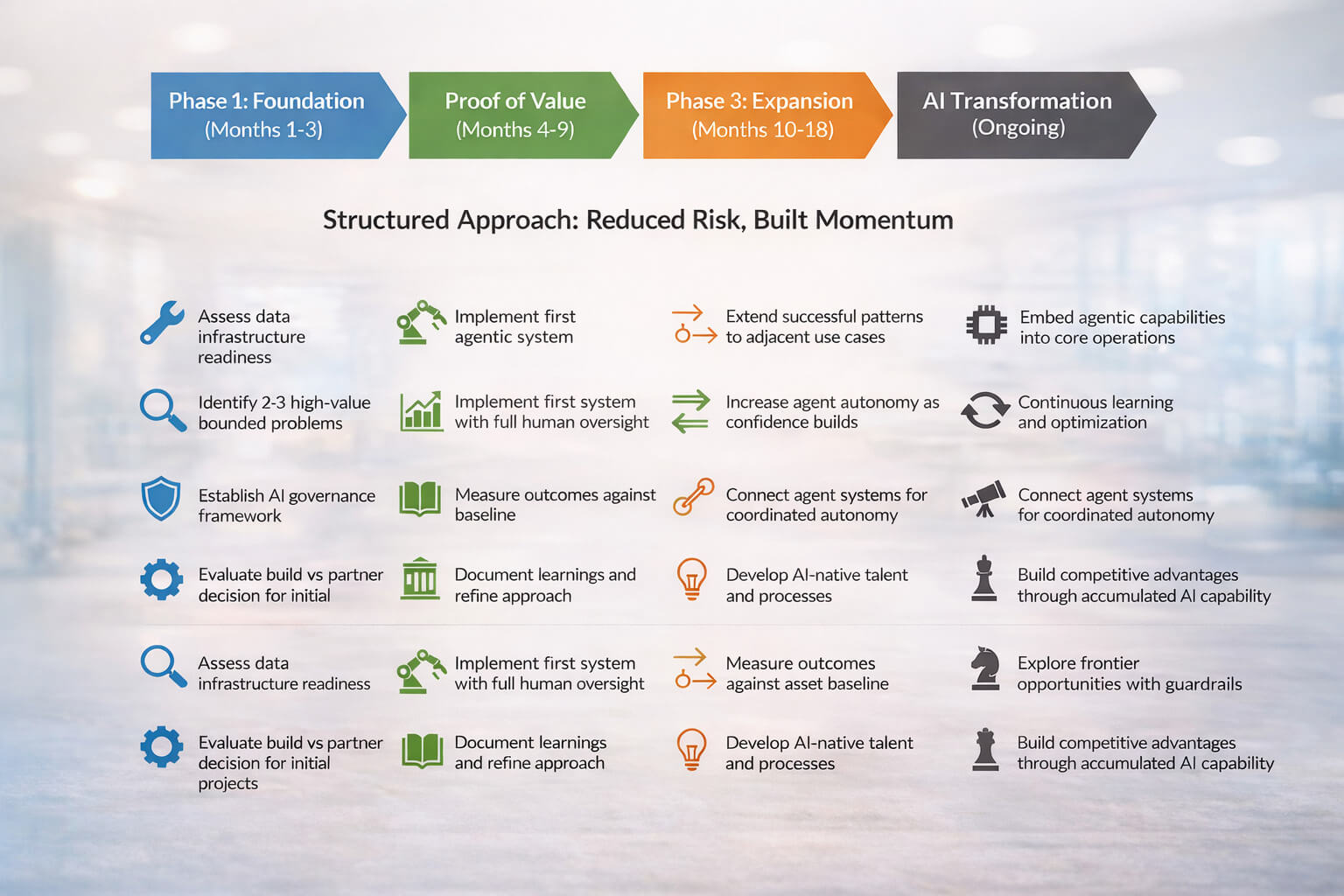
The Conversation Worth Having
AI digital transformation is no longer optional for enterprises that intend to compete over the next decade. The shift from AI tools to agentic AI systems is the most significant operational change since cloud computing. Maybe since the internet.
The organizations navigating this successfully have one thing in common: they are not trying to figure it out alone.
Pace Wisdom has delivered AI-native solutions across 100+ projects with a team of 250+ engineers. Healthcare, fintech, logistics. We have built systems that work and, honestly, systems that did not work the first time. One early healthcare project taught us that agents without proper escalation paths create more problems than they solve. The system was flagging everything as urgent, clinicians started ignoring alerts, and a real issue got buried in the noise. We rebuilt the entire human-oversight layer from scratch. That lesson now shapes every implementation we do.
We do not bolt AI onto existing approaches. We engineer systems where intelligence is foundational. And we know what breaks, because we have broken it.
If you are evaluating how agentic AI fits into your transformation strategy, we should talk. Not a pitch deck. A real conversation about where you are and whether we can actually help.
You may also want to read