
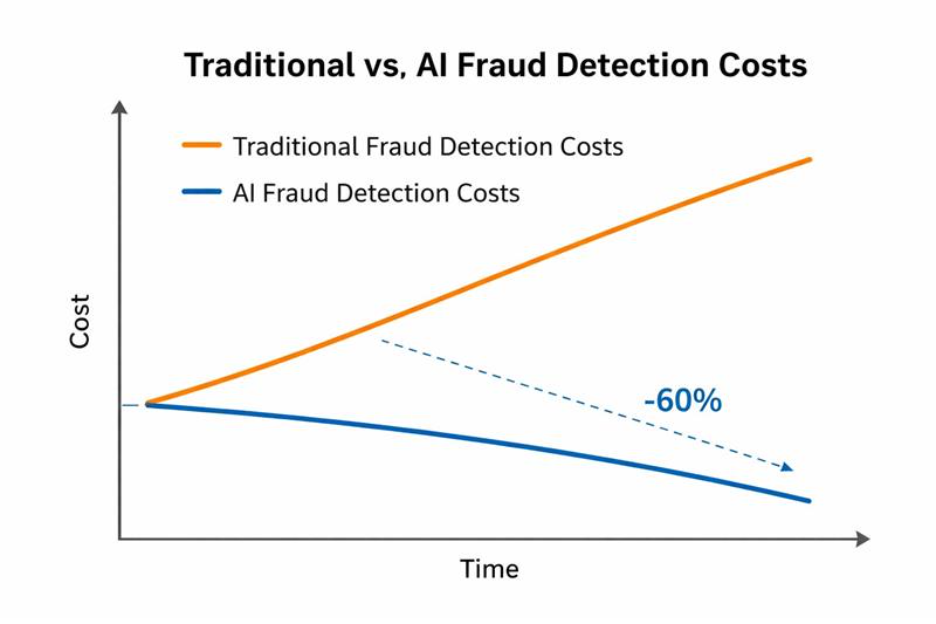
Fraud losses in fintech now exceed $10 billion annually, with traditional rule-based systems generating excessive false positives that overwhelm investigators and erode customer trust. AI fraud detection in fintech promises 60% cost reductions by replacing rigid rules with adaptive behavioral models that catch sophisticated attacks in real-time while minimizing legitimate transaction friction.
Fintech CTOs can achieve this through transaction anomaly detection, GenAI risk scoring, and cloud-native fraud systems that scale without proportional cost increases.
The Evolving Fraud Landscape in Fintech
Why Rules-Based Systems Are Failing
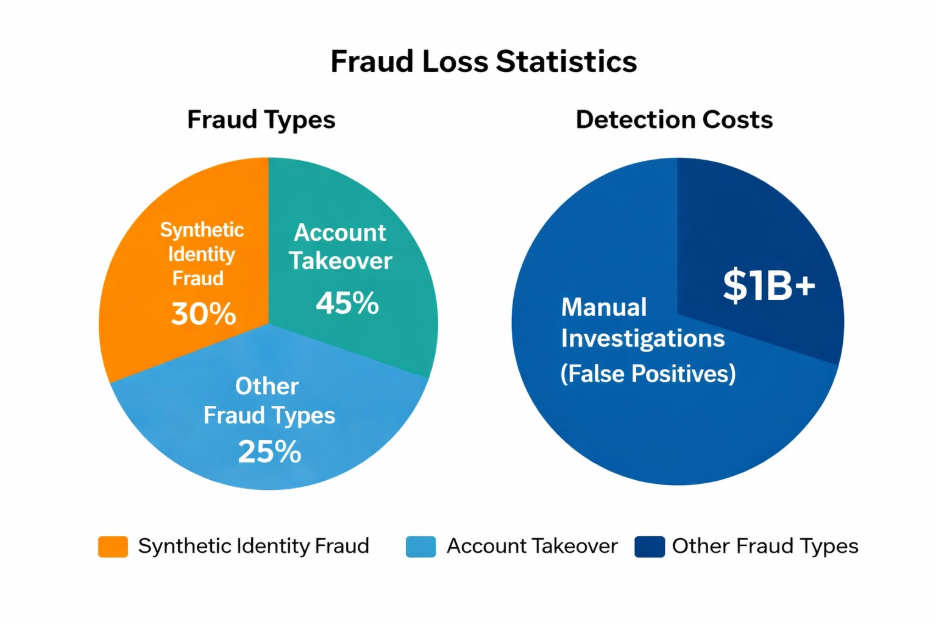
Legacy fraud detection relies on static rules that trigger alerts based on predefined thresholds like transaction amount or velocity. Fraudsters easily bypass these by testing small transactions or using stolen legitimate accounts, while the systems generate 90-95% false positives that require expensive manual review.
Scale of the Problem
Fintechs processing billions of transactions daily across payments, lending, and crypto with digital lending platforms and digital banking app development services at the forefront face fraud rates averaging 1-2% but losses concentrated in sophisticated attacks like account takeover and synthetic identity fraud. Manual investigation costs $5-10 per alert, making false positives a $1B+ annual burden across the industry.
Our engineers will audit your workflow and estimate time-to-value at no cost.
Claim your free audit
AI Anomaly and Behavioral Modeling: The Next Generation
Beyond Rules – Learning from Patterns
AI fraud detection in fintech models analyze hundreds of behavioral signals - device fingerprinting, geolocation velocity, spending patterns, and peer group comparisons to establish baseline user behavior and flag deviations in milliseconds. Graph neural networks uncover hidden relationships between accounts, merchants, and IP addresses that rules miss entirely.
GenAI for Risk Scoring and Investigation
GenAI risk scoring accelerates investigations by summarizing transaction histories, generating hypotheses for suspicious patterns, and drafting case notes for analysts. Risk scores combine supervised ML with unsupervised anomaly detection, enabling dynamic thresholds that adapt to fraud evolution without manual tuning.
Proven Results
PayPal reports fraud rates under 0.17% using AI, while Mastercard's adaptive models process billions of transactions with sub-second decisions. False positives drop 30-40%, directly slashing manual review costs.
Real-Time Streaming Pipelines for Millisecond Decisions
Cloud-Native Event Streaming
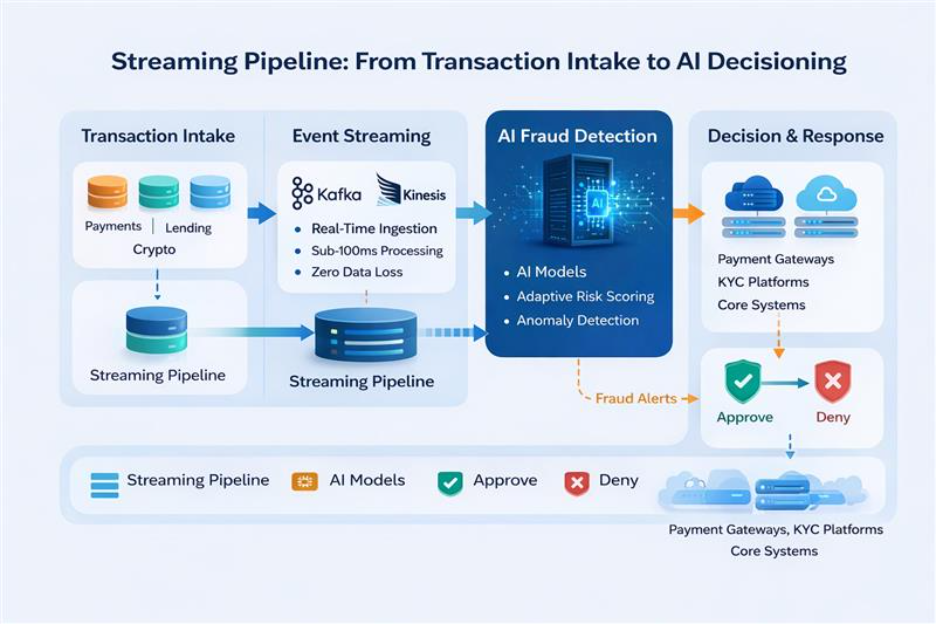
Apache Kafka or AWS Kinesis streams transaction events to AI models with zero data loss and sub-100ms latency, enabling approve/decline decisions before funds move. Serverless Lambda functions invoke models only for high-risk transactions, avoiding unnecessary computation on routine flows.
Edge and Hybrid Deployment
Cloud-native fraud systems deploy lightweight models at the edge for instant low-risk decisions, reserving heavy graph analysis for the cloud. Kubernetes orchestrates scaling across regions to handle peak volumes without overprovisioning.
Integration with Core Systems
Seamless APIs connect AI fraud detection in fintech scoring to payment gateways, digital KYC and onboarding solutions, and case management tools, creating unified workflows that reduce handoffs and delays.
We'll map the exact workflows from this article to your business - free, in 30 minutes.
Cost Benefits Through GPU and Compute Optimization
Rightsizing AI Workloads
Transaction anomaly detection models rarely need massive GPUs; optimized TensorFlow Serving or ONNX Runtime runs inference on CPU/GPU hybrids, cutting costs 70% compared to overprovisioned clusters. Spot instances handle model retraining overnight, while caching reduces repeated feature engineering.
Quantifiable Savings Breakdown
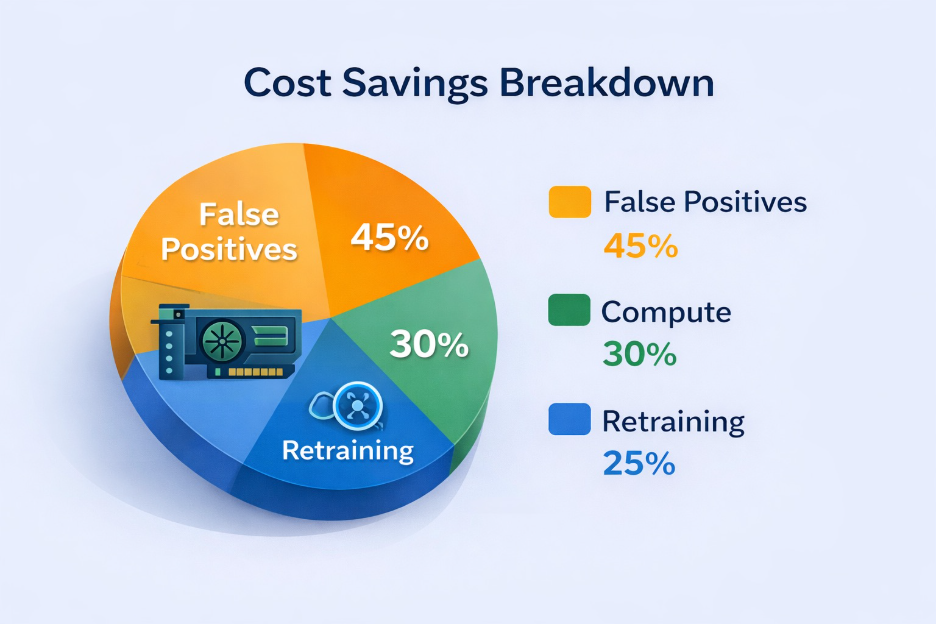
- False positive reduction: 30-40% fewer investigations at $5-10 each = $3-4M annual savings for mid-sized fintechs.
- Streaming efficiency: Serverless eliminates idle compute, saving 50-70% on monitoring infrastructure.
- Retraining optimization: Automated pipelines retrain only on drift-detected data, reducing ML Ops costs 60%.
Total 60% Reduction Achievable
Combined, cloud-native fraud systems deliver 60% net cost reduction: from $12M baseline to $4.8M, with fraud losses dropping an additional 50%.
Regulatory Considerations for AI Fraud Systems
Explainability and Auditability
Regulators demand transparency: XAI techniques like SHAP values explain model decisions, while decision logs capture every feature and score for audits. Model cards document training data, drift monitoring, and performance metrics for ongoing compliance with RegTech compliance solutions.
Fairness and Bias Mitigation
Continuous monitoring detects model drift or bias amplification, with automated retraining on diverse datasets to maintain fairness across demographics. Human-in-the-loop escalation ensures high-stakes decisions remain accountable.
Global Compliance Mapping
Cloud-native fraud systems tag transactions by jurisdiction, applying region-specific thresholds and reporting formats automatically.
Implementation Roadmap for Fintech CTOs
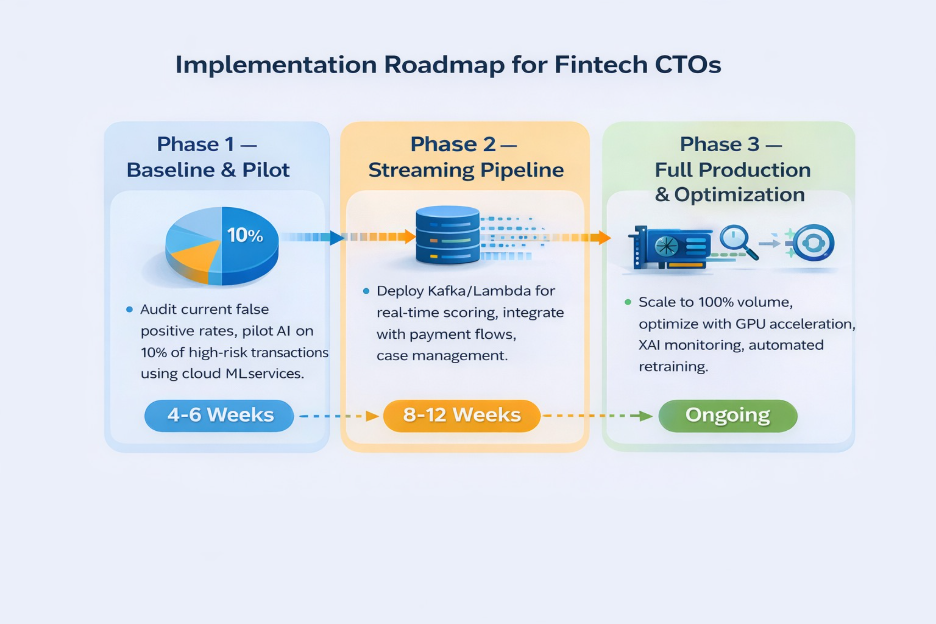
Pace Wisdom Solutions accelerates this journey with fintech IT consulting services expertise in cloud-native fraud systems, combining AI fraud detection in fintech, real-time pipelines, and RegTech compliance solutions to deliver your 60% cost reduction.
Conclusion: The Competitive Edge Awaits
AI fraud detection in fintech moves beyond cost savings to create defensible moats through superior accuracy, speed, and customer experience. Transaction anomaly detection and GenAI risk scoring enable 60% operational reductions while catching attacks rules-based systems miss.
Fintechs acting now will dominate 2026 payments, lending, and crypto markets through fintech digital transformation. Partner with proven experts to build cloud-native fraud systems that scale securely and profitably.
You may also want to read

What Is a Cloud Transformation Assessment? A Guide for Enterprises