GenAI in digital lending refers to the use of Generative AI to automate loan workflows, assess credit risk, detect fraud, and speed up lending decisions. It replaces slow, manual processes with intelligent systems that read documents, analyze borrower data, and deliver faster, more accurate outcomes for both lenders and borrowers.
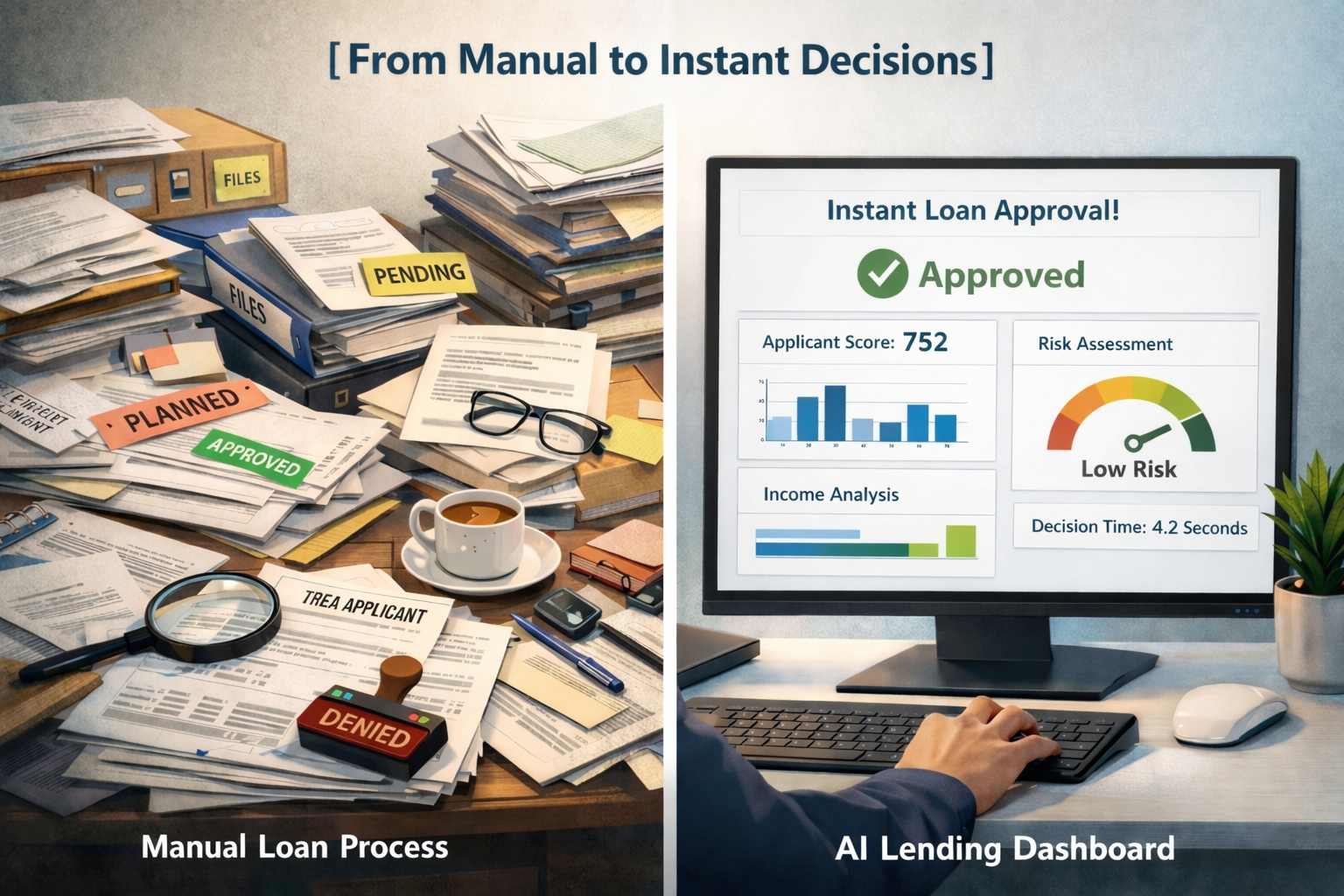
Traditional lending is slow by design. Applications sit in queues. Underwriters review stacks of documents. Approvals take days or weeks. GenAI in digital lending changes this by processing applications in real time, surfacing risk signals instantly, and helping financial teams make smarter decisions with far less manual effort.
This blog covers how generative AI in financial services is transforming loan origination, underwriting, risk management, and fraud detection. It also looks at the real-world benefits, common challenges, and what comes next. For broader AI context, see our guide on Generative AI vs Agentic AI.
What Is GenAI and How Does It Apply to Lending?

Our engineers will audit your workflow and estimate time-to-value at no cost.
Claim your free audit
Understanding Generative AI in Simple Terms
Generative AI refers to AI systems that can read, understand, and generate human-like content from complex inputs. Unlike traditional AI that follows fixed rules (for example, reject if credit score is below 650), GenAI can reason across unstructured data like bank statements, scanned documents, and employment letters to draw nuanced conclusions.
In lending, this capability is transformative. Here are the key applications of AI-powered digital lending:
- Automated extraction of data from uploaded financial documents
- Personalized loan product recommendations based on borrower profiles
- Natural language responses to borrower questions via AI chatbots
- Dynamic risk scoring using alternative and traditional data sources
From Manual Processes to AI-Driven Lending
The lending industry has transformed steadily over the past two decades:
- Early 2000s: Paper applications, manual underwriting, weeks of processing time
- 2010s: Online application portals arrived, but back-end processes stayed largely manual
- 2020s: GenAI becomes the true game changer, processing complex financial data at a speed and accuracy humans cannot match
As explored in Provectus's analysis of Generative AI in finance, financial institutions using GenAI are accelerating decisions and building greater trust with borrowers through transparency and speed.
For financial institutions ready to modernize, our custom software development for enterprises provides the technical expertise to build and deploy production-ready GenAI lending solutions.
AI-driven credit decisioning also makes outcomes more consistent. A well-trained GenAI model applies the same logic across every application, reducing the kind of subjective variation that can creep into human-led underwriting.
Enhancing Risk Management with GenAI
AI Credit Risk Assessment
Traditional credit scoring depends heavily on historical credit bureau data. This approach excludes a large segment of creditworthy borrowers: young professionals, freelancers, and small business owners who have strong finances but limited credit history.
GenAI-powered AI credit risk assessment takes a broader view:
- Analyzes cash flow patterns directly from bank statements
- Evaluates employment stability using HR letters and tax documents
- Incorporates alternative data such as utility payments, rental history, and digital transaction behavior
- Generates a composite risk score that is more predictive than traditional FICO scoring alone
The outcome is higher approval rates for qualified borrowers who were previously overlooked, and lower default rates for lenders. Both sides benefit.
AI Fraud Detection in Lending
Fraud is a serious and growing challenge in digital lending. As more loan applications move online, bad actors exploit gaps using synthetic identities, forged documents, and coordinated fraud schemes.
AI fraud detection in lending is where GenAI proves especially effective:
- Detects anomalies in real time, including mismatched document metadata, inconsistent fonts, and unusual geographic or device patterns
- Identifies synthetic identities by cross-referencing data points that appear valid individually but are inconsistent when viewed together
- Continuously learns from new fraud patterns, adapting to evolving tactics without requiring manual rule updates
According to Biz2x's analysis of GenAI in fraud detection, GenAI systems can flag potentially fraudulent applications with high precision, reducing false positives that frustrate genuine borrowers while still catching bad actors effectively.
A real-world example: A loan application arrives with a valid-looking pay stub. GenAI cross-references the employer tax ID, the document font metadata, the applicant's IP address, and device fingerprint simultaneously. If the data does not add up, the application is flagged as high risk in milliseconds, before any human reviewer ever sees it.
We'll map the exact workflows from this article to your business - free, in 30 minutes.
Key Benefits and Real-World Impact

Faster Decisions, Lower Costs, Better Experiences
For Lenders
- 30 to 50 percent faster loan approval cycles
- Lower cost per loan through end-to-end workflow automation
- Reduced default rates driven by more accurate risk models
- Scalable operations that handle more applications without proportional headcount growth
For Borrowers
- Near real-time decisions rather than multi-day waits
- Fairer access to credit for thin-file and non-traditional applicants
- Transparent and explainable decisions that meet regulatory standards
- Consistent support available 24/7 through AI-powered communication tools
Challenges and How to Address Them
Adopting GenAI in lending comes with real challenges. Here is how responsible lenders are handling them:
- Bias and Fairness: GenAI models can reflect bias from historical training data. Regular audits, diverse datasets, and human review loops for edge cases help keep models fair
- Regulatory Compliance: Lending is heavily regulated under frameworks like ECOA, FCRA, and GDPR. Explainable AI architectures provide the audit trail regulators require
- Data Privacy: Borrower data is sensitive. End-to-end encryption, role-based access controls, and on-premise deployment options protect it
- Model Drift: AI models can lose accuracy over time as market conditions change. Continuous monitoring and scheduled retraining pipelines address this
The Future of GenAI in Digital Lending
Emerging Trends and Predictions
The next phase of GenAI in digital lending will be shaped by several converging trends:
- Agentic AI Integration: Moving beyond single-task GenAI to autonomous agents that manage entire loan workflows end to end, from application intake through to closing
- Hyper-Personalization: AI systems that tailor loan products, interest rates, and repayment schedules to individual borrower behavior in real time
- Embedded Lending: GenAI enabling frictionless loan offers at the point of purchase across e-commerce, healthcare, and B2B platforms
- Proactive Compliance AI: AI that monitors regulatory changes automatically and updates decision logic without requiring manual intervention
- Federated Learning: Lenders sharing model improvements without sharing raw borrower data, improving AI accuracy while preserving privacy
- Lenders who invest in AI-powered digital lending infrastructure today will be the ones setting the benchmark for the industry in the years ahead.
Conclusion
GenAI in digital lending is already reshaping how loans are processed, underwritten, risk-assessed, and fraud-protected. From cutting approval timelines by 30 to 50 percent to detecting synthetic identity fraud in milliseconds, the results are measurable and growing.
At Pace Wisdom, we work with financial institutions to build and deploy custom software solutions for enterprises leading that are production-ready, compliant, and built to scale with your business...
Frequently Asked Questions (FAQs)
Q1. What is GenAI in digital lending?
GenAI in digital lending is the use of Generative AI to automate and improve loan workflows, including origination, underwriting, credit risk assessment, and fraud detection. It enables lenders to make faster, more accurate decisions while reducing reliance on manual processes.
Q2. How does GenAI improve credit risk assessment in lending?
GenAI-powered AI credit risk assessment goes beyond traditional credit bureau scores. It analyzes bank statements, employment records, and alternative financial data to build a more complete and accurate picture of borrower risk, which leads to better approval rates and fewer defaults.
Q3. Can GenAI detect loan fraud effectively?
Yes. AI fraud detection in lending uses GenAI to spot anomalies in real time, including synthetic identities, forged documents, and suspicious behavioral patterns. It is significantly more effective than rules-based fraud systems because it learns and adapts continuously.
Q4. How much faster are loan approvals with GenAI?
According to Provectus's research on GenAI in financial services, lenders using GenAI in their credit processes report 30 to 50 percent faster approval times. Some digital-first lenders achieve near-instant decisions on straightforward applications.
Q5. Is GenAI lending technology compliant with financial regulations?
Yes, when built correctly. Explainable AI frameworks ensure that every lending decision made by a GenAI model is transparent, documented, and auditable. This supports compliance with ECOA, FCRA, GDPR, and other financial regulations. Compliance should be built into the AI architecture from the start, not added as an afterthought.
Q6. What is the difference between GenAI and Agentic AI in lending?
GenAI handles specific tasks such as document analysis, risk summarization, or borrower communication. Agentic AI takes this further by managing multi-step workflows autonomously with minimal human input. Read our detailed comparison here: Generative AI vs Agentic AI: Key Differences.
Q7. How can Pace Wisdom help with GenAI in digital lending?
Pace Wisdom offers end-to-end custom software development for enterprise lending covering everything from GenAI strategy and system design through to deployment and ongoing model management. We help financial institutions build compliant, scalable lending solutions tailored to their specific workflows and regulatory environment.
You may also want to read

What Is a Cloud Transformation Assessment? A Guide for Enterprises