
GenAI in manufacturing is helping plant managers reduce manufacturing downtime by up to 35 percent by giving operational teams the ability to predict and prevent equipment failures before they occur.
The losses that AI prevents are rarely dramatic. They are the 47 minutes of unplanned downtime on a Tuesday afternoon. The conveyor stopped because no one caught the early warning signs. These are quiet, repeated, and entirely preventable failures that compound across every shift.
This article explains how LLMs on the shop floor detect failure patterns, generate plain-language maintenance alerts, and deliver a measurable reduction in downtime that traditional analytics cannot match.
What Is GenAI and Why Does It Matter on the Shop Floor?
Traditional manufacturing analytics tells you what happened. GenAI in manufacturing tells you what is about to happen and what to do about it. Large language models can process unstructured data simultaneously: maintenance logs, technician notes, equipment manuals, sensor readings, and shift reports. They surface patterns that no fixed dashboard was configured to catch, because they were never built on rigid, pre-programmed rules.
The shift is from reactive to predictive. From reporting to reasoning. That distinction is what separates a 35 percent downtime reduction from incremental gains.
Our engineers will audit your workflow and estimate time-to-value at no cost.
Claim your free audit
How GenAI Reads and Reasons Across Shop Floor Data?
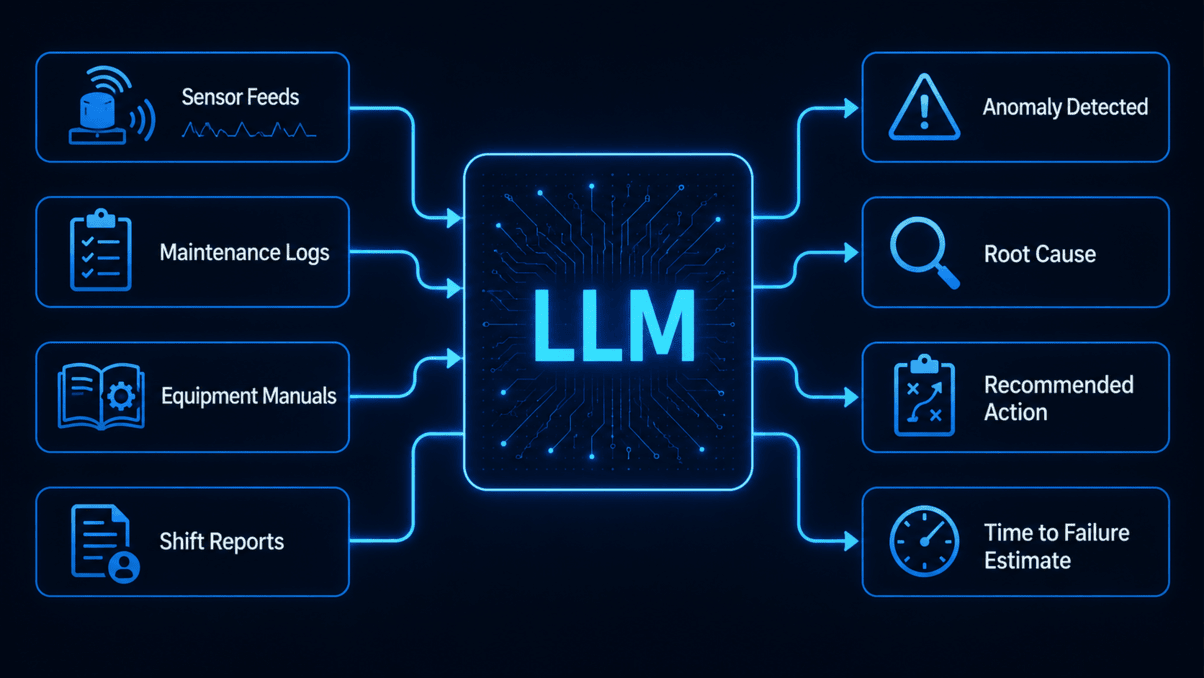
The architecture is straightforward. LLMs in manufacturing are fine-tuned on plant-specific data: historical downtime records, equipment specifications, maintenance schedules, and real-time sensor feeds. They learn what normal looks like for each machine, each line, and each shift pattern. When something deviates, they flag it, explain why, and recommend a course of action in plain language that any technician can act on immediately. This is what distinguishes them from rule-based alert systems that require someone to have configured the right threshold in the first place.
Deploying generative AI and LLM development services for this kind of industrial use requires connecting LLMs to existing operational systems without disrupting current workflows, and that integration layer is what determines whether the AI delivers actionable outputs or just more data to review.
How LLMs in Manufacturing Cut Downtime by 35%?
The 35 percent figure comes from real deployments of AI on the shop floor where language models are actively integrated with SCADA systems, MES platforms, and maintenance databases. Here is how the reduction is achieved.
Predictive Maintenance with AI
Predictive maintenance with AI powered by LLMs works by continuously analyzing patterns across machine telemetry, maintenance logs, and operational history. When a motor's vibration signature begins to drift, or a pressure valve shows a pattern that preceded a failure six months ago on a similar unit, the model flags it before the breakdown occurs. The cost difference is significant: planned maintenance typically costs three to ten times less than emergency repair combined with production loss.
This is where the majority of the 35 percent downtime reduction is achieved. Failures that previously arrived without warning now come with a 48 to 72 hour lead time and a recommended action.
Real-Time Fault Detection and LLM Powered Maintenance Alerts
LLM powered maintenance alerts go well beyond standard threshold notifications. Instead of a generic system warning, the technician receives a plain-language message: Pump 4B is showing a vibration pattern consistent with bearing wear. Based on historical data, the estimated time to failure is 48 to 72 hours. Recommended action: inspect during the next scheduled break and order replacement bearings now.
That is actionable intelligence. Not a dashboard number that requires interpretation. That is what reduces manufacturing downtime at scale.
Step-by-Step: How an LLM Handles a Machine Alert
From sensor signal to maintenance action, the full flow in real time:
- Sensor data from the production line feeds into the LLM continuously in real time.
- The model cross-references current readings with historical failure patterns for that equipment.
- An anomaly is identified and its severity, likely cause, and urgency are assessed automatically.
- A plain-language alert is generated and sent to the relevant technician immediately.
- The alert includes a recommended action, parts list, and estimated repair window.
- Maintenance is scheduled before the failure occurs, keeping the production line running.
No manual log review. No missed warning. No unplanned line stop.
We'll map the exact workflows from this article to your business - free, in 30 minutes.
With vs Without GenAI: Performance Comparison

Key Use Cases of GenAI on the Shop Floor
Predictive maintenance is the highest-impact starting point, but GenAI in manufacturing applies across the full operational lifecycle of a plant. Here are the three use cases delivering the most consistent results.
AI on the Shop Floor for Quality Control
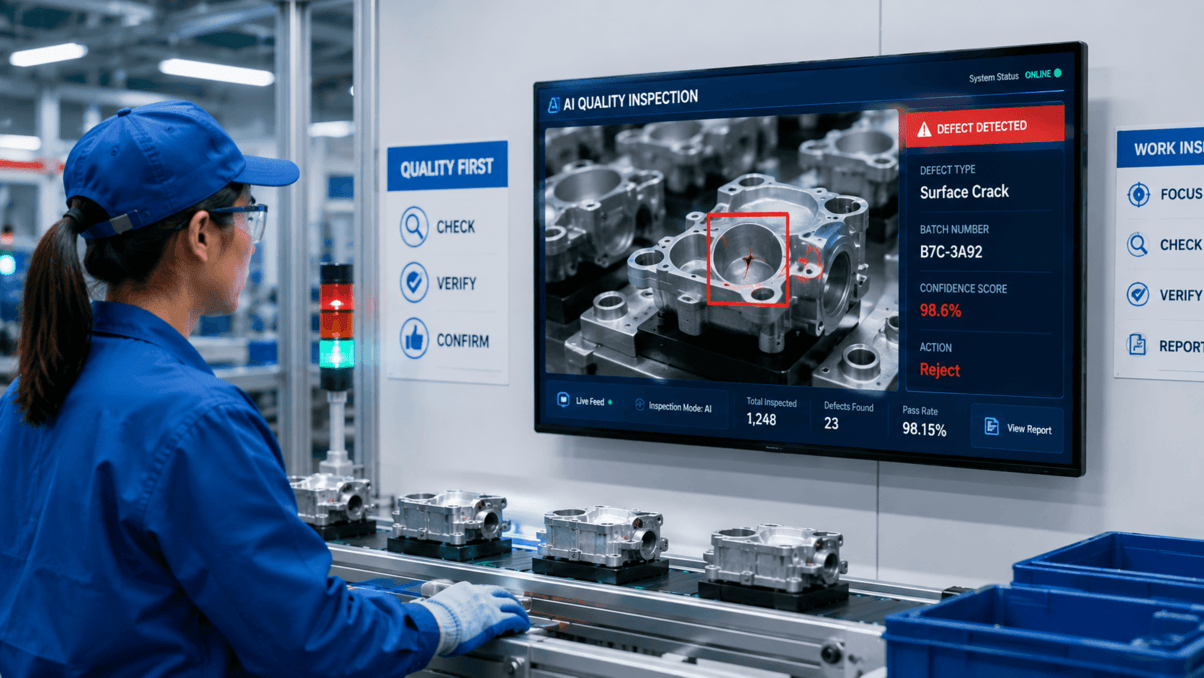
AI on the shop floor applied to quality control allows LLMs to analyze inspection data, production parameters, and defect logs simultaneously. They identify which combination of variables, including line speed, temperature, material batch, and operator shift, is correlated with quality issues. This is something no fixed rule set can do without having been pre-programmed for every possible failure mode. The result is fewer rejects, less rework, and a quality signal that improves continuously as the model processes more production data.
Manufacturing AI Automation for Production Scheduling
Manufacturing AI automation extends naturally to production scheduling and changeover optimization. LLMs can reason across demand forecasts, current inventory levels, machine availability, and upcoming maintenance windows to recommend production sequences that minimize idle time and maximize throughput. This is the operational equivalent of having a highly experienced production planner available at all times, without the dependency on any single person's availability.
Knowledge Transfer and Workforce Support
One of the most underestimated applications of generative AI for industrial use is knowledge transfer. When experienced engineers retire, decades of operational knowledge walks out with them. LLMs fine-tuned on their documentation, troubleshooting notes, and historical decisions preserve that knowledge in a queryable form. A new technician can ask: what does this error code typically indicate on Line 3 and how was it resolved last time? The model answers from the plant's actual history, not a generic manual.
Manufacturers looking to build this capability can explore AI-powered manufacturing solutions that cover the full deployment lifecycle, from use case identification through to production integration and ongoing model optimization.
GenAI in Manufacturing vs Other Industries: What Makes the Factory Floor Unique
GenAI is reshaping multiple industries simultaneously. The same LLM architecture that powers GenAI in retail for personalization and inventory prediction, and that enables GenAI in digital lending for risk assessment and document processing, is now being applied to the structured, high-stakes environment of the factory floor.
But manufacturing has characteristics that make the application both more demanding and more rewarding. The cost of a wrong decision is higher: a false positive maintenance alert means unnecessary downtime, while a missed alert means line failure. The data is more structured, coming from sensors, MES platforms, and SCADA systems. And the ROI is more directly measurable: every hour of avoided downtime carries a precise dollar figure.
For AI for factory operations to deliver on its potential, it needs to be grounded in plant-specific data and integrated with existing operational systems. Generic deployments do not capture the nuance of a specific production line. Fine-tuned, plant-specific LLMs do.
What Manufacturers Need to Get Started with GenAI
The foundation for GenAI in manufacturing is data quality and system connectivity. Language models are only as good as the data they are trained on. Manufacturers with siloed SCADA systems, incomplete maintenance logs, or inconsistent sensor data will need to address those gaps before AI can deliver its full potential. The good news is that a targeted deployment on the highest-risk or highest-cost equipment delivers measurable ROI within months.
Key requirements for a successful deployment:
- Clean, labeled historical data: maintenance records, failure logs, sensor readings with timestamps and outcomes.
- System connectivity: API access between the LLM and existing MES, SCADA, and maintenance management systems.
- Defined use cases: start with predictive maintenance on the highest-cost equipment, then expand.
- Change management: technicians need to understand, trust, and act on AI recommendations consistently.
- Phased deployment: pilot on one line or one machine class before scaling across the plant.
Deploying generative AI for industrial use does not require a full-scale digital transformation to begin delivering value. A well-scoped pilot on critical equipment can demonstrate measurable downtime reduction within the first quarter of deployment, providing the business case for broader rollout.
Conclusion
The 35 percent downtime reduction that manufacturers are achieving with GenAI on the shop floor is not the result of more sensors or bigger dashboards. It is the result of language models that reason across operational data, surface the right action at the right time, and do it consistently across every shift and every line.
GenAI in manufacturing is not a future technology. It is a current competitive differentiator. Manufacturers deploying it now are building operational advantages that compound over time, while those that wait absorb the cost of preventable downtime, quality failures, and knowledge loss every single day.
The question is not whether to adopt GenAI on the factory floor. It is how quickly you can get a well-scoped pilot running on your highest-cost equipment
Frequently Asked Questions
Q1. What is GenAI in manufacturing and how does it work?
GenAI in manufacturing refers to the use of large language models fine-tuned on plant-specific data: sensor readings, maintenance logs, equipment manuals, and production records. These models reason across that data to detect anomalies, predict failures, recommend maintenance actions, and support operational decision-making in plain language that technicians and engineers can act on immediately.
Q2. How do LLMs specifically reduce manufacturing downtime?
LLMs in manufacturing reduce downtime by identifying failure patterns before they result in line stops. By cross-referencing real-time sensor data with historical failure records, the model flags deviations early, typically 48 to 72 hours in advance, and recommends a specific maintenance action. Planned maintenance costs three to ten times less than emergency repair plus production loss, which is where the 35 percent downtime reduction figure originates.
Q3. What is predictive maintenance with AI and how is it different from traditional maintenance?
Traditional maintenance follows fixed schedules (replace every 90 days) or reacts after failure. Predictive maintenance with AI uses live operational data to intervene only when the equipment actually shows signs of impending failure. This means fewer unnecessary maintenance events, no missed failures, and a maintenance schedule that adapts in real time to actual machine condition rather than calendar date.
Q4. Is GenAI in manufacturing only suitable for large factories or enterprises?
No. While large manufacturers have more data to train on, mid-size plants with consistent maintenance records and operational data can deploy GenAI in manufacturing effectively on a targeted basis. Starting with the highest-cost or highest-risk equipment delivers measurable ROI without requiring a full-plant rollout. A phased approach makes GenAI accessible and financially justifiable for manufacturers of any size.
Q5. How long does it take to see results from GenAI on the shop floor?
A well-scoped pilot deployment targeting one equipment class or one production line typically shows measurable results within the first quarter. Early indicators include a reduction in emergency maintenance events, improved maintenance scheduling accuracy, and fewer unplanned stoppages. Broader AI for factory operations benefits, including quality improvement and scheduling optimization, typically emerge at the three to six month mark as the model accumulates more plant-specific operational data.
You may also want to read