Most enterprises did not plan their multi-cloud setup. They arrived at it.
A business unit adopted AWS for compute. The data science team moved analytics to GCP. Azure came in through an Office 365 rollout. A company acquisition brought a third provider. Before any formal multi-cloud strategy was defined, the organization was already operating across multiple cloud environments.
That is the real story of enterprise cloud strategy in 2026. Multi-cloud is not primarily about avoiding vendor lock-in. It is about routing AI workloads to where AI runs best. It is about keeping financial data in the country that law requires. It is about building resilience into critical systems. Vendor lock-in is one consideration among several, not the primary trigger.
This guide covers the real reasons enterprises end up multi-cloud, how to build the right architecture around those reasons, and how to govern the result effectively.
How Enterprises Actually End Up Multi-Cloud?
Understanding the real triggers behind multi-cloud strategy is important because the trigger shapes the architecture and governance that should follow. There are four common paths.
- Best-in-class service selection: AWS leads in compute breadth. Azure is the natural fit for Microsoft workloads. GCP is where AI, machine learning, and large-scale data analytics perform best. Enterprises route workloads to where each one runs best, not where a single provider can accommodate everything adequately.
- Accidental multi-cloud: Accidental multi-cloud enterprises are the norm, not the exception. Different business units adopt different providers. M&A brings new infrastructure running on a different cloud. SaaS platforms sit on specific cloud backends. Before a strategy is defined, the organization is already multi-cloud by default.
- Data residency and sovereignty: Some workloads cannot be placed freely. Personal data covered by GDPR, financial records, and healthcare data must sit in specific regions or with providers that hold the right regulatory certifications. The law determines the cloud placement, not preference.
- AI and data workloads: As AI adoption grows, enterprises are adding GCP specifically for data analytics and model training. The capabilities of Vertex AI and BigQuery are not matched evenly across AWS and Azure for the same workload types.
Our engineers will audit your workflow and estimate time-to-value at no cost.
Claim your free audit

AI and Data Pooling: Why GCP Gets a Dedicated Role
The most common example of deliberate multi-cloud strategy in 2026 is the GCP addition. Organizations already running AWS or Azure for general infrastructure are adding GCP specifically for AI and data workloads. Not to avoid lock-in. Because GCP is genuinely better at certain things.
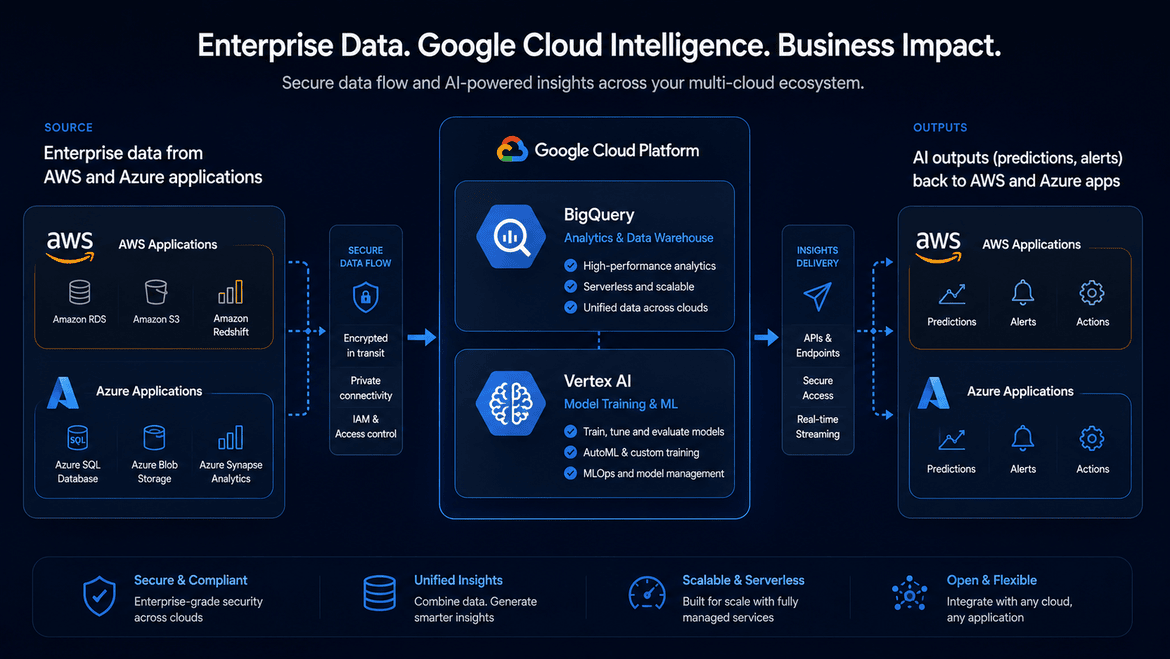
AI workloads on GCP follow a consistent pattern. Data lands in BigQuery for analytics and transformation. Model training and inference run on Vertex AI. The outputs feed back into applications running on AWS or Azure. The entire GCP for AI and machine learning layer sits alongside the existing cloud infrastructure rather than replacing it.
Vertex AI gives enterprise teams a managed ML platform with direct access to Google's foundation models. BigQuery handles large-scale analytics at a cost and performance point that AWS Athena and Azure Synapse do not consistently match for the same workload types. For organizations building real-time pipelines that feed machine learning models, GCP is the rational choice for that specific layer.
This is what best-in-class enterprise cloud strategy looks like in practice. Not one provider for everything. The right provider for each job.
Data Residency and Sovereignty as a Cloud Placement Driver
Not all multi-cloud decisions come from performance or capability needs. Many are driven by law.
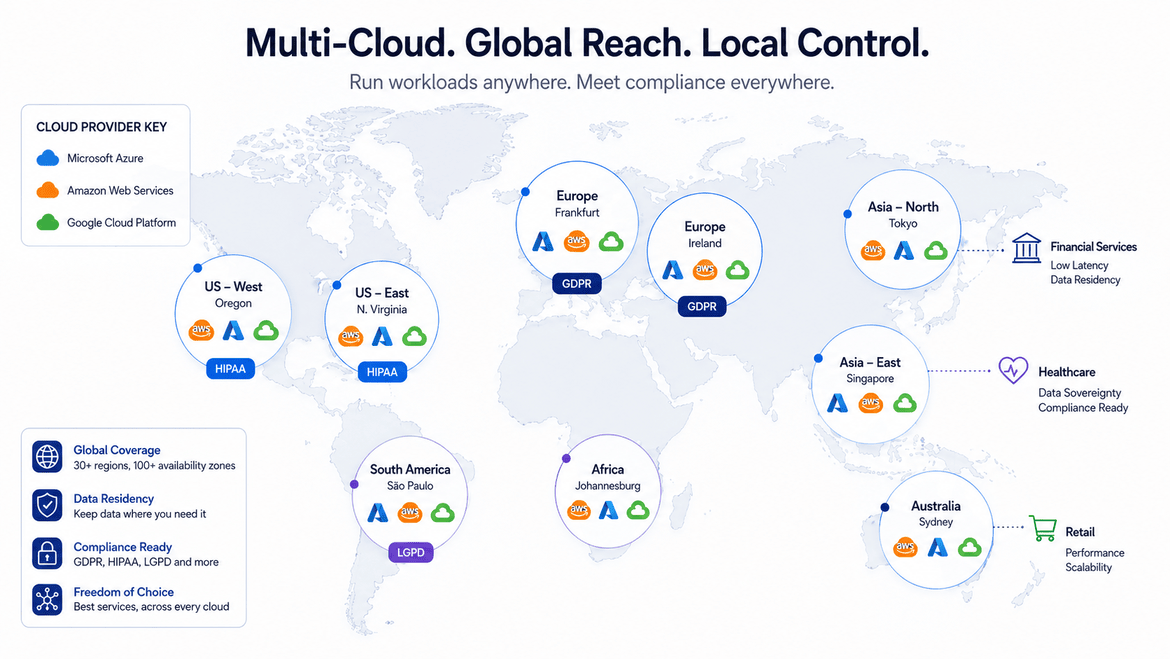
Data residency cloud requirements mandate that specific data types stay within defined geographic boundaries. GDPR requires personal data on EU residents to be stored within the EU. Financial services regulators in many markets require customer records to remain within national borders. Healthcare data must comply with jurisdiction-specific storage and access requirements that vary significantly by country.
These requirements often determine which cloud provider an enterprise uses in a given region. AWS, Azure, and GCP each have different geographic coverage and different regulatory certifications. An enterprise serving customers across the EU, the US, and Southeast Asia may use different providers in different regions simply because the required certification exists with one provider and not another in that market.
Multi-cloud for data sovereignty is therefore not optional for regulated industries. Banks, hospitals, insurers, and government contractors often have no choice about which provider holds which data. The multi-cloud strategy must be designed around those constraints from the start.
Building a Resilient Multi-Cloud Architecture
Once an enterprise is running workloads across multiple providers, the multi-cloud architecture that connects them determines whether the setup delivers resilience or just creates complexity. A cloud resilience strategy in a multi-cloud environment is built on three things.
- Workload portability: applications built using containers (Kubernetes) and infrastructure-as-code (Terraform) can run on any provider without re-architecture. This keeps workloads movable as business needs change
- Unified observability: a single monitoring layer covering AWS, Azure, and GCP gives operations teams one view of system health. Without it, every provider runs its own tooling and incidents fall through the gaps
- Automated failover: critical workloads configured to switch to a secondary provider automatically when the primary reports degraded service. Resilience should not depend on a human catching an alert at the right moment
For enterprises modernizing from on-premise infrastructure into a multi-cloud setup, a structured On-Prem to Cloud Modernization approach builds portability and resilience into the migration from day one rather than retrofitting them later.
We'll map the exact workflows from this article to your business - free, in 30 minutes.
Governance, Cost Management and Keeping Vendor Lock-In in Check
With the architecture in place, governance is what makes a multi-cloud strategy financially and operationally sustainable. Without it, multiple cloud accounts generate cost sprawl and security gaps that offset the benefits of the multi-cloud setup.
- Cost visibility: a single platform aggregating spend across all providers is the baseline. Each provider's native cost tools show only their own spend. Without a unified view, cloud waste accumulates invisibly across all three
- Security governance: identity, access, and compliance policies must apply consistently across every provider environment. A security gap in one environment can expose data in another if the governance layer is not unified
- Vendor lock-in management: this is one item in the governance checklist, not the headline concern. Workload portability prevents the most expensive forms of lock-in. Monitoring egress costs and contract terms across providers preserves negotiating leverage at renewal
Enterprises building this governance layer alongside their technical migration can explore how multi-cloud transformation services support the design of both the architecture and the operating model.
Conclusion
Multi-cloud strategy in 2026 reflects the reality of how enterprises actually operate. Different workloads go to the provider where they run best. Data sovereignty requirements determine where certain data must sit. Acquisitions bring new providers. AI workloads demand GCP's specific capabilities.
Vendor lock-in is a real concern and worth managing. But it is one item in a broader enterprise cloud strategy, not the reason most enterprises end up with multiple clouds in the first place.
The enterprises managing multi-cloud well are not the ones that planned it perfectly from day one. They are the ones that built the right architecture and governance around the multi-cloud reality they already have.
Frequently Asked Questions - Multi cloud Strategy
1. What are the real reasons enterprises adopt a multi-cloud strategy?
Enterprises end up multi-cloud for several reasons, often at the same time. Best-in-class service selection routes AI workloads to GCP, Microsoft workloads to Azure, and general compute to AWS. Data residency laws require certain data to stay in specific regions or with certified providers. M&A and business unit decisions create accidental multi-cloud enterprises. And cloud resilience strategy drives deliberate distribution across providers to avoid single points of failure. Vendor lock-in avoidance is one benefit that follows from these decisions — it is rarely the primary trigger.
2. Why do enterprises specifically route AI workloads to GCP?
AI workloads on GCP are concentrated there because of specific capabilities that AWS and Azure do not match evenly for the same workload types. Vertex AI provides a managed ML platform with direct access to Google's foundation models. BigQuery handles large-scale analytics at a cost and performance point that competes favorably for data-heavy workloads. GCP for AI and machine learning is a deliberate capability decision, not a generic cloud preference. Enterprises add GCP as a third cloud specifically for this layer while keeping AWS and Azure for other workloads.
3. What is data residency and how does it drive multi-cloud decisions?
Data residency cloud requirements mean that specific types of data must be stored within defined geographic boundaries by law. GDPR mandates that personal data on EU residents stays within the EU. Financial services and healthcare regulations impose similar requirements in many jurisdictions. Enterprises serving customers across multiple regions often use different cloud providers in different markets because only one provider holds the required regulatory certification in that geography. Multi-cloud for data sovereignty is therefore a compliance necessity for many regulated businesses, not an architectural preference.
4. What is accidental multi-cloud and is it a problem?
Accidental multi-cloud enterprises are organizations that ended up running workloads across multiple providers without a formal strategy — through M&A, business unit decisions, or SaaS platform dependencies. It is extremely common. According to Gartner, 92% of large enterprises are already multi-cloud. Most did not plan it. Accidental multi-cloud is not inherently a problem. It becomes one without governance: cost visibility, unified security, and clear workload placement policies. The goal of a multi-cloud strategy is to make the existing reality governable, not to rebuild from scratch.
5. How do you build a resilient multi-cloud architecture?
A cloud resilience strategy in a multi-cloud architecture requires three things: workload portability so applications can run on any provider without re-architecture (achieved through Kubernetes and Terraform), unified observability so operations teams have a single view of system health across all providers, and automated failover so critical workloads switch to a secondary provider automatically when the primary reports degraded service. For enterprises modernizing from on-premise infrastructure, building these capabilities into the migration sequence from day one is significantly cheaper than retrofitting them afterward.
You may also want to read