Most cloud migrations go over budget. Not because the cloud is expensive, but because teams move before they plan. They discover the hard problems (hidden dependencies, security gaps, surprise costs) only after the work has started. By then, fixing them is slow and costly.
A cloud transformation assessment prevents this. It answers the hard questions first, before any workload moves. It tells you what is ready, what needs work, what it will cost, and where the risks sit. This guide explains what the assessment is, what it covers, how to run one, and how to turn its findings into a clear plan.
What Does a Cloud Transformation Assessment Evaluate?
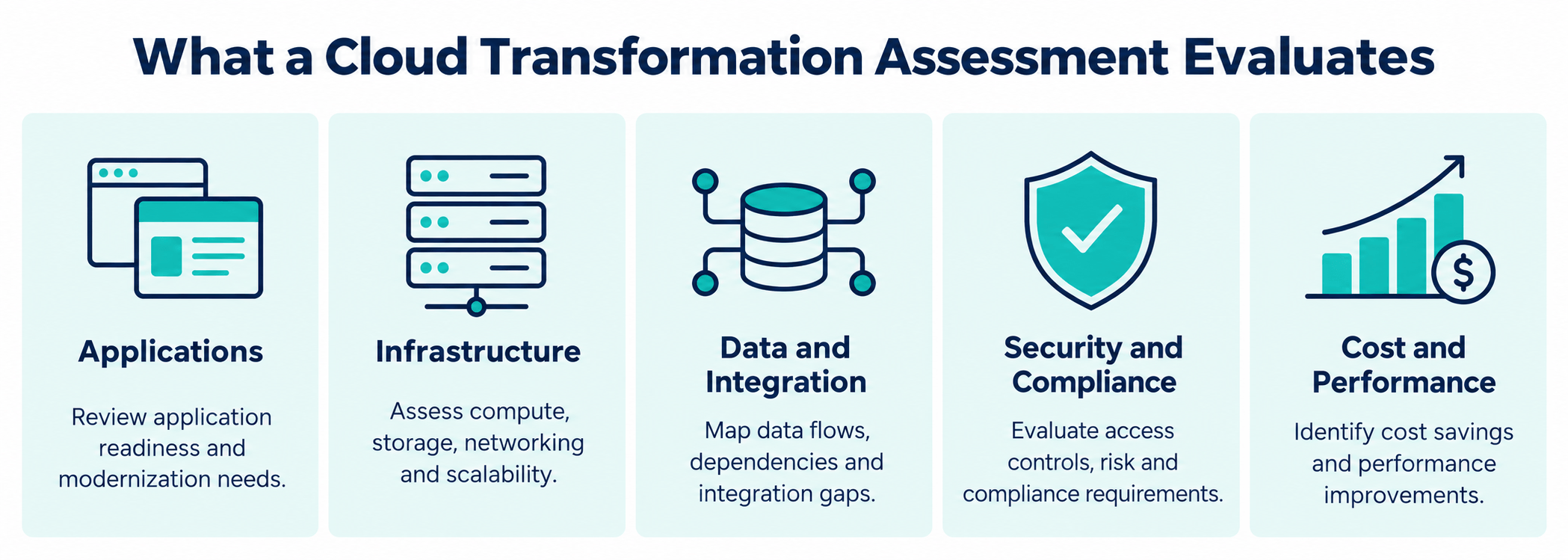
A cloud transformation assessment reviews five areas of your IT estate before you move. Each area answers a different question about whether a workload is ready for the cloud and what it will take to move it.
A full assessment looks at five things:
- Your applications and how ready each one is to move
- Your infrastructure and how it maps to the cloud
- Your data, integrations, and how systems connect
- Your security posture and compliance needs
- Your current and future cloud costs
Our engineers will audit your workflow and estimate time-to-value at no cost.
Claim your free audit
Cloud Assessment vs Cloud Readiness Assessment
A cloud readiness assessment asks whether you are ready to move at all. A cloud migration assessment asks how to move each workload. Both sit inside the wider transformation assessment. The table below makes the difference clear.
Why Do Enterprises Need a Cloud Transformation Assessment?
Teams that plan with a structured assessment succeed far more often than teams that move on instinct. The evidence is consistent across every major cloud research study.
Skipping the assessment is where the common failures come from:
- Hidden dependencies that break systems mid-migration
- Security and compliance gaps found too late
- Costs that balloon because workloads were never right-sized
- Rollbacks when a workload simply was not ready to move
An assessment surfaces all of these before they cost you money. That is its whole value.
Key Components of a Cloud Transformation Assessment
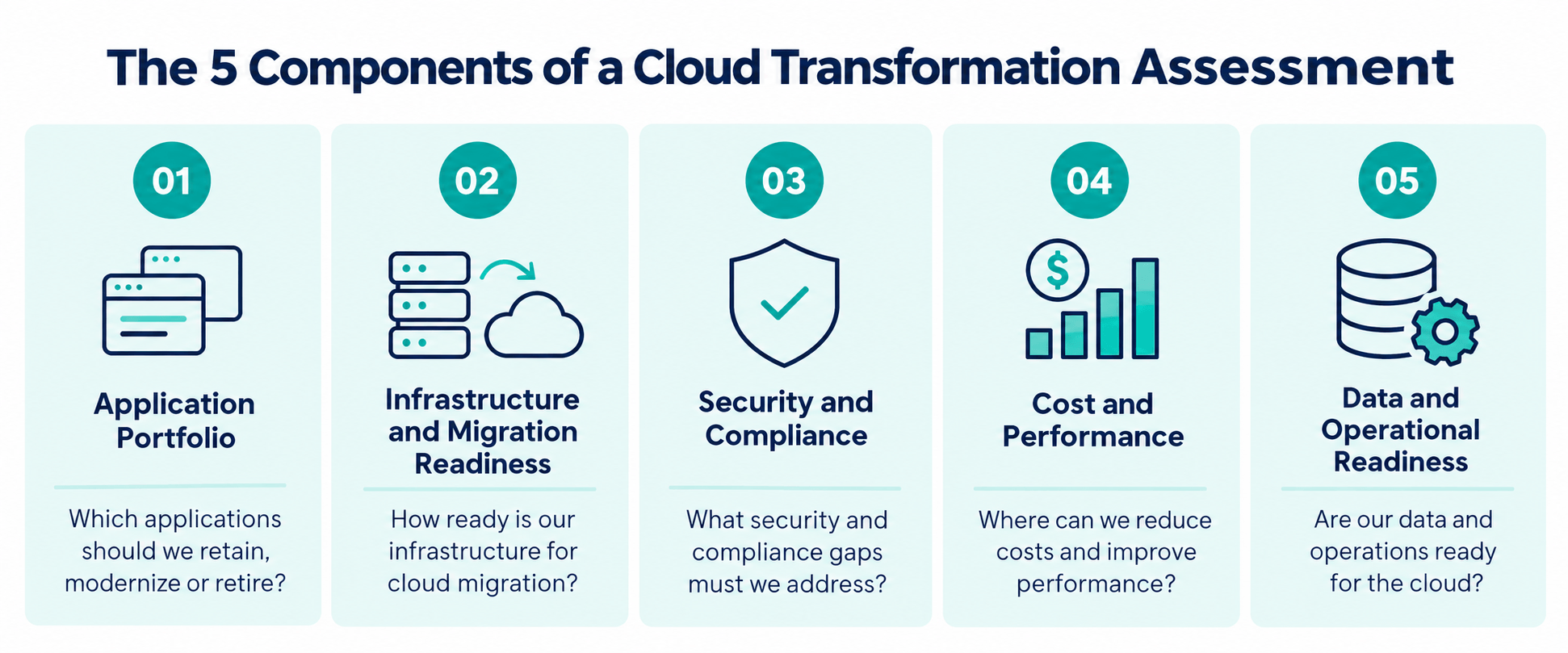
A complete cloud assessment framework covers five components. Each answers a different question about your readiness to move.
Application Portfolio Assessment
This reviews every application you run and scores how ready each one is to move. It flags which apps can lift and shift, which need rework, and which should be retired. This application portfolio assessment is the foundation the whole roadmap is built on.
Cloud Infrastructure and Migration Readiness
This maps your servers, storage, and networks to cloud equivalents. It checks cloud migration readiness for each workload: can it move as is, or does it need changes first?
Cloud Security and Compliance Assessment
This reviews your security controls and the rules you must follow (such as HIPAA, PCI DSS, or GDPR). A cloud security assessment makes sure protection and compliance are designed in before you move, not bolted on after.
Cloud Cost and Performance Assessment
This estimates what the cloud will cost and how workloads will perform. A clear cloud cost assessment prevents the bill shock that hits most first-time migrations in the first year.
Data, Integration, and Operational Readiness
This checks how your systems connect and share data, and whether your team is ready to run the cloud environment day to day. Broken integrations and skills gaps are common, quiet causes of failure.
How to Conduct a Cloud Transformation Assessment: Step-by-Step
A cloud transformation assessment follows five steps in a fixed order. Each step builds on the one before it.
- Define business goals and scope.
Start with why you are moving: lower cost, more scale, faster releases, or better security. Set the scope so the assessment stays focused on what matters. - Assess existing applications and infrastructure.
Build a full inventory of your apps and infrastructure. You cannot plan a move for systems you have not mapped. - Evaluate workloads, dependencies, and migration risks.
Map how systems depend on each other. Unclear dependencies are the single biggest cause of migration problems, so this step matters most. - Assess security, compliance, and costs.
Check your security gaps, compliance duties, and expected cloud spend. Price each workload so there are no surprises later. - Identify modernization opportunities and priorities.
Decide which workloads simply move and which should be modernized for real cloud value. Rank them by impact and effort.

How to Build a Cloud Modernization Roadmap After Assessment
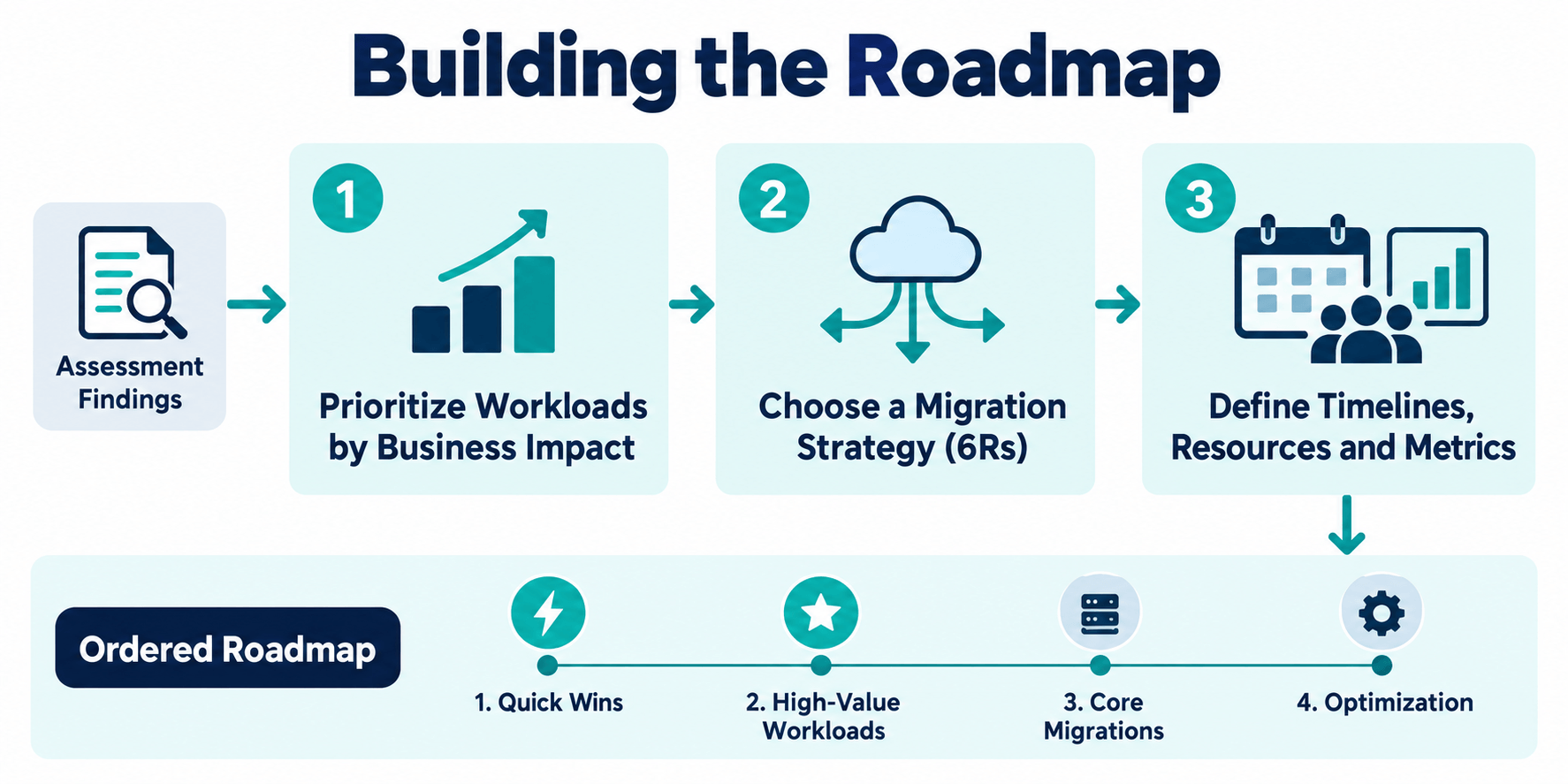
The assessment gives you findings. The cloud modernization roadmap turns those findings into an ordered plan. It has three parts.
Prioritize Workloads by Business Impact
Not everything moves at once. Start with workloads that give the most value for the least risk. Quick wins build momentum and prove the approach works.
Choose the Right Migration and Modernization Strategy
Pick an approach for each workload using the cloud 6Rs: rehost, replatform, repurchase, refactor, retire, or retain. Simple apps can lift and shift. High-value apps are worth refactoring for cloud-native benefits.
Define Timelines, Resources, and Success Metrics
Set a realistic schedule, name the people and budgetneeded, and decide how you will measure success: cost saved, uptime, releasespeed, or performance. A roadmap without metrics is just a wish list.
For a deeper, stage-by-stage walk through of moving from on-premises to the cloud, this cloud modernization roadmap guide breaks down each phase in detail.
Common Cloud Transformation Assessment Challenges
Four challenges recur across most cloud transformation assessments. Knowing them early helps you plan around them, especially as the volume of workloads waiting to migrate keeps growing.
The most common challenges are:
- Unclear application dependencies, the leading cause of migration delays
- Incomplete or outdated inventory, which forces costly rework mid-project
- Underestimated costs, especially data transfer and right-sizing
- Skills gaps, where the team is not ready to run the cloud day to day
How Cloud Transformation Services Help Enterprises
Running a full assessment needs skills most teams do not have in-house: cloud architecture, security, cost modelling, and migration experience across many workloads. This is where cloud transformation services earn their value.
A good partner brings proven assessment frameworks, automated discovery tools, and experience from migrations like yours. They find the risks a first-time team would miss, and they build a roadmap you can actually deliver. The result is a faster, safer, and more cost-controlled move to the cloud.
Pace Wisdom provides end-to-end cloud transformation services, from the first assessment through migration, modernization, and ongoing optimization.
Key Takeaways
Conclusion: Turn Cloud Assessment Insights Into Action
A cloud transformation assessment is not red tape before the real work. It is the work that makes everything after it succeed. It replaces guesswork with a plan, surfaces risks while they are still cheap to fix, and turns a risky migration into a managed one.
The findings only matter if you act on them. Use the roadmap to move in the right order, measure as you go, and adjust. Assess first, move second, and the cloud delivers what it promised instead of a surprise bill.
We'll map the exact workflows from this article to your business - free, in 30 minutes.
Frequently Asked Questions
1. What is a cloud transformation assessment?
A cloud transformation assessment is a structured review of your applications, infrastructure, data, security, and costs before migrating to the cloud. It produces a readiness score, a risk list, and a roadmap, so you move with a plan instead of guesswork.
2. How long does a cloud transformation assessment take?
Most assessments take two to six weeks, depending on howmany applications you run and how complex your environment is. A small estatecan be assessed in a couple of weeks. A large enterprise with hundreds of applications takes longer, often phased by business unit.
3. What is included in a cloud readiness assessment?
A cloud readiness assessment checks whether your organization is ready to move: your team's skills, your processes, your tech maturity, and your governance. It produces a readiness score and a list of gaps to close before migration begins.
4. What is the difference between a cloud assessment and a cloud migration assessment?
A broad cloud assessment reviews your whole readiness to move. A cloud migration assessment is narrower: it focuses on how to move each specific workload, including dependencies and the right migration method. The migration assessment usually sits inside the wider transformation assessment.
5. How much does a cloud transformation assessment cost?
Cost depends on the size of your estate and the depth of the review. A focused assessment of a small environment costs less; a full enterprise assessment across hundreds of applications costs more. Most partners price it as a fixed engagement, and the cost is small next to the budget overruns it prevents.
6. How does a cloud assessment help reduce migration risks?
It finds problems before they cost you. By mapping dependencies, checking security, and modelling costs upfront, a cloud security assessment and the wider review catch the gaps that cause failures. This is why teams that assess first have far higher success rates and fewer rollbacks.
You may also want to read