The question of hybrid cloud vs multi cloud comes up in almost every enterprise cloud planning conversation. Both approaches address real business problems. Both are widely adopted. And both are frequently confused with each other.
This blog explains how each model works, where each one performs best, and how to decide which enterprise cloud strategy fits your business in 2026. Pace Wisdom is an AWS Advanced Tier Partner with 13 years of production cloud delivery experience across fintech, healthcare, logistics, and manufacturing.
What Is Hybrid Cloud Architecture?
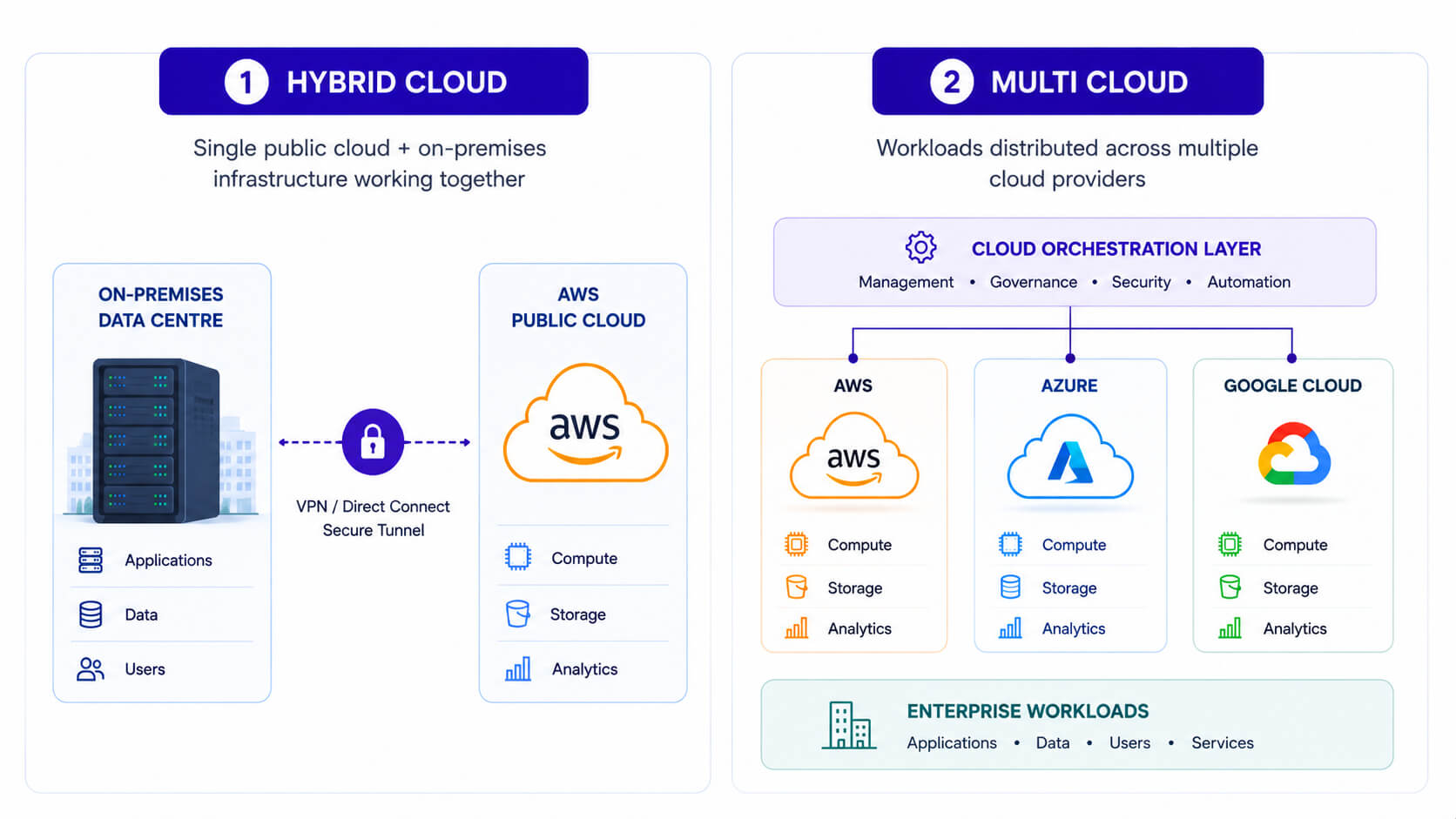
Definition: Hybrid cloud architecture connects on-premises or private cloud infrastructure to one or more public cloud environments, allowing workloads and data to move between them based on compliance, latency, and cost requirements.
A hybrid cloud architecture gives organizations the control and security of private infrastructure alongside the scalability and managed services of public cloud.The two environments are linked through secure networking, typically a VPN or dedicated connection like AWS Direct Connect or Azure Express Route, and managed through a unified control plane.
Our engineers will audit your workflow and estimate time-to-value at no cost.
Claim your free audit
How Hybrid Cloud Works?
In a hybrid cloud setup, sensitive workloads,regulated data, and legacy systems remain on-premises or in a private cloud.Non-sensitive workloads, development environments, and high-scale compute jobs run in the public cloud. The integration layer handles data synchronization, identity management and networking between the two environments.
This model is common in industries where data residency rules or regulatory frameworks prevent certain data from residing outside a controlled environment. Financial services, healthcare, and government organisations frequently run hybrid cloud and multi cloud architectures for exactly this reason.
Hybrid Cloud Benefits and Use Cases
The primary hybrid cloud benefits are control, compliance, and cost optimization.Organizations retain direct ownership of sensitive data while consuming public cloud services for workloads where that control is not required.
Common hybrid cloud use cases:
- Regulated data workloads that must remain on-premises under GDPR, HIPAA, or PCI-DSS
- Legacy application modernization where full migration to public cloud is not immediately feasible
- Disaster recovery setups that replicate on-premises data to a public cloud standby environment
- Burst computing for seasonal or variable workloads that exceed on-premises capacity
- Industries with data sovereignty requirements including banking, healthcare, and government
What Is Multi Cloud Architecture?
Definition: Multi cloud architecture uses services from two or more public cloud providers simultaneously, distributing workloads across AWS, Azure, Google Cloud, or others based on service capability, cost, performance, or geographic availability.
A multi cloud architecture does not require on-premises infrastructure. The defining characteristic is provider diversity. Organizations running multi cloud deliberately choose different clouds for different purposes: AWS for compute and AI services, Azure for Microsoft ecosystem integration, Google Cloud for data analytics and BigQuery, or regional providers for data localisation requirements.
We'll map the exact workflows from this article to your business - free, in 30 minutes.
How Multi Cloud Works?
Multi cloud environments typically involve separate accounts or subscriptions with each provider, a cloud management or orchestration layer that provides unified visibility across providers, and cross-cloud networking configurations for workloads that need to communicate across environments.
For enterprises building a deliberate multi cloud strategy, the orchestration layer is critical. Without it, multi cloud becomes multi-silo: separate teams managing separate clouds with no shared governance, cost visibility, or security posture.
Multi Cloud Benefits and Use Cases
The primary multi cloud benefits are flexibility, resilience, and freedom from vendor lock-in. Organisations that depend on a single provider are exposed to outages,pricing changes, and feature gaps that a multi cloud approach mitigates.
Common multi cloud use cases:
- Avoiding single-vendor dependency for mission-critical application infrastructure
- Accessing best-of-breed managed services that are unique to specific providers
- Meeting data residency requirements across multiple geographic regions using regional cloud providers
- Mergers and acquisitions where the acquired company runs a different cloud than the parent
- Cost arbitrage by routing specific workloads to the most cost-effective provider at any given time
Business Impact: 76% of multi cloud users say managing costs across providers is their biggest operational challenge. Multi cloud management platform spending grew 28% year over year in 2025, reflecting the investment required to govern multiple providers effectively. (Medha Cloud 2026).
Multi Cloud vs Hybrid Cloud: Side-by-Side Comparison
The table below compares multi cloud vs hybrid cloud across the six dimensions that matter most for enterprise architecture decisions.
Can You Run Hybrid Cloud and Multi Cloud at the Same Time?
Yes. Most large enterprises already do. The term hybrid multi cloud describes an architecture that combines on-premises or private infrastructure with multiple public cloud providers. In practice, this means a company might keep its core database on-premises, run its customer-facing application on AWS, and use Azure for Microsoft 365 integration and analytics through Power BI.
Running both models simultaneously requires strong governance from day one. You need a unified identity and access management layer, consistent security policies across all environments, centralised cost monitoring, and an orchestration platform that provides visibility across every environment in a single interface.
The operational complexity of hybrid cloud and multi cloud running together should not be underestimated. IBM's 2025 breach cost research found that multi-environment incidents cost $5.05 million on average, compared to $4.18million for single public cloud breaches. Governance and security architecture must scale with the environment count.
The tools that make this manageable include infrastructure-as-code platforms like Terraform for consistent provisioning across providers, Kubernetes for workload portability across environments, and cloud management platforms like HashiCorp or Morpheus that provide a single control plane above the provider layer. Without these, teams end up managing separate cloud environments in isolation, which defeats the strategic benefit of running both models together.
Which Enterprise Cloud Strategy Is Right for Your Business?
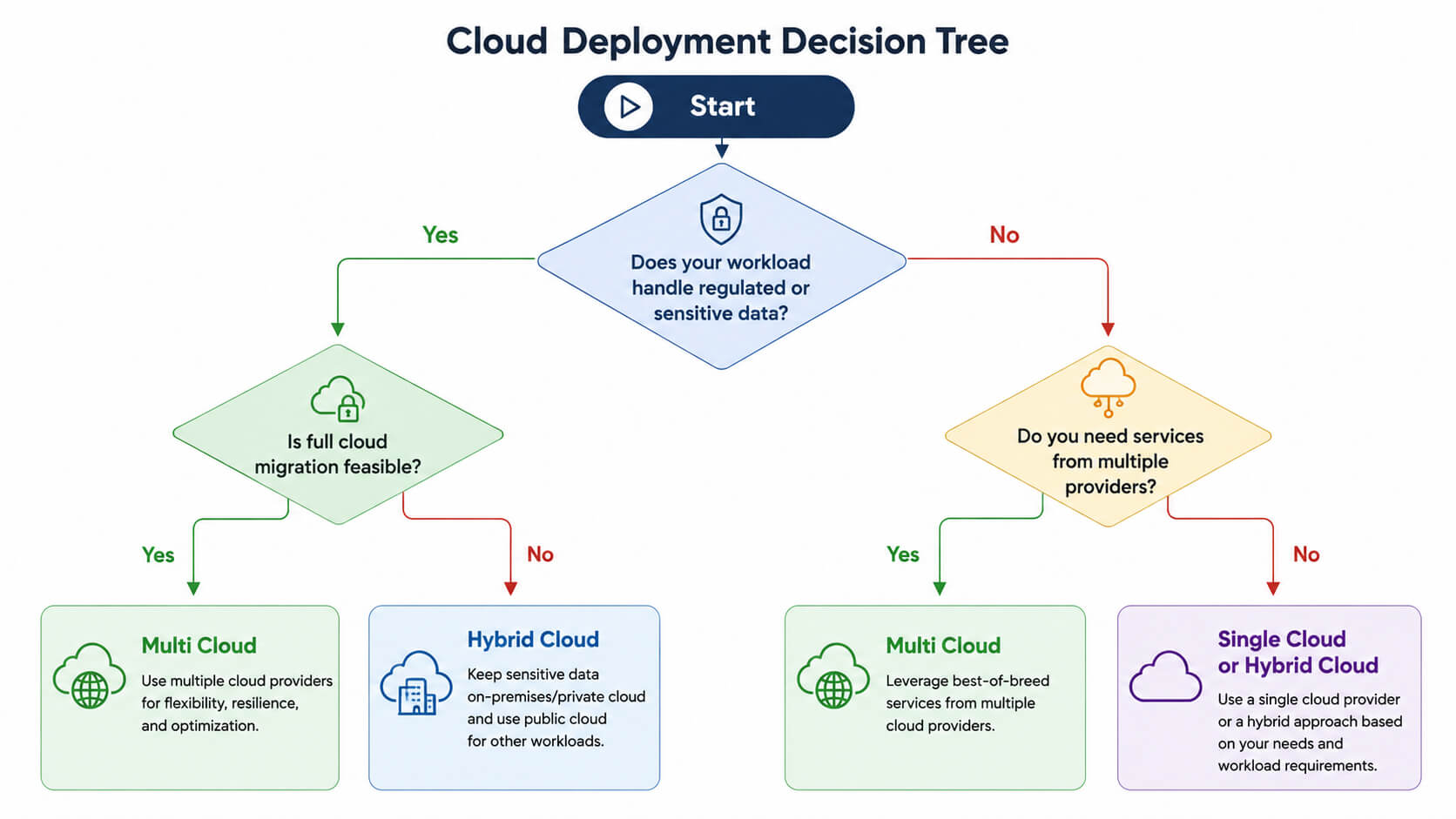
There is no universal answer. The right enterprise cloud strategy depends on four factors specific to your organisation.
Choose hybrid cloud if:
- You operate in a regulated industry where certain data cannot leave your direct control
- You have significant on-premises infrastructure that is not yet ready for full cloud migration
- Your disaster recovery strategy requires a private environment for RPO and RTO compliance
- Data residency laws in your operating markets require local data storage
Choose multi cloud if:
- Vendor lock-in is a strategic risk and you need negotiating leverage across providers
- Different teams or business units already operate on different cloud providers
- You need specific managed services that are only available on certain platforms
- Your application requires geographic distribution across regions that one provider does not cover well
Consider both if:
- You have a mix of regulated and non-regulated workloads that benefit from different deployment models
- Your organization is growing through acquisitions and inheriting existing cloud environments
- You want maximum flexibility without committing to a single architecture philosophy
One practical starting point is a workload audit. List every application and data set your organization runs, then classify each by sensitivity, compliance requirement, latency tolerance, and current infrastructure dependency. That classification will naturally segment into workloads that belong on-premises, workloads that are ready for public cloud, and workloads where provider choice is flexible. The resulting map is the foundation of a sound enterprise cloud strategy rather than an ad hoc mix of cloud decisions made independently by different teams.
Most organizations find that their compliance-sensitive workloads and legacy systems point toward hybrid cloud,while their modern applications, analytics platforms, and SaaS integrations point toward multi cloud. The architecture reflects the portfolio, not a single blanket decision.
How Pace Wisdom Helps You Build the Right Cloud Architecture
Choosing between multi cloud vs hybrid cloud is a strategy decision. Executing that strategy correctly is an architecture and engineering challenge. Both require experience with the real-world tradeoffs that do not appear in vendor documentation.
Pace Wisdom delivers cloud engineering services for enterprises that need production-grade cloud infrastructure. As an AWS Advanced Tier Partner and Jio Cloud ISV Partner, we design and build hybrid cloud and multi cloud architectures for clients across fintech, healthcare, logistics, and manufacturing.
We help enterprise teams with:
- Hybrid cloud architecture design including AWS Direct Connect, VPN configuration, and private cloud integration
- Multi cloud orchestration setup with unified IAM, cost governance, and security policy management
- Cloud migration strategy using AWS's 7Rmigration framework (Retire, Retain, Rehost, Relocate, Repurchase, Replatform,and Refactor), tailored to each workload's business and technical requirements.
- Compliance architecture for HIPAA, PCI-DSS, SOC2, and ISO 27001 across hybrid and multi cloud environments
- FinOps implementation and cost optimisation across AWS, Azure, and Jio Cloud
Conclusion
Hybrid cloud vs multi cloud is not a single answer question. It is a strategic architecture decision that depends on your workload sensitivity, compliance obligations, vendor preferences, and operational maturity. Most enterprises in 2026 run both models simultaneously,segmenting workloads across environments to maximise each model's strengths.
The right cloud strategy is the one that maps to your business model, not someone else's reference architecture.
Frequently Asked Questions
Q1. What is the difference between hybrid cloud and multi cloud?
Hybrid cloud vs multi cloud comes down to where your infrastructure lives. Hybrid cloud connects on-premises or private cloud to one or more public clouds. Multi cloud uses two or more public cloud providers without requiring on-premises infrastructure. Both strategies can coexist within the same enterprise architecture.
Q2. Which is better: multi cloud or hybrid cloud ?
Neither is universally better. Hybrid cloud and multi cloud serve different needs. Hybrid cloud is better for regulated workloads, legacy integration, and data sovereignty. Multi cloud is better for vendor independence, best-of-breed services, and resilience across providers. Most large enterprises run both simultaneously.
Q3. What are the main hybrid cloud benefits for enterprises?
The main hybrid cloud benefits are data control, regulatory compliance, cost optimisation across owned and rented infrastructure, and the ability to modernise legacy systems incrementally without forcing a full migration.
Q4. What are the main multi cloud benefits for enterprises?
The main multi cloud benefits are freedom from vendor lock-in, access to best-of-breed managed services across providers, improved resilience through provider diversification, and the ability to optimise costs by routing workloads to the most cost-effective platform.
Q5. Can a company use hybrid cloud and multi cloud at the same time?
Yes. Many enterprises run a hybrid multi cloud architecture that combines on-premises or private infrastructure with multiple public cloud providers. The key requirement is a unified governance layer covering identity management, security policy, cost monitoring, and orchestration across every environment.
You may also want to read
What Is a Cloud Transformation Assessment? A Guide for Enterprises