An AI agent is an autonomous system that can plan, reason, and act across multiple tools to complete complex tasks without step-by-step human input. A chatbot is a conversational program that responds to user queries using pre-set rules or basic language understanding. While both technologies fall under artificial intelligence, they are built for very different purposes and produce very different business outcomes.
Why the Confusion Between AI Agents and Chatbots Is Costing Businesses
Most businesses today have deployed some form of conversational AI, but very few have a clear picture of what it can actually do. The terms chatbot and AI agent get used interchangeably in vendor pitches, product roadmaps and internal strategy decks. That confusion has real consequences. Companies end up deploying chatbots where they need agents, and investing in agent infrastructure for tasks a simple chatbot could handle. Either way, they leave value on the table.
This guide settles the ai agent vs chatbot debate with plain definitions, a side-by-side breakdown, real-world use cases and a practical decision framework to help you choose the right technology for the right job.
What Is a Chatbot? (And What It Is Actually Good At)
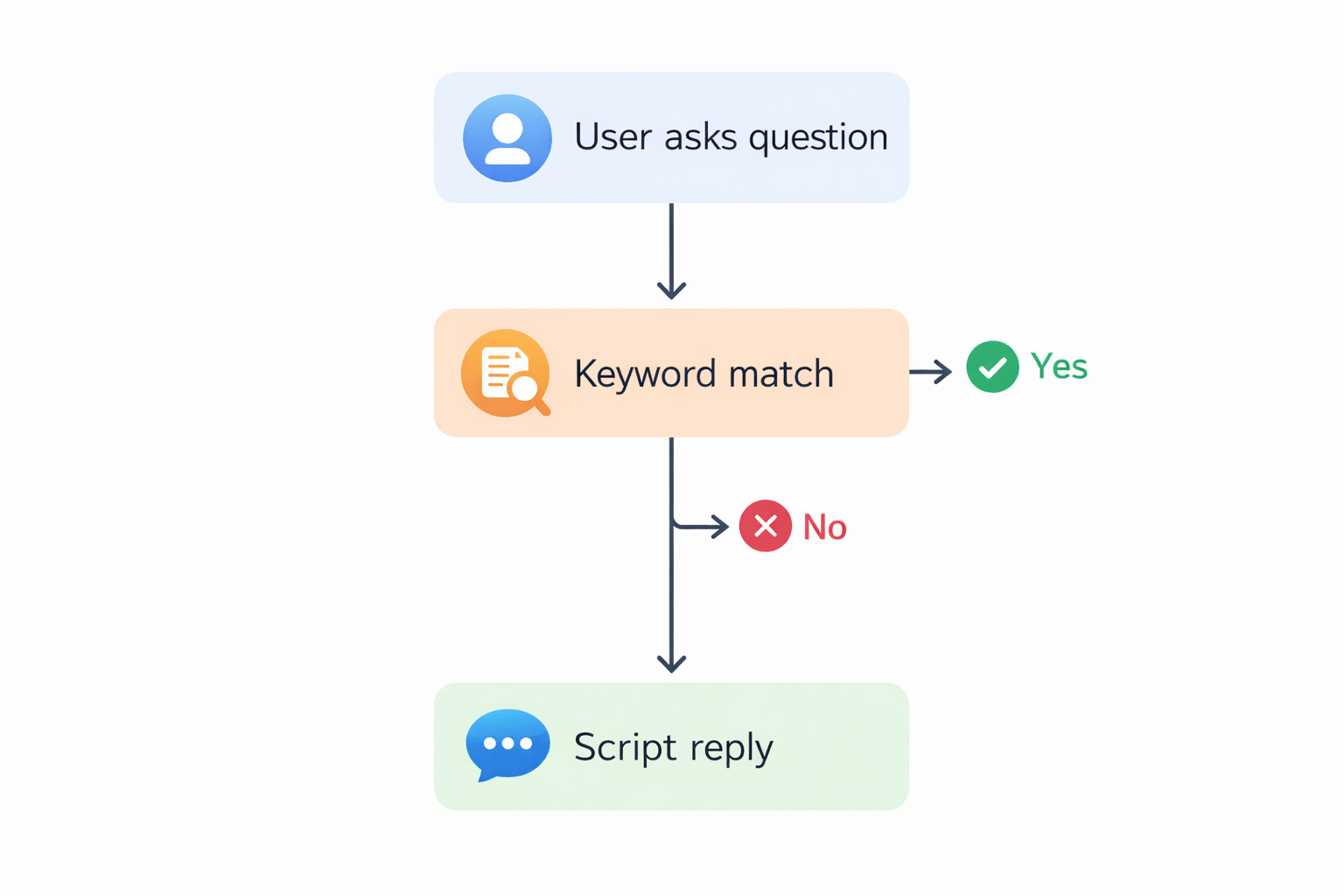
A chatbot is a software program designed to have a conversation with users. It works by recognising keywords or phrases in a message and returning a pre-written response. More capable versions use Natural Language Processing to understand different ways of phrasing the same question, but the core logic stays fixed. A chatbot operates inside a defined conversation flow. It can answer questions, but it cannot take independent action beyond the responses it has been programmed to give. It does not connect to live systems, it does not complete tasks on your behalf, and it does not adapt beyond what it has been configured to handle.
Our engineers will audit your workflow and estimate time-to-value at no cost.
Claim your free audit
How a Chatbot Works: The Simple Version
- Operates on pre-defined rules or basic NLP to recognise keywords and return scripted responses
- Lives inside a fixed conversation flow and can answer, but cannot act
- Best deployed for FAQs, lead capture forms, appointment booking and order status queries
- Example: A chatbot on a retail site that tells a customer their order ships in three days
Where Chatbots Shine in Business
- 24/7 availability with zero wait time
- Low deployment cost and easy to set up on websites, WhatsApp and social channels
- Ideal for chatbot in customer service at scale, handling tier-one support volume
- Works well for e-commerce, booking systems and HR onboarding FAQs
Quick Tip: If your goal is to deflect repetitive queries and reduce ticket volume, a well-configured artificial intelligence chatbot can handle the job efficiently without adding headcount.
What Is an AI Agent? (And Why It Is a Different Beast)
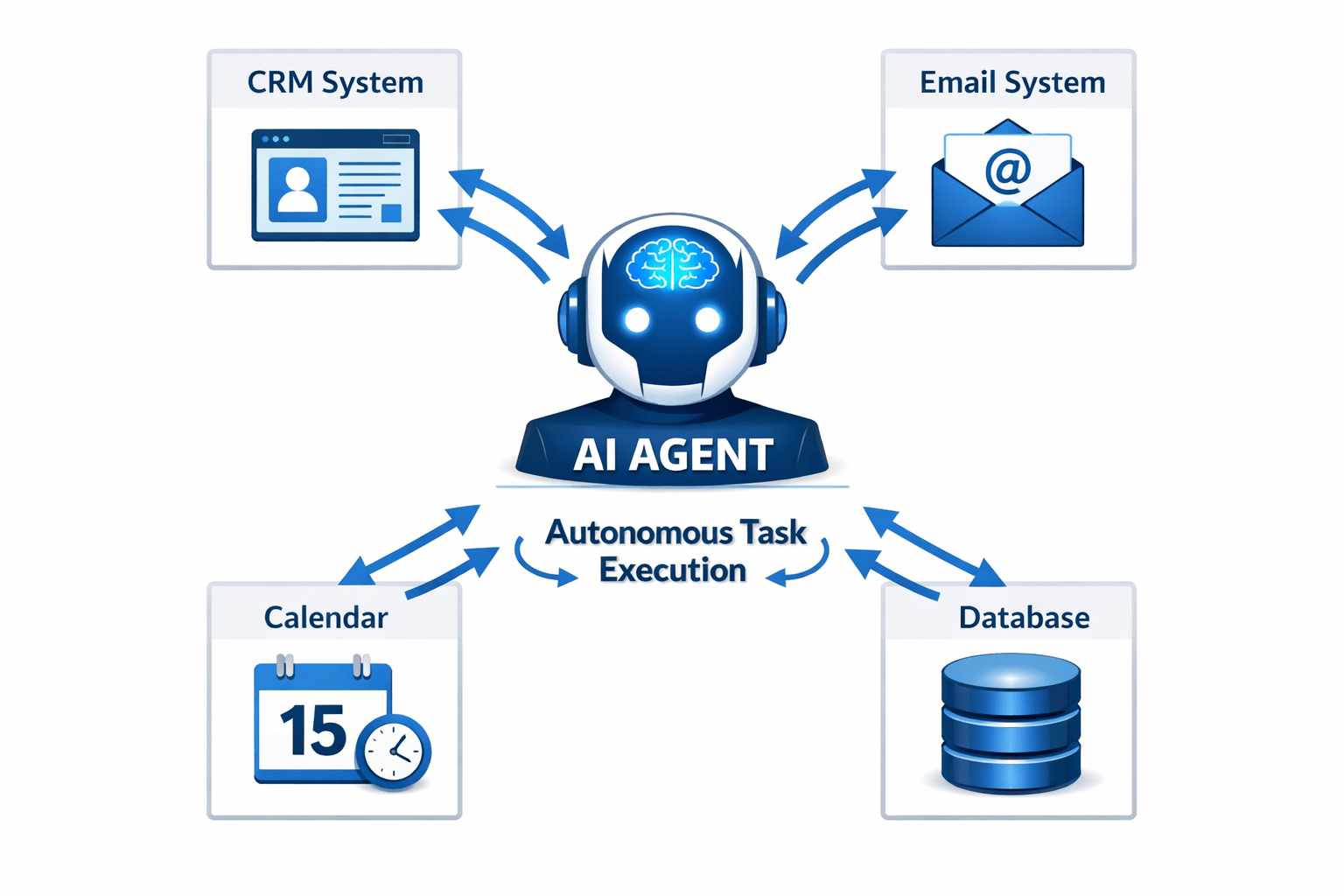
An AI agent is a system powered by large language models that can plan, make decisions, use tools and take autonomous action across multiple platforms to achieve a goal. Unlike a chatbot that waits for the right keyword, an AI agent understands intent. It figures out what needs to happen, breaks it into steps, executes those steps across connected systems and adapts based on what it encounters. It does not need a human to manage each stage.
This is what “what is an ai agent” really means in a business context. It is not just a smarter chatbot. It is a fundamentally different kind of system built to complete work, not just answer questions.
How an AI Agent Works: The Key Distinction
- Powered by large language models with reasoning and tool use built in
- Can plan, decide, execute and learn across multi-step tasks
- Connects to external systems including CRMs, databases, APIs, calendars and payment gateways
- Does not wait for a human prompt at each step and acts autonomously toward a goal
- Example: An AI agent that detects customer churn risk, pulls CRM data, drafts a retention email and schedules a follow-up call, all without human input
To see how this plays out in practice across different industries, explore AI agent use cases across industries from the Pace Wisdom CTO guide.
We'll map the exact workflows from this article to your business - free, in 30 minutes.
What Sets AI Agents Apart: The Agentic Difference
Here is a clear breakdown of the key capabilities that separate agentic ai vs chatbot in real-world deployment:
AI Agent vs Chatbot: 6 Key Differences Businesses Must Understand
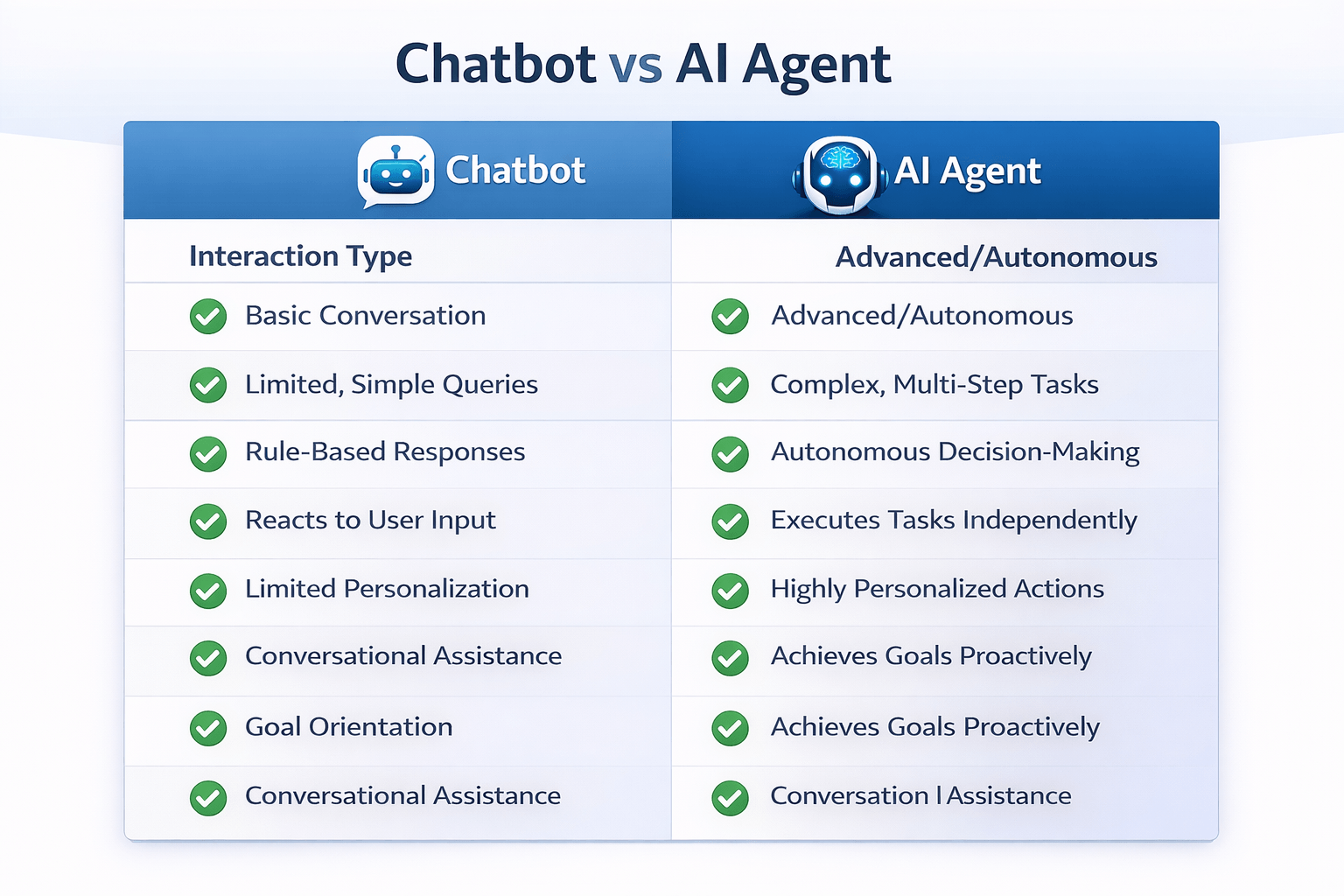
Now that both technologies are defined, here is a structured breakdown of the ai agent vs chatbot comparison across the six dimensions that matter most to business decision-makers evaluating automation investments.
1. Intelligence and Decision-Making
- Chatbot: Matches inputs to outputs using rules or basic NLP
- AI Agent: Reasons about goals, builds plans and adjusts based on outcomes
- Think of it this way: a chatbot answers. An AI agent solves.
2. Task Complexity
- Chatbot: Single-turn or limited multi-turn conversations
- AI Agent: End-to-end workflows covering research, analysis, action and reporting
3. Integration Depth
- Chatbot: Typically surface-level, drawing answers from a knowledge base
- AI Agent: Deep integrations that read and write to live systems including CRM, ERP and ticketing tools
- This is what separates a virtual agent vs chatbot at the enterprise level
4. Autonomy Level
- Chatbot: Needs human-defined paths to function
- AI Agent: Operates autonomously and escalates to humans only when genuinely needed
5. Memory and Context Retention
- Chatbot: Memory typically resets at the end of each session
- AI Agent: Retains context across sessions, users and tasks
6. Business Impact and ROI
- Chatbot: Reduces support ticket volume and improves response time
- AI Agent: Drives revenue, reduces operational costs and automates entire business functions
- This is the core consideration for anyone evaluating an enterprise ai chatbot against a true agentic solution
For a deeper look at where AI agents are creating impact across sectors, see Pace Wisdom's guide on AI agent use cases across industries.
Real-World Use Cases: Choosing the Right Tool for the Right Job
The chatbot vs conversational agent debate becomes much easier when you map each technology to the type of work it handles best. Here is a practical guide to matching the tool to the task across the most common business scenarios.
When to Use a Chatbot
- E-commerce: Answer product queries, track orders and process returns
- Healthcare: Appointment scheduling, symptom FAQs and clinic hours
- Banking: Account balance queries, branch locator and basic account FAQs
- HR: Onboarding FAQ bot, leave balance queries and policy lookups
Best for: High-volume, repetitive, low-complexity interactions
When to Use an AI Agent
- Sales: Qualify leads, research prospects, draft outreach emails and update the CRM
- Customer Retention: Monitor churn signals and trigger retention workflows autonomously
- IT Operations: Auto-diagnose issues, open and resolve tickets and notify stakeholders
- Finance: Reconcile reports, flag anomalies and generate summaries for review
- Supply Chain: Monitor inventory levels, reorder automatically and alert on delays
Best for: Complex, multi-step, judgement-dependent tasks that span systems
The Hybrid Model: When You Need Both
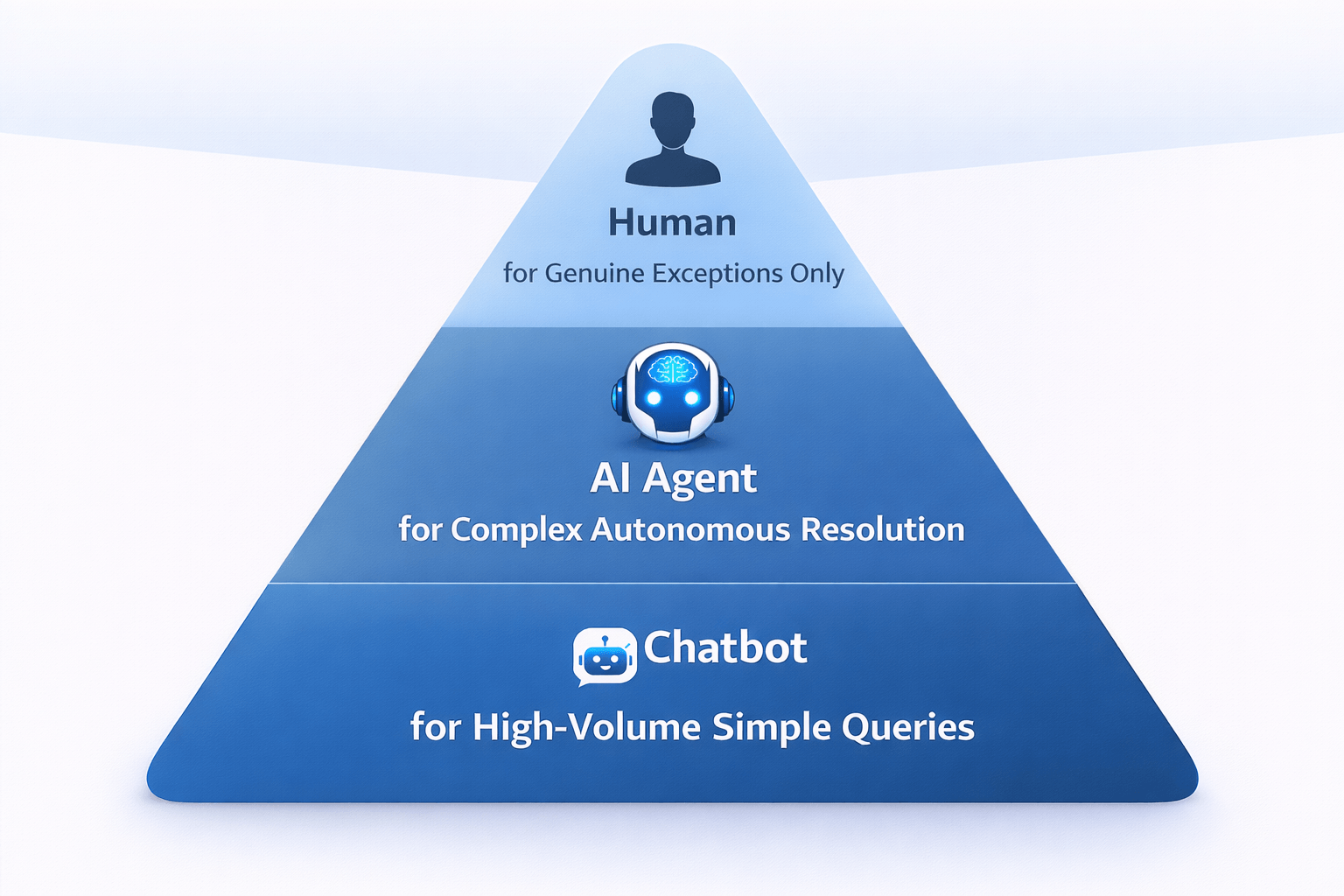
Many enterprise teams deploy chatbot agents in a layered model. The chatbot handles tier-one volume. The AI agent takes over for complex resolution that requires system access and judgement. A human steps in only for genuine exceptions. This architecture maximises cost efficiency while delivering high-quality outcomes at every tier.
To understand how this fits into a broader transformation strategy, explore how agentic AI is transforming business operations at the enterprise level.
AI Agent vs AI Assistant: Is There Yet Another Distinction?
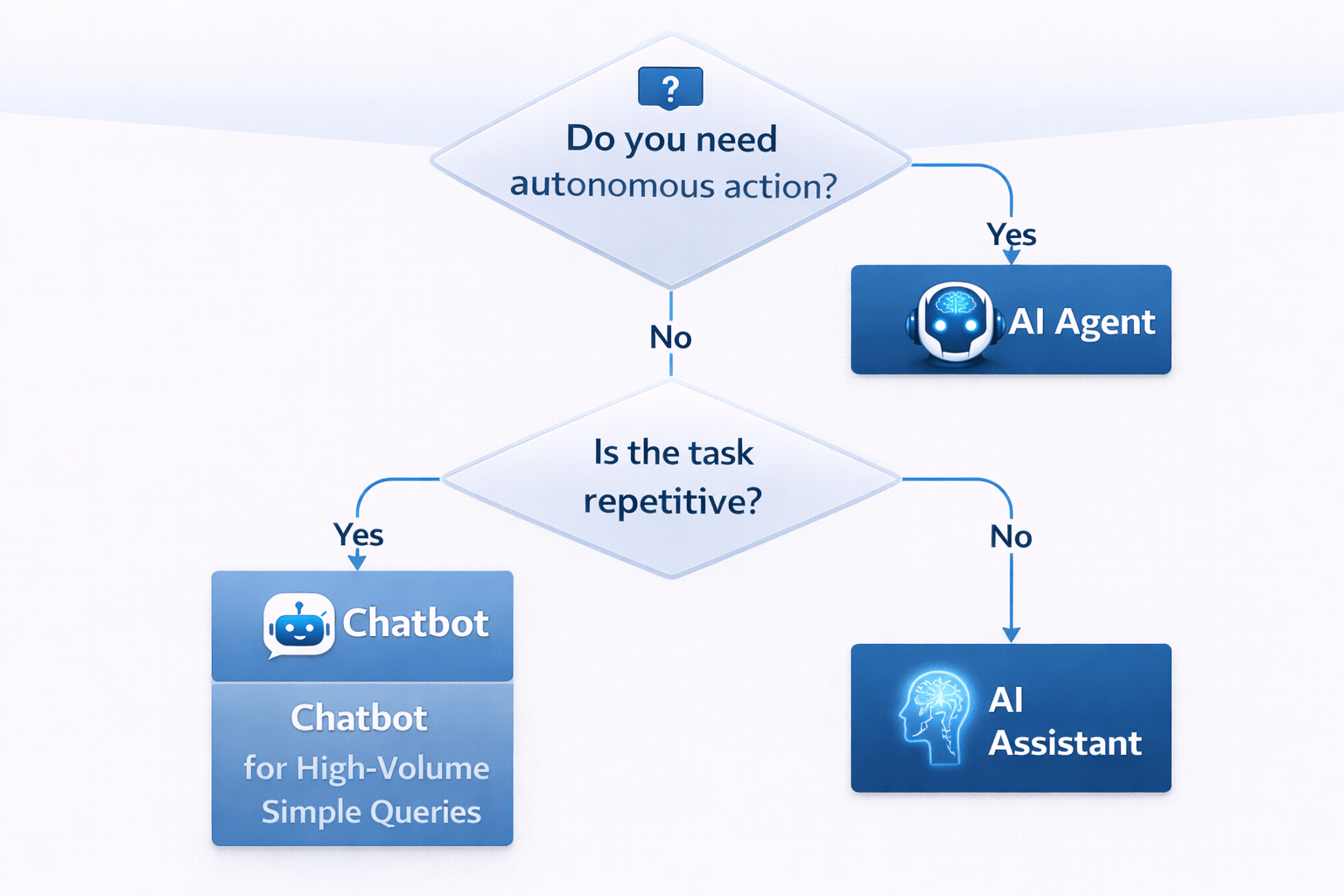
Yes, and it is worth clarifying quickly. Businesses searching for ai agent vs ai assistant or comparing conversational ai chatbot vs assistants are navigating a spectrum of AI capability. Each level offers more autonomy, deeper integration and higher business value, but also requires more thoughtful implementation.
The Spectrum Explained Simply
- An AI assistant is reactive: it responds when prompted
- An AI agent is proactive: it pursues goals and takes initiative
- The conversational ai chatbot sits at the base of this stack, not the top
For businesses: The further along this spectrum you move, the higher the autonomy, integration depth and business value, but also the greater the need for proper governance and implementation planning.
For an independent perspective on how AI agents are being adopted in enterprise environments, MIT Sloan Management Review covers autonomous AI systems and their business implications in its ongoing AI and strategy research.
How to Decide: AI Agent or Chatbot for Your Business?
Choosing between the two does not have to be complicated. Use this practical framework designed for CTOs, operations leaders and digital transformation managers to make the right call before committing budget or resources.
Ask These 5 Questions Before Choosing
- How complex are the tasks? Simple queries point to a chatbot. Multi-step workflows requiring judgement point to an AI agent.
- Do you need system integrations? If your solution needs to read from or write to live systems, you need an AI agent.
- Is autonomous action acceptable? If every step requires human approval, start with a chatbot and escalation paths.
- What is your budget and timeline? Chatbots deploy faster and cost less upfront. AI agents take more setup but deliver compounding returns.
- What business outcome are you targeting? Cost deflection points to a chatbot. Revenue growth and end-to-end operational efficiency point to an AI agent.
Start Small, Scale Smart
- Pilot a chatbot for customer service deflection, measure results, identify where autonomy and integration would add more value, then layer in AI agents for those workflows
- Partner with an AI implementation team to architect the right stack from the start
Explore Pace Wisdom's AI solutions for business automation to see how enterprises are building intelligent, scalable AI systems.
The Bottom Line on AI Agent vs Chatbot
The difference between an AI agent and a chatbot is not a matter of degree. It is a matter of kind. Chatbots are purpose-built tools that answer questions quickly, reliably and at scale. AI agents are intelligent systems that understand goals, take action across platforms and drive outcomes without requiring constant human direction. Both have a role in a well-designed automation strategy.
- Chatbots are fast, efficient and excellent at handling narrow, repetitive tasks
- AI agents are capable of judgement, end-to-end action and transforming entire business functions
- The ai agent vs chatbot question is not about which is better. It is about which is right for the job at hand
- Businesses that get this distinction right will automate smarter, serve customers better and scale faster than those that treat both as the same technology
Frequently Asked Questions
1. What is the main difference between an AI agent and a chatbot?
A chatbot follows a pre-configured script and responds to specific keywords within a fixed conversation flow. An AI agent reasons through a problem, plans the steps needed to resolve it and executes those steps across connected systems without requiring human input at each stage. A chatbot answers questions. An AI agent resolves problems end to end.
2. Can a chatbot be upgraded to become an AI agent?
Not in a straightforward way. Chatbots and AI agents are built on different architectural foundations. A chatbot relies on rule-based logic or limited NLP. An AI agent is built on large language models with reasoning, memory and tool-use capabilities. Moving from one to the other typically means adopting a new platform, though both can coexist in a layered automation strategy.
3. Which is better for customer service, an AI agent or a chatbot?
It depends on what your customer service function actually involves. For high-volume repetitive queries such as FAQs, order tracking and appointment booking, a chatbot in customer service is cost-effective and efficient. For complex issue resolution, personalised engagement or interactions requiring data from multiple systems, an AI agent delivers significantly stronger outcomes.
4. Is ChatGPT a chatbot or an AI agent?
In its standard form, ChatGPT functions as an AI assistant. It is conversational and reactive, generating responses when prompted but not independently taking action in external systems. When integrated with tools, plugins or automation frameworks, it can operate as an AI agent. The distinction is whether the system is generating responses or completing tasks within connected platforms.
5. Which industries benefit most from AI agents?
AI agents deliver the highest impact in industries with complex, data-heavy and repetitive workflows. Financial services, healthcare, e-commerce, IT operations and sales functions all
see strong returns. Any business where teams spend significant time on routing, follow-up, data entry or cross-system coordination is a strong candidate for AI agent deployment.
6. How much does it cost to deploy an AI agent compared to a chatbot?
Chatbots are considerably more affordable upfront. No-code platforms are available from a few hundred dollars per month. AI agents require more investment in model infrastructure, system integrations and configuration, but they also deliver a substantially higher return. Businesses typically report 30 to 40 percent reductions in operational costs once AI agents are embedded in core workflows.
7. What does agentic AI mean in a business context?
Agentic AI refers to AI systems that operate with a meaningful degree of autonomy. They can set intermediate goals, use tools, interact with external platforms and complete tasks without step-by-step human instruction. In practice, agentic AI enables workflows like autonomous lead nurturing, multi-system data reconciliation and proactive customer outreach to run at scale with minimal human oversight.
8. How do I know if my business is ready for an AI agent?
Your organisation is likely ready if you have well-documented workflows that repeat across teams, if staff spend significant time on data entry or routing decisions, if you already use a CRM, ERP or ticketing system that could benefit from automation, and if leadership is open to AI-assisted decision-making. Starting with a single focused pilot on one workflow and one team is the lowest-risk way to demonstrate value before scaling further.
You may also want to read
What Is a Cloud Transformation Assessment? A Guide for Enterprises