Every financial services firm that has deployed an AI agent has implicitly made a security decision. Most have not made it explicitly. An AI agent that can read account data, initiate transactions, or communicate with customers on behalf of the institution is not a model to be evaluated. It is an actor to be governed, and AI agent security in financial services requires an entirely different set of controls than the model risk management frameworks institutions have spent years building.
The governance gap is measurable. Across the industry, agentic AI adoption is consistently outpacing the security controls built around it. Banks and fintechs deploying agents are moving faster than their security and compliance functions can track. This guide covers the threat landscape, the controls architecture, the regulatory obligations, and the practical steps to close that gap before it becomes a disclosed incident.
Our engineers will audit your workflow and estimate time-to-value at no cost.
Claim your free audit
Why AI Agent Security in Financial Services Is Different
Agents Act. Traditional AI Advises.
Model risk management frameworks such as SR 11-7 were built for models that produce outputs: a credit score, a fraud probability, a recommended action. A human reads the output and decides what to do. AI agent security addresses a fundamentally different risk profile: systems that receive a goal and take autonomous steps to achieve it, including calling APIs, querying databases, initiating workflows, and in some configurations, instructing other agents.
Financial Services Is the Highest-Stakes Environment for Agent Failure
The consequences of an agent taking an incorrect autonomous action in AI security in banking are not contained to a bad recommendation in a UI. They include erroneous transaction execution, unauthorised data access, regulatory non-compliance on customer-facing decisions, and reputational exposure when a firm cannot explain what its agent did and why. The financial services attack surface for AI agents combines real money, regulated personal data, and systemic risk if agents operate across interconnected platforms.
The Trust Chain Problem
In multi-agent architectures, one agent may call another to complete a task. If the second agent accepts instructions without verifying the identity or authority of the first, an adversary who compromises the first agent can traverse the entire chain. Financial services multi-agent systems need explicit trust verification between every agent-to-agent interaction, not just at the human-to-agent boundary.
Top Threats to AI Agent Security in Financial Services
The following threat categories represent the primary agentic AI security risks in production financial services deployments, each with its primary control response.
Prompt Injection
An adversary embeds malicious instructions in data the agent reads (emails, documents, web content), causing it to take actions outside its intended scope, including transferring funds, exfiltrating data, or modifying account records.
Control: Input sanitisation, deny-lists, schema enforcement, sandboxed execution environments
Privilege Escalation via Tool Misuse
An agent with access to multiple tools uses a lower-risk tool to gain context it then passes to a higher-risk tool, effectively bypassing per-tool access controls through lateral chaining.
Control: Scoped service accounts per tool, no cross-tool credential sharing, action logs reviewed for anomalous tool sequences
Sensitive Data Exfiltration via Memory
Agent memory or context windows accumulate sensitive data across sessions. If memory is not scoped and purged appropriately, it becomes an unintended persistent store of customer PII, account data, or transaction history.
Control: Session-scoped memory, automatic PII detection and redaction, no persistent memory across customer boundaries
Agent Impersonation and Spoofing
A malicious actor creates a fake agent endpoint that legitimate agents or users interact with, extracting credentials, injecting instructions, or poisoning the agent's knowledge base.
Control: Mutual TLS authentication between agents, signed instruction payloads, endpoint verification before tool calls
Cascading Failures in Multi-Agent Systems
A failure or compromise in one agent propagates through downstream agents before human oversight can intervene, amplifying the impact of a single point of failure across the whole system.
Control: Circuit breakers between agent layers, confidence thresholds before propagating outputs, human approval gates at defined escalation points

The AI Agent Guardrails Framework for Financial Services
Guardrails are not a product you buy. They are an architectural pattern you design. AI agent guardrails in financial services span eight control layers, each addressing a different attack surface. The table below maps each layer to its function and the specific financial services implementation requirement.
The most important design principle across all eight layers: guardrails must be defined before the agent is built, not after the first incident. The most common failure pattern in financial services AI agent deployments is a team that builds the agent, ships it to production, and then attempts to retrofit controls when a problem surfaces. By that point, the agent has already established usage patterns, tool integrations, and data access that are expensive to redesign around a security architecture that should have been foundational.
AI Agent Risk Management and Governance
Effective AI agent governance in financial services requires answering one question before any agent goes to production: when this agent takes an incorrect autonomous action, who is accountable?
Governance Ownership: The CISO, CRO, and Chief AI Officer Triangle
AI agents in financial services sit at the intersection of technology risk (CISO), operational and credit risk (CRO), and AI strategy (Chief AI Officer or equivalent). Without explicit ownership assignment across these three functions, agents fall into a governance gap where each team assumes another is responsible for the controls. Define in writing which function owns agent security, which owns model validation, and which owns regulatory compliance for each agent class before deployment.
Extending Model Risk Management to AI Agents
SR 11-7 model risk management requirements extend to AI agent risk management in any financial institution supervised by the Federal Reserve or OCC. This means pre-deployment validation, ongoing performance monitoring, and clear documentation of agent scope, decision logic, and escalation paths. The key difference from traditional model validation: agents must be validated not just on output quality but on action scope, access behaviour, and escalation frequency.
The AI Agent Risk Register
- Agent identifier, version, and deployment date
- Functions the agent can perform and systems it can access
- Defined action boundaries and escalation thresholds
- Last validation date and next scheduled review
- Incident history and control gap findings
Regulatory AI Agent Compliance Framework for Financial Services
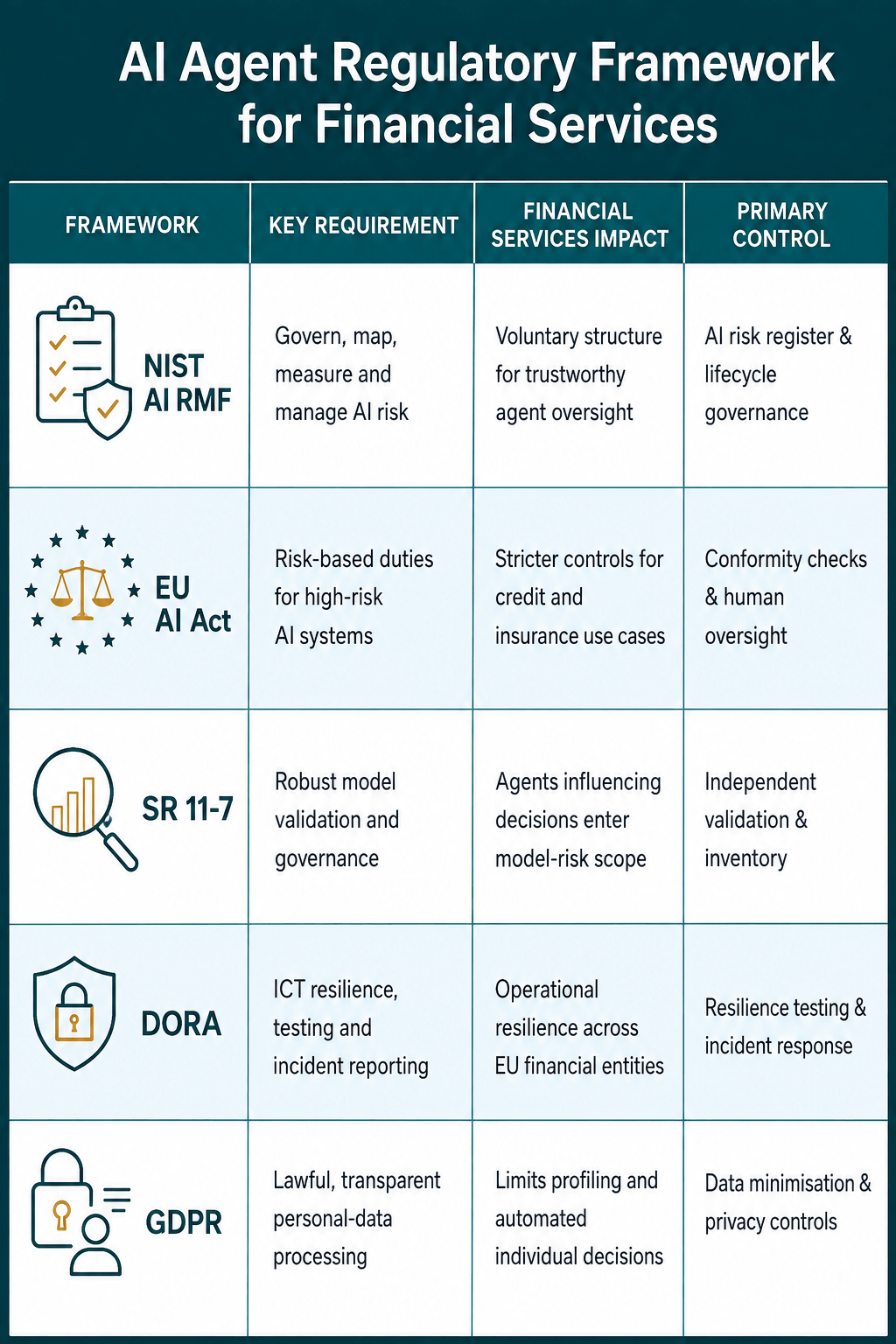
Financial services AI governance operates under a layered regulatory environment that is tightening rapidly. The following matrix maps the primary frameworks applicable to AI agents in BFSI and their specific control implications.
For a practical view of how AI agents are being deployed across regulated sectors and what architecture patterns are emerging, the guide on industry-specific AI agents covers the implementation considerations across BFSI, healthcare, and manufacturing in depth.
AI Agent Access Controls: Least-Privilege Architecture
The single most impactful AI agent access controls decision is the one made before the agent touches any system: define the minimum permission set required for the agent to complete its defined function, and grant nothing beyond that. In AI security in banking, this is not a best practice. It is the foundational control from which every other security measure derives its effectiveness.
Never Share Credentials Between Agents and Human Users
Human user credentials carry implicit trust and often broad access inherited from role-based permission models built for people. An AI agent running under a human credential inherits every permission that human has, including access to systems the agent has no business touching. Every agent must have its own non-human service account with permissions scoped explicitly to the agent's function.
Scoped Permissions, Ephemeral Credentials, JIT Access
Each agent should hold the minimum permissions required for each specific call. Where the agent needs access to a sensitive system for a single task, implement just-in-time credential provisioning that grants access for the duration of the task and revokes it immediately on completion. Ephemeral credentials eliminate the persistent access that makes a compromised agent a persistent threat.
Action Blocklist: What No Agent Should Do Autonomously in Banking
- Initiate wire transfers above defined thresholds without human approval
- Close or freeze accounts without a logged human authorisation
- Modify KYC data or identity verification records
- Access data outside the specific customer or account scope of the current task
- Communicate externally (email, SMS, API calls to third parties) without content filtering and logging
We'll map the exact workflows from this article to your business - free, in 30 minutes.
Building a Secure AI Agent Programme: Where to Start
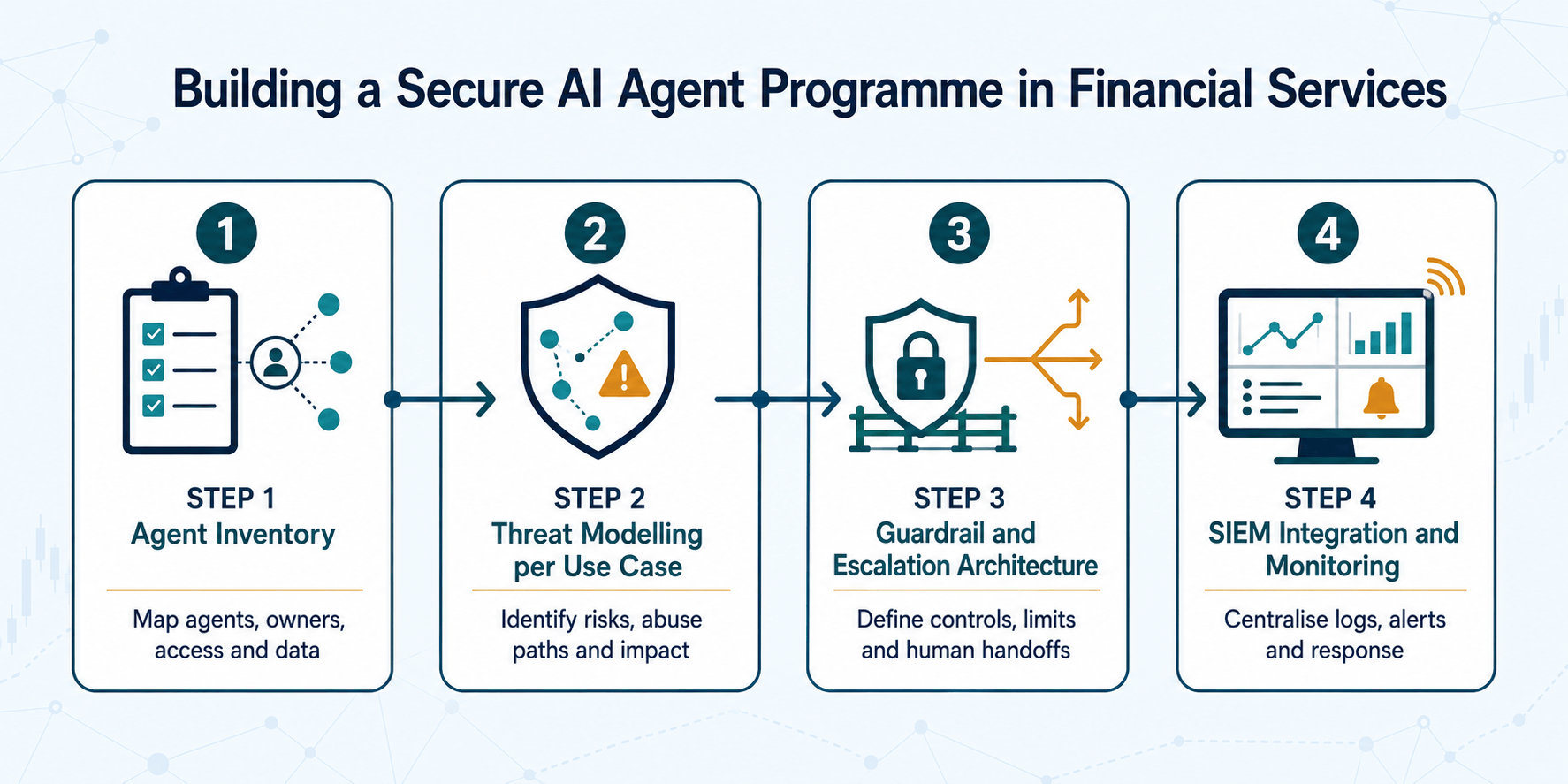
For financial services teams at the start of formalising their AI agent security in financial services programme, the sequence matters. The worst outcome is building the agent, then the guardrails. The right sequence puts governance and access architecture before any agent reaches production data.
Step1: Inventory every AI agent currently in production and pilot across the organisation. Many financial services firms have more agents running than their CISO knows about.
Step2: Run a threat model per agent use case using the five threat categories in Section 2. Score each by likelihood and financial services impact severity.
Step3: Define the guardrail architecture and escalation thresholds before engineering begins. Get compliance sign-off on the audit logging design before the first line of agent code is written.
Step4: Integrate agent monitoring into your existing SIEM and SOC workflows. Agents should generate alerts the same way applications do, not be treated as a separate monitoring silo.
For financial services organisations building the technical foundation for secure agent deployments, fintech software development services that combine financial domain knowledge with security-first AI architecture are the most direct path to production-grade agentic systems that satisfy both engineering and compliance requirements.
Conclusion
The financial services firms that will use AI agents safely and at scale are not the ones that deploy the most agents. They are the ones that build the security architecture before the first agent reaches production. AI agent security in financial services is not a project that follows deployment. It is the prerequisite for deployment. The governance gap between agentic AI adoption and agentic AI security is real, measurable, and closeable. Closing it requires treating agent security as infrastructure, not afterthought.
Frequently Asked Questions
1. What is AI agent security in financial services?
AI agent security in financial servicesrefers to the controls, governance frameworks, and compliance architecture required to deploy autonomous AI agents safely in banking, insurance, and fintech environments. Unlike traditional model security, it addresses agents that take actions, not just produce outputs: transacting, accessing data, and communicating with customers without human approval at each step.
2. What are AI agent guardrails?
AI agent guardrails are architectural controls that define and enforce the boundaries of an AI agent's behaviour: what inputs it will accept, what actions it can take, what data it can access, and under what conditions it must escalate to a human. Guardrails are not a product layer you add after deployment. They are design decisions made before the first line of agent code is written.
3. What regulations apply to AI agents in banking?
The primary frameworks governing AI agent compliance in financial services are NIST AI RMF (adopted by most US institutions), SR 11-7 (model risk management, now extended to AI agents), DORA (EU, January 2025, ICT risk including AI), the EU AI Act (high-risk classification for BFSI AI), and GDPR for consumer-facing automated decisions.
4. What is the biggest AI agent security risk in finance?
Prompt injection is the highest-severity technical threat: an adversary embeds malicious instructions in data the agent reads, causing it to take unintended actions. But the biggest systemic risk is governance failure: agents deployed without defined ownership, action boundaries, or audit trails, where no one can determine what the agent did or why after an incident.
5. How do I implement least-privilege access for AI agents?
Assign each agent its own dedicated non-human service account. Define the specific APIs, databases, and systems the agent needs for its function and grant only those. Implement just-in-time credential provisioning for sensitive system access, revoking credentials immediately after task completion. Never allow AI agent access controls to be inherited from human user accounts.
6. What is human-in-the-loop for AI agents?
Human-in-the-loop(HITL) is an architectural requirement that mandates human approval before an agent executes defined classes of high-risk actions. In financial services this typically includes transactions above defined value thresholds, account status changes, and any action with irreversible consequences. HITL is not a fail-safe added after the agent runs. It is a pre-execution gate configured as part of the agent's action boundary architecture.
You may also want to read
What Is a Cloud Transformation Assessment? A Guide for Enterprises