Enterprise teams today face a relentless pressure: do more with the same headcount, make faster decisions with more data, and stay ahead of competitors who are moving quickly. Traditional automation helped - but it was rigid, rule-based, and broke the moment an exception appeared.
Agentic AI for enterprises changes that equation. Instead of following a fixed script, AI agents reason through goals, use tools, coordinate across systems, and take action - all with minimal human intervention. They do not just answer questions; they get things done.
This guide walks you through everything you need to know to implement agentic AI in enterprise applications the right way: what it is, how it works architecturally, and a clear step-by-step process to go from first use case to production scale. Whether you are a CIO, IT leader, or digital transformation head, this is your practical starting point.
What Is Agentic AI - And Why Are Enterprises Moving Fast on It?
From Single Prompts to Autonomous Agents
Most people have experienced generative AI as a question-and-answer tool: you type a prompt, it gives a response. Useful - but still reactive and limited to one step at a time.
Agentic AI in enterprise applications works very differently. An AI agent is given a goal - not just a question - and it plans how to achieve it, selects the tools it needs, executes tasks across multiple systems, checks its own output, and adapts if something changes. Think of it less like a search engine and more like a capable, always-available digital co-worker.
For enterprises, this distinction is fundamental. A generative AI tool might draft an email. An agentic AI system can receive a customer complaint, query the CRM for history, check inventory status, draft and send a resolution email, and log the outcome - all without a human directing each step.
Our engineers will audit your workflow and estimate time-to-value at no cost.
Claim your free audit
Agentic AI vs. Generative AI in Enterprises
Both technologies have a place in the modern enterprise. Here is how they compare:
The takeaway: generative AI makes your people smarter. Agentic AI makes your operations faster and more autonomous. Both together create an enterprise that is genuinely competitive.
Core Architecture of Agentic AI for Enterprises
Before you can implement agentic AI, you need to understand what powers it. A robust agentic AI architecture for enterprises is not a single model - it is a layered system of four interconnected components working together.
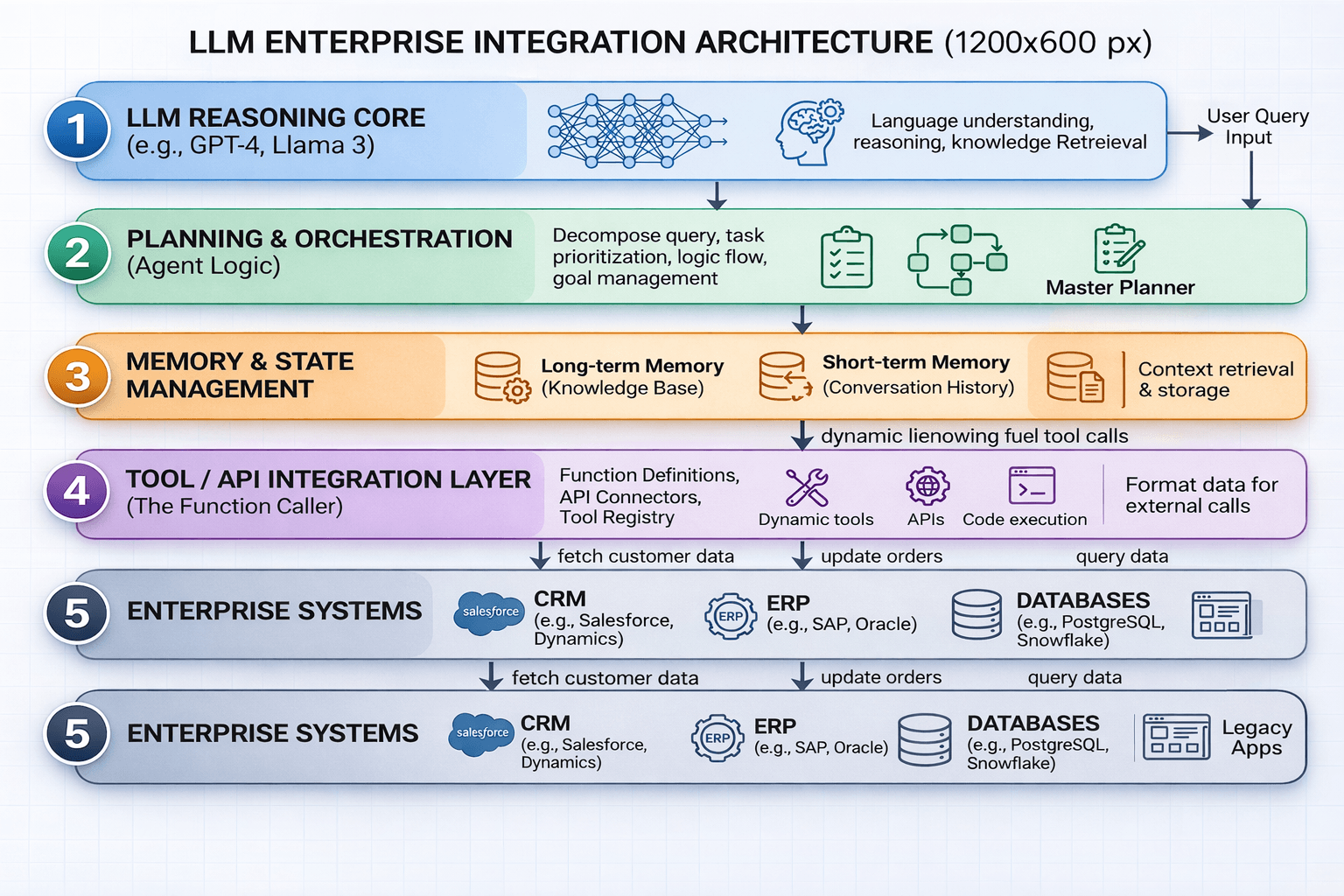
The Four Layers Every Enterprise Agentic System Needs
1. LLM Reasoning Core
This is the brain of the agent - a large language model (such as GPT-4, Claude, or Gemini) that understands natural language goals, reasons through complex problems, and generates step-by-step plans. The model receives the objective and breaks it into sub-tasks the system can execute.
2. Planning and Orchestration Engine
The orchestration layer decides which tools to use, in what sequence, and when to escalate to a human. This is what makes agentic AI genuinely autonomous rather than just reactive. In enterprise deployments, frameworks like LangGraph, AutoGen, and CrewAI handle this layer. Critically, CIO.com recommends deploying an LLM gateway as the central control panel - acting as a unified entry point that manages model routing, rate limiting, guardrails, PII filtering, and observability across all agents. This platform-first approach is what separates scalable enterprise deployments from one-off pilots
3. Memory and State Management
Unlike single-turn AI, agentic systems maintain context across time and tasks. This breaks into three types:
• Short-term memory - context within an active session or task
• Long-term memory - knowledge stored across sessions using vector databases such as Pinecone or Weaviate
• Episodic memory - logs of previous agent actions, used for audit trails, compliance, and continuous improvement
4. Tool and API Integration Layer
Agents are only as powerful as the systems they can reach. In enterprise environments, this means connecting securely to CRM platforms, ERP systems, internal databases, data warehouses, communication platforms, and custom internal APIs
We'll map the exact workflows from this article to your business - free, in 30 minutes.
Step-by-Step: How to Implement Agentic AI in Enterprise Software
Successful enterprise AI transformation with agentic AI does not happen through a single big-bang deployment. It is a phased, deliberate journey - from a focused pilot to a governed, production-scale system. Here is how to do it right.
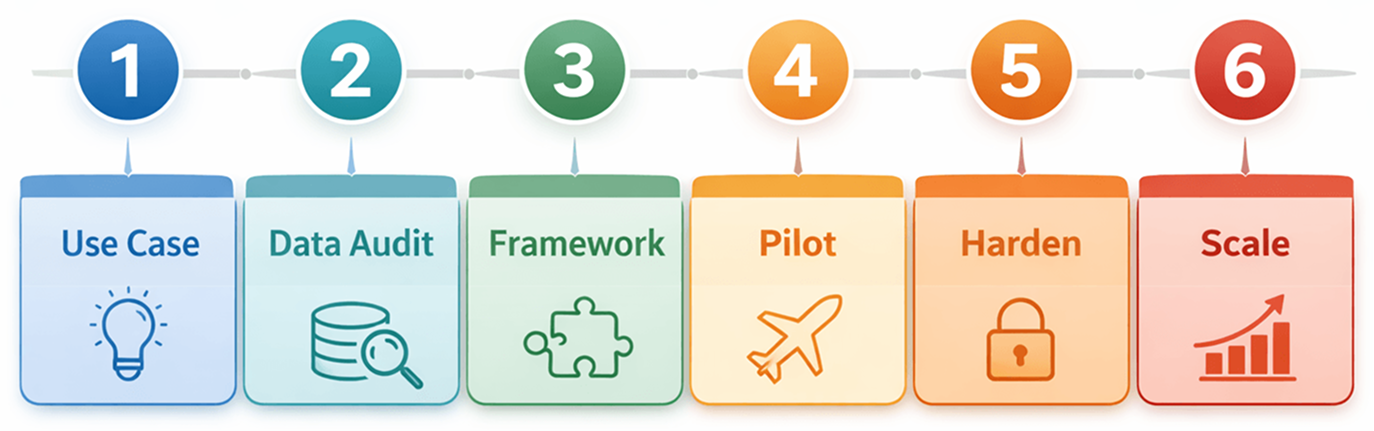
Step 1: Define Your Use Case and Business Outcome
The most common mistake enterprises make is starting with technology instead of business outcome. Before selecting any tool or framework, get specific about the problem you are solving.
Agentic AI works best for processes that are multi-step with several decision points, high-frequency and repetitive, and data-driven - where the right action depends on reasoning across multiple data sources.
Strong starting examples include invoice processing, IT incident resolution, customer onboarding, compliance monitoring, and lead qualification. Tie your use case to a measurable success metric from day one. If you cannot define what success looks like, you will never be able to prove value or justify scaling.
Step 2: Assess Your Data and Integration Readiness
Agentic AI is only as reliable as the data it can access. Before you build anything, audit your readiness across three areas. For a deeper look at how leading enterprises handle this, see our guide on agentic AI workflow automation in enterprises.
• Data quality: Is your data clean, complete, and up to date across the relevant systems?
• API availability: Can your core enterprise platforms be accessed programmatically?
• Existing automation: What RPA or iPaaS tools are already in place that agents could build on?
Gaps here do not mean you cannot proceed - but they do mean you need a data remediation plan before you build. Skipping this step is the single biggest cause of agent deployments that fail to scale.
Step 3: Choose the Right Agentic AI Frameworks and Tools
Your technology choices should follow your use case - not the other way around. Here is a quick reference for the most widely adopted agentic AI frameworks and tools in enterprise environments:
Step 4: Build a Focused Pilot with Human-in-the-Loop Checkpoints
Resist the urge to automate everything at once. Pick the single use case you identified in Step 1, build a tightly scoped proof of concept, and design human oversight into the architecture from the start - not as an afterthought. Salesforce's Agentic AI Playbook recommends deploying to just 5-10% of your traffic or volume initially, which gives you real-world data without exposing your entire operation to risk.
A strong pilot has a single, well-defined workflow with measurable success criteria, one or two connected systems rather than the entire tech stack, explicit human checkpoints at every high-stakes decision point, and a feedback mechanism so agent output can be rated and improved continuously.
Step 5: Integrate, Test, and Harden
Once the pilot demonstrates value, move to full integration with live systems. Connect agents to live enterprise systems with proper role-based authentication, stress-test edge cases, add guardrails including rate limits and PII filtering, and run a security and compliance review - especially important in regulated industries.
Step 6: Scale with Governance and Monitoring
Deploying an agent is the beginning, not the end. Treat your agents the same way you treat your human employees: coach them, measure them, and continuously improve them.
• Deploy an agent performance dashboard tracking completion rate, error rate, escalation rate, and task latency
• Maintain full audit logs for every agent action - critical for compliance in regulated industries
• Establish a Center of Excellence (CoE) to govern agent development and set standards across teams
• Build continuous feedback loops so real-world outcomes improve agent behaviour over time
Agentic AI Use Cases in Business: Where It Delivers Real ROI
Agentic AI use cases in business span every major enterprise function. The ROI compounds when agents across departments begin sharing context and coordinating actions.
Finance and Accounting
• Automated invoice processing, three-way matching, and exception handling
• Real-time fraud detection - agents that monitor transaction patterns and flag anomalies instantly
• Regulatory compliance monitoring: agents track rule changes and audit internal processes continuously
HR and Talent Management
• Autonomous candidate screening: agents match CVs to job requirements and rank shortlists
• Onboarding orchestration: agents trigger account creation, training assignments, and equipment requests across multiple systems
• Employee query resolution for HR policies, payroll, and benefits without routing every question to a human
Customer Service
• End-to-end resolution of complex, multi-turn customer queries without human queues
• Proactive outreach: agents identify at-risk customers and trigger personalised interventions
Salesforce's Agentforce achieved an 85% resolution rate in production customer service deployments - with human agents freed to focus on the most complex, relationship-critical interactions.
IT Operations
• Incident detection, root cause analysis, and auto-remediation without manual triage
• Patch management and compliance enforcement across distributed infrastructure
• Infrastructure monitoring with autonomous alerting, escalation, and preliminary diagnosis
Key Challenges of Implementing Agentic AI - And How to Overcome Them
The challenges of implementing agentic AI are real - but they are manageable when anticipated early. Here is where enterprise deployments most often run into difficulty, and what to do about each.
According to SketchDev's Agentic AI Implementation Guide, pilot purgatory - where AI initiatives succeed at small scale but never make it into mainstream operations - is one of the most common and costly failure patterns in enterprise AI. The remedy is to define what scale looks like before you start, not after.
Best Practices for Agentic AI Implementation
Organisations that successfully build and scale agentic AI for enterprises share a consistent set of habits. These are the patterns that separate deployments that compound in value from deployments that stall.
• Start with one well-defined, measurable use case - not a broad transformation programme
• Design human-in-the-loop oversight into the architecture from the start, not as an afterthought
• Use modular, composable agent design so you can add or swap tools without rebuilding from scratch
• Treat prompt engineering and agent testing as first-class engineering disciplines with their own QA processes
• Track agent KPIs alongside business KPIs: completion rate, error rate, cost per task, and escalation rate
• Build feedback loops that route real-world outcomes back into agent improvement - agents should get better over time
• Invest in change management as seriously as technical implementation - the biggest barrier to scale is people, not technology
Pace Wisdom's AI and machine learning solutions for enterprises cover every stage of this journey - from initial strategy and agentic AI architecture through to deployment, monitoring, and long-term optimisation.
The Future of Agentic AI in Enterprise Software
The trajectory of agentic AI in enterprise software is steep and fast-moving. By 2028, analysts project that 33% of all enterprise applications will include native agentic capabilities - up from less than 1% in 2024. The organisations building scalable AI agent systems for enterprises today are setting the competitive baseline for their industries.
Key trends shaping the next phase of enterprise agentic AI include:
• Agent-to-agent (A2A) ecosystems - networks of specialised agents collaborating across departments and across organisational boundaries, per Salesforce AI Research
• Vertical-specific agents - pre-built, compliance-ready agents for legal, healthcare, finance, and manufacturing
• Robotics convergence - digital agents directing physical systems in warehouses, facilities, and industrial environments
• Enterprise General Intelligence (EGI) - AI systems that combine high capability with high consistency across complex, mission-critical workflows
• Regulated-domain agentic AI - governance frameworks specifically designed for GDPR, HIPAA, and sector-specific compliance requirements
The enterprises that invest in building autonomous AI agents for business today will be positioned to lead their industries not just in efficiency - but in the speed, quality, and scale of innovation they can deliver.
Conclusion: Enterprise AI Transformation Starts with the Right Foundation
Implementing agentic AI for enterprises is not a single project with a start and end date. It is a capability you build deliberately - starting with one focused use case, validating it rigorously, and scaling with governance and measurement baked in from the beginning.
The organisations that win with agentic AI are not the ones with the biggest budgets. They are the ones with the clearest outcomes, the strongest data foundations, and the discipline to treat agents as a long-term product - not a short-term experiment.
Whether you are defining your first use case or ready to scale enterprise AI automation across business units, the right partner makes the difference. Pace Wisdom's AI and machine learning solutions for enterprises are built to meet organisations where they are - and help them move further, faster, with confidence.
Frequently Asked Questions About Agentic AI for Enterprises
1: What is the difference between agentic AI and traditional automation like RPA?
Traditional RPA (Robotic Process Automation) follows fixed, rule-based scripts. It breaks when the process changes or an exception appears. Agentic AI, by contrast, can reason through variability - it understands the goal, not just the steps. When it encounters an exception, it can assess options, decide on an action, and escalate to a human if needed. For enterprises, agentic AI handles the messy, judgment-heavy processes that RPA was never designed for.
2 : How long does it typically take to implement agentic AI in an enterprise?
A focused pilot for a single, well-scoped use case can be live in 4-8 weeks, depending on data readiness and integration complexity. Full production deployment with governance, monitoring, and multi-system integration typically takes 3-6 months. Enterprises that try to do too much too fast - integrating multiple systems and use cases simultaneously - consistently take longer and achieve worse outcomes than those that start narrow and scale deliberately.
3 : What are the biggest risks of implementing agentic AI in enterprise applications?
The three most significant risks are:
(1) Data quality issues that cause agents to make decisions on incomplete or inaccurate information.
(2) Security gaps, particularly prompt injection attacks and unauthorised data access if proper guardrails are not in place.
(3) Governance failures - agents taking actions that are technically correct but operationally inappropriate without a human review step.
All three are preventable with proper architecture and planning, which is why data and governance readiness should come before any agent build.
4 : Do enterprises need to build custom AI agents or can they use off-the-shelf platforms?
Most enterprises benefit from a hybrid approach. Off-the-shelf platforms like Salesforce Agentforce, Microsoft Copilot Studio, or AWS Bedrock Agents offer faster time to value for standard business processes and reduce the engineering overhead of building from scratch. Custom agent builds using frameworks like LangGraph or CrewAI are more appropriate for unique workflows, proprietary processes, or situations where deep integration with legacy systems is required. The right choice depends on your use case, internal engineering capability, and how differentiated your process is.
5 : How does Pace Wisdom help enterprises implement agentic AI?
Pace Wisdom's AI Practice Team works with enterprises across the full agentic AI implementation lifecycle - from use case identification and architecture design to pilot build, production deployment, and ongoing optimisation. Our engagements are grounded in real delivery experience across industries including BFSI, healthcare, retail, and technology. To explore how we can support your agentic AI journey, visit our AI and ML Solutions page or read more about our approach to enterprise workflow automation with agentic AI.
You may also want to read