Logistics has always been a race against time, cost, and complexity. But today, the rules of that race are changing fast. Multi agent AI systems in logistics are replacing manual dispatch boards and rigid routing software with intelligent, self-coordinating networks that adapt in real time. From fuel-hungry detours to missed delivery windows, these systems tackle the most expensive pain points in fleet management: automatically, continuously, and at scale.
For a deeper look at how this fits into broader supply chain strategy, explore Pace Wisdom's Logistics and Supply Chain Managed Services.
What Are Multi Agent AI Systems in Logistics?
A multi-agent AI system is a network of specialized AI agents that each handle a distinct function (routing, predictive maintenance, dispatch scheduling, and driver compliance) while communicating and coordinating with one another in real time. Unlike a single AI model trying to do everything, each agent is purpose-built for its domain and passes decisions up or across to other agents when needed.
In a logistics context, this means one agent monitors live GPS feeds and traffic data, another tracks vehicle health diagnostics, a third manages delivery window compliance, and a central orchestrator ties all their decisions together into one unified operational output.
Our engineers will audit your workflow and estimate time-to-value at no cost.
Claim your free audit
How They Differ from Single-Agent and Traditional Automation
Here is how the three approaches compare across key operational capabilities:

We'll map the exact workflows from this article to your business - free, in 30 minutes.
Why Logistics Enterprises Are Adopting Multi Agent AI Systems Now
Scale, Complexity, and Real-Time Pressure
Modern logistics operations span hundreds of vehicles, thousands of daily stops, multiple time zones, and ever-shifting customer expectations. Real-time fleet management AI is no longer a competitive advantage; it is an operational necessity. A single rerouting decision delayed by even 10 minutes can cascade into missed SLAs, failed deliveries, and idle drivers across an entire region.
Multi-agent systems are built for this scale. They process simultaneous inputs from every vehicle, every depot, and every delivery constraint, and resolves conflicts across all of them in seconds.
IoT and Telematics as the Data Foundation
The power of multi-agent AI depends entirely on the quality and speed of its data inputs. IoT integration fleet routing connects agents to a continuous stream of live signals: GPS position updates, engine diagnostics via OBD-II, fuel card transactions, Electronic Logging Device (ELD) records, and real-time road condition data.
Each agent subscribes to the data streams relevant to its function. The maintenance agent watches engine temperature and brake wear. The routing agent watches GPS and traffic APIs. Together, they form a nervous system for the entire fleet.
Core Functions of Multi Agent AI Systems in Fleet and Route Management
Multi agent AI systems in logistics do not just automate existing processes. They fundamentally reimagine what fleet operations can do. AI fleet route optimization and dynamic route optimization AI are at the heart of the value these systems deliver.
Dynamic Route Optimization AI
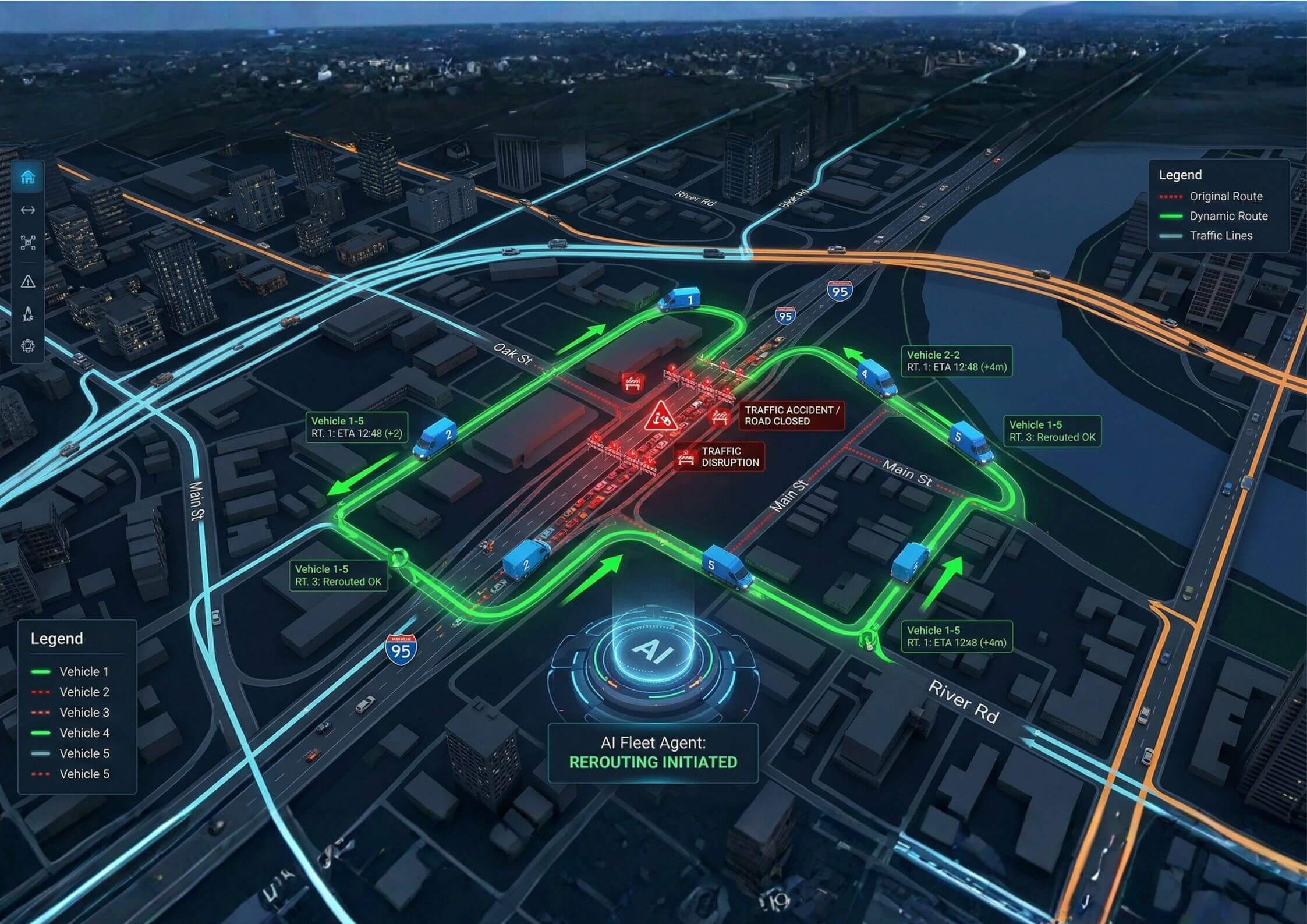
Traditional routing tools calculate the best path once, at the start of the day. Dynamic route optimization AI recalculates continuously. It factors in live traffic congestion, weather events, road closures, updated delivery windows, and vehicle capacity in real time.
The results speak for themselves. UPS's ORION system processes over 1 billion data points daily and has saved the company an estimated 38 million liters of fuel annually by shaving just one mile per driver per day across its fleet.
Predictive Maintenance for Fleets
Unplanned vehicle breakdowns are among the most expensive events in logistics operations. Beyond repair costs, they cause missed deliveries, driver reassignment, and customer relationship damage. Predictive maintenance for fleets uses machine learning models to analyze engine sensor data, brake wear indicators, tire pressure patterns, and transmission diagnostics.
These models can flag likely failure events 2 to 4 weeks before they occur, giving fleet managers time to schedule repairs during off-peak hours rather than responding to emergency breakdowns mid-route.
Fuel Cost Reduction Through Route Optimization
Fuel is typically the largest variable cost in fleet operations. AI routing reduces fuel spend by 10 to 25 percent through a combination of smarter route sequencing, load balancing across vehicles, and driver behavior coaching. All of this is powered by fuel cost reduction route optimization models that learn continuously from historical and live data.
Even a 10 percent reduction in fuel costs across a 200-vehicle fleet translates to hundreds of thousands of dollars saved annually.
Last-Mile Delivery Optimization AI
Last-mile delivery accounts for approximately 53 percent of total logistics costs, and it is the most unpredictable leg of any shipment. Last mile delivery optimization AI enables agents to dynamically re-sequence stops based on traffic, customer availability updates, failed delivery attempts, and package priority rules.
These agents also generate accurate ETAs, notify customers in real time, and automatically reschedule failed deliveries, reducing both cost and customer friction simultaneously.
Machine Learning Route Prediction
Every delivery creates data. Machine learning route prediction models learn from this historical record. It identifies which routes perform best under which conditions, which drivers are most efficient on which road types, and which time windows yield the highest first-attempt delivery success rates.
Over time, the system gets measurably smarter. Route quality improves not just because of better real-time data, but because the underlying models are continuously retrained on accumulated operational experience.
For a technical deep-dive on agent architectures in fleet management, see this resource from Akira.ai on AI Agents for Fleet Route Management.
How Multi Agent AI Systems Coordinate Fleet Operations
What makes multi-agent AI fundamentally different from a collection of standalone tools is coordination. Each agent shares state and signals with the others, enabling the system to make decisions that reflect the full operational picture, not just one slice of it.
The Orchestrator and Specialist Agent Architecture
At the center of every multi-agent deployment is an orchestrator, which acts as the master coordination layer that receives signals from all specialist agents and resolves their outputs into unified decisions. In a typical autonomous supply chain technology architecture, this includes:
- Routing Agent - calculates and continuously updates optimal delivery sequences
- Maintenance Agent - monitors vehicle health and triggers service alerts or depot reassignments
- Dispatch Agent - manages driver availability, shift windows, and load assignments
- Compliance Agent - enforces Hours of Service rules, weight limits, and regional regulations

Conflict Resolution Across Agents
Agent conflicts are inevitable in real-world operations. The cheapest route may violate a driver's hours-of-service window. The fastest pickup may require a vehicle flagged for maintenance. The orchestrator layer resolves these conflicts by applying weighted priority rules (typically cost, compliance, and customer SLA) and selecting the outcome that best satisfies the highest-priority constraints.
This conflict resolution capability is what separates multi-agent systems from simple automation: the system handles trade-offs that previously required a human dispatcher to evaluate.
Real-World Business Value of Multi Agent AI Systems in Logistics
Time Savings and On-Time Delivery
DHL has reported a 25 percent reduction in delivery times using AI-powered Smart Trucks, along with a 95 percent accuracy rate in delivery time prediction. These numbers reflect what becomes possible when routing, dispatch, and vehicle monitoring are unified under a single intelligent system rather than managed as separate operational silos.
Driver Safety and Compliance
AI agents monitor driver behavior continuously, tracking hard braking events, speeding patterns, sharp cornering, and signs of fatigue based on driving rhythm analysis. Alerts are pushed in real time to fleet managers and drivers, enabling proactive intervention before an incident occurs. This reduces accident rates, insurance costs, and regulatory liability simultaneously.
Sustainability and Emissions Reduction
AI-optimized routing reduces empty miles (the distance driven with no cargo), which is one of the largest contributors to unnecessary fuel burn and carbon emissions in logistics. By coordinating vehicle loads and return routes intelligently, multi-agent systems can meaningfully cut a fleet's carbon footprint while also reducing operating costs.
To understand how agentic AI fits within a broader digital transformation strategy, read Pace Wisdom's blog on Agentic AI in Digital Transformation.
How to Implement Multi Agent AI Systems in Your Logistics Operations
Adopting AI fleet route optimization and real-time fleet management AI does not require replacing your entire technology stack. Most enterprises start with a structured four-step approach.
Step 1: Audit Existing Workflows and Data Infrastructure
Begin by mapping your current fleet operations end to end. Identify what data you already capture, including GPS logs, fuel records, maintenance history, and delivery outcomes, and assess the gaps. Evaluate your existing TMS and ERP platforms for API accessibility, since integration readiness determines how quickly agents can be connected to live operational data.
Step 2: Define Agent Roles and Optimization Goals
Decide which functions will be handled by dedicated agents (routing, predictive maintenance, dispatch, and compliance) and define clear KPIs for each. This step is critical: vague objectives lead to agents optimizing for the wrong outcomes. Set measurable targets such as on-time delivery rate, fuel cost per mile, and unplanned maintenance incidents per quarter.
Step 3: Integrate IoT, Telematics, and External Data Feeds
Connect your agents to the data streams they need: GPS telemetry, ELD feeds, fuel card systems, weather APIs, and real-time traffic data. IoT integration fleet routing is the technical foundation on which every agent's decision quality depends. Without clean, timely data inputs, even the most sophisticated AI models produce unreliable outputs.
Step 4: Start with a Pilot Fleet, Then Scale
Launch with a pilot group of 20 to 50 vehicles. Measure performance against your baseline KPIs over 3 to 6 months. Most fleets see measurable ROI within this window, particularly from fuel savings and reduced unplanned maintenance. Once validated, expand the system enterprise-wide with confidence in the ROI model.
Conclusion: Multi Agent AI Systems as the Future of Fleet Intelligence
Multi agent AI systems in logistics are not a future technology. They are an operational reality delivering measurable results today. From dynamic route optimization and predictive maintenance to last-mile AI and IoT-powered telematics, these systems bring together every dimension of fleet intelligence into one coordinated, continuously improving platform.
The logistics enterprises winning on efficiency, cost, sustainability, and customer experience are the ones investing in this architecture now, not waiting for it to become standard practice.
Ready to explore what multi-agent AI can do for your fleet? Connect with the team at Pace Wisdom's Logistics and Supply Chain Managed Services to start the conversation.
Frequently Asked Questions (FAQs)
1. What are multi agent AI systems in logistics and how do they work?
Multi agent AI systems in logistics are networks of specialized AI agents, each handling routing, maintenance, dispatch, or compliance, governed by a central orchestrator. They share live data continuously, resolve conflicts automatically, and make coordinated decisions across the entire fleet in real time.
2. How does dynamic route optimization AI differ from standard GPS navigation?
Standard GPS finds the shortest or fastest path based on static map data. Dynamic route optimization AI simultaneously accounts for live traffic, weather disruptions, delivery time windows, driver availability, vehicle capacity, and customer priority. It recalculates routes continuously as conditions change.
3. What is predictive maintenance for fleets and why does it matter?
Predictive maintenance for fleets uses machine learning models to analyze vehicle sensor data (engine diagnostics, brake wear, tire pressure) and forecast likely failures 2 to 4 weeks in advance. This eliminates costly emergency breakdowns, reduces unplanned downtime, and keeps delivery commitments intact.
4. How do multi agent AI systems reduce fuel costs in logistics?
They combine smarter route sequencing, real-time traffic avoidance, load balancing across vehicles, and driver behavior coaching to deliver fuel cost reductions of 10 to 25 percent. Fuel cost reduction route optimization models improve continuously as they learn from more operational data over time.
5. Can multi agent AI systems integrate with existing TMS and ERP platforms?
Yes. Modern multi-agent platforms connect via standard APIs to existing TMS, ERP, WMS, telematics providers, and IoT devices. Full stack replacement is not required. Most implementations layer AI agents on top of existing systems progressively, starting with the highest-impact functions first.
6. What is last-mile delivery optimization AI and why is it critical?
Last-mile delivery optimization AI dynamically re-sequences final-leg stops, generates accurate ETAs, handles failed delivery exceptions, and coordinates real-time customer notifications. Since last-mile costs represent approximately 53 percent of total logistics spend, even modest improvements in this leg deliver significant financial impact.
7. How long does it take to see ROI from AI fleet management systems?
Most fleets report measurable ROI within 3 to 6 months of deployment. The fastest returns typically come from fuel savings and reduced unplanned maintenance costs, both of which are quantifiable within the first full quarter of operation at scale.
You may also want to read
What Is a Cloud Transformation Assessment? A Guide for Enterprises