Your ERP system has been collecting data for years. But if your team is still manually reconciling reports, chasing down forecasts, or spending hours on tasks that feel like they could run themselves. Something is off.
That gap is exactly where AI in Odoo ERP steps in.
Odoo has evolved from a flexible, modular ERP suite into a genuinely intelligent business platform. With AI now embedded natively across its core modules, including sales and CRM to finance, inventory, and HR. Businesses of all sizes can automate the repetitive, predict the unpredictable, and make faster decisions backed by real data.
In this blog, we break down how Odoo AI automation is transforming the way businesses operate, what it means for your sales pipeline, and the practical use cases you can act on today.
Why AI Is Now Central to Modern Odoo ERP
From Data Store to Decision Engine
Traditional ERP systems were built to record things like purchase orders, invoices, headcounts, stock levels. They told you what happened after it already did. That's useful, but it's no longer enough in a market where speed and accuracy of decision-making determine who wins.
AI-driven ERP systems flip this model. Instead of waiting for a human to pull a report, AI analyses patterns in real time and surfaces what needs attention before it becomes a problem. Odoo has taken this further than most: since Odoo 17, AI is built directly into the platform's core, not available as an expensive optional add-on.
Odoo 18 expanded this with AI-powered content drafting, document parsing, and predictive analysis. Odoo 19 goes further still, introducing customisable AI agents that operate across any module, from helpdesk to inventory, learning from your business data as they go.

Key Benefits of AI in Odoo ERP
Here is what businesses are seeing after activating AI-driven ERP systems in Odoo:
- 40% faster invoice processing through automated vendor bill handling
- Up to 25% improvement in demand forecasting accuracy
- 70% of AI-integrated ERP implementations lead to faster decision-making
- 60% more accurate customer data through AI-driven enrichment
- 35% reduction in order processing times for retail businesses
Our engineers will audit your workflow and estimate time-to-value at no cost.
Claim your free audit
Smarter Workflows: AI-Powered Workflow Automation in Odoo
One of the clearest benefits of AI in Odoo ERP is what it does to the day-to-day. Tasks that once required manual input, including data entry, reordering stock, chasing invoice approvals, can now run on their own, triggered by logic, not by someone remembering to do it.
Automating Repetitive Business Processes
Odoo AI automation handles the routine so your team can focus on the work that actually requires human judgement. Key areas include:
- Invoice capture & reconciliation: OCR extracts data from bills and receipts; AI matches them to journal entries automatically
- Inventory replenishment: purchase orders are generated based on forecasted demand, supplier lead times, and seasonal patterns
- HR operations: resume shortlisting, onboarding task creation, and performance tracking are streamlined
- Email workflows: AI drafts outreach, follow-up sequences, and customer replies based on context and history
Copilot Assistance and Natural Language Dashboards
Beyond automation, Odoo now offers guided, copilot-style assistance. Users get step-by-step AI support through complex processes like inventory adjustments, quality checks, accounting reconciliations, without needing to know every menu.
Ask Odoo Anything
In Odoo 18 and 19, dashboards are no longer static. Users can ask questions in plain English, such as "What were our top-selling products last quarter?" or "Which invoices are overdue?" and receive real-time answers instantly. No SQL. No waiting for a report to be built.
If your business needs these capabilities shaped around specific processes or industries, Pace Wisdom's Odoo ERP customization services cover everything from AI module setup to full workflow design.
We'll map the exact workflows from this article to your business - free, in 30 minutes.
Sales Intelligence: AI-Driven Forecasting & CRM in Odoo
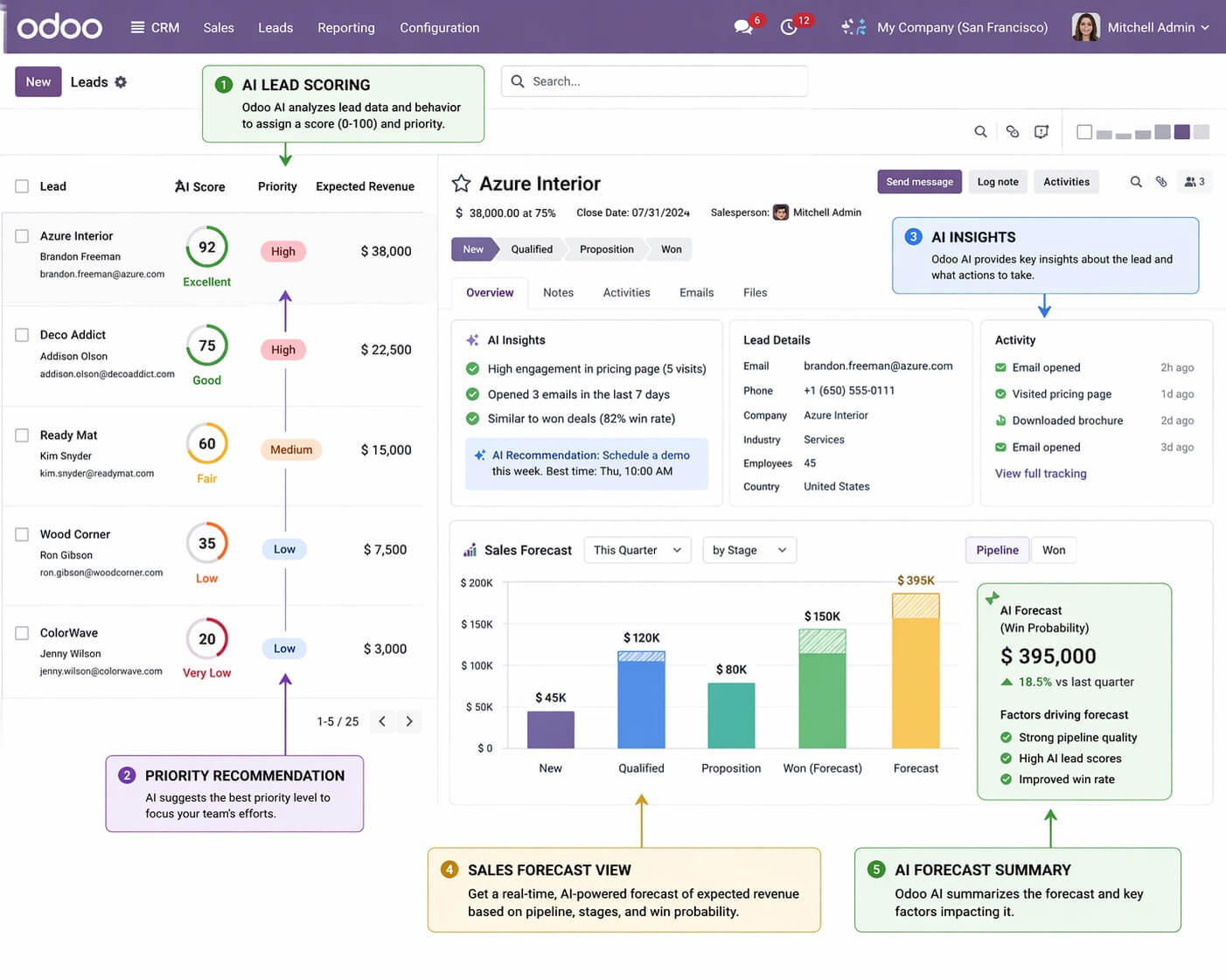
Sales is where AI in Odoo ERP arguably has its most visible impact. Odoo sales intelligence turns your CRM from a record-keeping tool into a revenue engine that guides your team toward the right deals at the right time.
Predictive Sales Forecasting in Odoo
Odoo's AI analyses historical sales data, deal stages, buyer behaviour, and external market patterns to generate forecasts that are far more accurate than manual projections. Sales managers get a clearer view of which deals will close, which are stalling, and where pipeline gaps are forming, well in advance. AI-driven sales forecasting in Odoo surfaces:
- Win-probability scores updated automatically as deals progress
- Pipeline health alerts for at-risk opportunities before they go cold
- Revenue projections by product line, region, or sales rep
Smarter CRM: From Reactive to Proactive
AI in CRM Odoo goes well beyond forecasting. It changes how your team engages with customers at every stage:
- Lead scoring: AI ranks leads by conversion probability so reps prioritise effort where it matters
- Personalised outreach: AI drafts context-aware emails based on deal stage and customer history
- Sentiment analysis: NLP tools read customer messages and flag frustration or urgency before it escalates
- AI chatbots: 24/7 virtual agents handle common queries instantly, freeing support teams for complex cases
- Churn prediction: AI identifies at-risk accounts early so account managers can intervene proactively
According to Gartner, 75% of ERP systems were projected to leverage AI by 2025 to enhance productivity. Odoo's native integration means businesses gain these capabilities without paying for expensive third-party add-ons.
Odoo AI Use Cases Across Business Functions
The reach of Odoo AI automation extends across every major business function. Here is a quick breakdown of what is available today:
Finance & Accounting
- Auto-reconciliation of bank statements and journal entries based on learned patterns
- Fraud detection that flags unusual transactions and duplicate payments in real time
- Document AI: OCR extracts and validates data from supplier invoices and receipts automatically
Supply Chain & Inventory
- Dynamic demand forecasting using sales history, supplier lead times, and seasonality data
- Auto-generated purchase orders triggered when stock falls below AI-predicted thresholds
- Logistics optimisation with AI-suggested shipping routes and supplier selections
HR & People Operations
- Intelligent resume screening that shortlists candidates based on role criteria and past hiring patterns
- Automated onboarding: task assignments, document requests, and checklists triggered on day one
Customer Support
- AI-powered helpdesk with knowledge-base answers served before a human agent steps in
- Proactive issue detection: AI identifies patterns in complaints and resolves likely problems early
Planning a phased rollout? Understanding your Odoo ERP implementation cost upfront helps you sequence AI module adoption strategically and avoid surprises.
Is Your Business Ready for AI-Driven Odoo ERP?
Signs You Are Ready to Move
You do not need to be a large enterprise to benefit from AI in Odoo ERP. If any of the following sounds familiar, it is a good signal:
- Your team manually reconciles data across departments instead of getting automated summaries
- Sales reps spend more time updating CRM records than actually selling
- Inventory errors, overstock, or stockouts keep recurring despite best efforts
- Decisions are based on reports that are already days old by the time they reach the right person
- You are on Odoo 17 or above but have not yet activated the built-in AI features
What to Expect From an AI Implementation?
AI adoption in ERP is not a one-day switch. Industry data puts the average implementation timeline at around eight months. To make it work well:
- Start with one high-friction process. Invoice capture or lead triage are common first wins
- Clean your data first, as AI performs best when existing Odoo records are accurate and consistently maintained
- Plan for change management. User training and internal champions matter as much as the technical setup
- Measure early: set a baseline before go-live so you can track time saved and accuracy gained
The Intelligent ERP Era Is Already Here
AI in Odoo ERP is not a roadmap item. It is available now, built into the platform your team already uses, and it covers every function from finance and sales to supply chain and HR.
The businesses gaining ground are not the ones with the biggest budgets. They are the ones that have started activating these tools, measuring the results, and expanding from there. The question is not whether AI belongs in your ERP. It is whether you are making the most of what is already available.
At Pace Wisdom, we help businesses move from knowing what Odoo AI can do to actually doing it, with implementation, customisation, and ongoing support designed around how your business works.
Frequently Asked Questions
1. What is AI in Odoo ERP?
AI in Odoo ERP refers to the artificial intelligence capabilities built natively into the Odoo platform. These include automated invoice processing, predictive sales forecasting, intelligent lead scoring, demand forecasting, fraud detection, and AI-powered chatbots. Since Odoo 17, these features are part of the core system, not optional add-ons.
2. How does Odoo AI automation help small and mid-sized businesses?
Odoo AI automation removes the manual work that slows small and mid-sized teams down. Tasks like data entry, stock replenishment, invoice matching, and customer follow-ups can all be automated. This means smaller teams can operate at the efficiency of a much larger organisation without hiring additional headcount.
3. Can AI in Odoo ERP improve sales forecasting accuracy?
Yes. Odoo uses machine learning to analyse historical sales data, buyer behaviour, deal stages, and market patterns. This produces forecasts that are significantly more accurate than spreadsheet-based projections. Research shows AI-driven predictive analytics in ERP can improve revenue forecast accuracy by 15 to 20 percent.
4. What Odoo version do I need to use AI features?
AI features were first introduced in Odoo 17 with OCR invoice processing and automated replenishment. Odoo 18 expanded this with AI-powered content generation, document parsing, and predictive analysis. Odoo 19 introduced customisable AI agents across all modules. If you are on Odoo 17 or above, you already have access to a range of AI capabilities that may not yet be activated.
5. How does AI in CRM Odoo work?
AI in Odoo CRM analyses your pipeline data and customer interactions to score leads by conversion probability, draft personalised outreach emails, flag at-risk deals, and predict churn before it happens. It also powers chatbots that handle customer queries around the clock, reducing the load on your support team.
6. Is Odoo AI automation suitable for industries like manufacturing or logistics?
Absolutely. Manufacturing businesses benefit from AI-powered demand forecasting, production scheduling accuracy, and predictive maintenance alerts. Logistics operations gain from automated inventory replenishment and AI-suggested shipping route optimisation. Odoo AI use cases span retail, healthcare, professional services, and more.
7. How long does it take to implement AI features in Odoo ERP?
The timeline depends on the scope of your implementation. For a focused rollout targeting one or two processes such as invoice automation or lead scoring, businesses typically see results within a few months. A full AI-driven ERP transformation across multiple modules averages around eight months according to industry data. Pace Wisdom recommends a phased approach: start with one high-impact area, measure results, then expand.
You may also want to read