Healthcare cloud migration is now the foundational infrastructure decision for every health system serious about security, compliance, and the AI capabilities that are reshaping clinical practice.
Electronic health records are growing exponentially. HIPAA compliance requirements are tightening. Telehealth has permanently expanded the geographic footprint of care delivery. And AI-powered diagnostics, risk scoring, and clinical decision support are moving from pilot to production at health systems that have the infrastructure to support them. On-premise servers were not built for any of this.
This guide covers what healthcare organizations need to know about cloud computing in healthcare: how to migrate clinical systems securely, how to build infrastructure that scales with demand, and how to position your organization for the AI integration that will define the next decade of healthcare delivery.
Why Healthcare Organizations Are Moving to the Cloud?
On-premise healthcare infrastructure carries three compounding costs that healthcare cloud migration eliminates. First, the capital expenditure of maintaining servers, storage, and networking hardware at each facility, replaced on a cycle that never quite aligns with clinical demand. Second, the operational overhead of IT teams managing infrastructure rather than enabling clinical innovation. Third, and most significantly, the inability to scale quickly when patient volumes spike, new facilities come online, or data volumes exceed what was originally provisioned.
Cloud computing in healthcare resolves each of these structurally. A cloud-hosted infrastructure scales on demand without capital expenditure. Clinical systems are accessible securely from any location. Patient data is replicated across geographically distributed servers with automatic failover, delivering the uptime that healthcare operations require. A structured cloud transformation services engagement helps healthcare organizations assess which systems to migrate first, define compliance architecture upfront, and move clinical workloads without disrupting live patient care.
HIPAA Compliant Cloud Security for Healthcare Data
Security is where most healthcare cloud migration programs stall. The concern is legitimate: a misconfigured cloud environment can expose electronic protected health information (ePHI) in ways that a locked on-premise server room cannot. But a correctly architected HIPAA compliant cloud environment is not just as secure as on-premise infrastructure. It is measurably more secure, because controls are enforced at the platform level rather than depending on consistent individual IT practice at each facility.
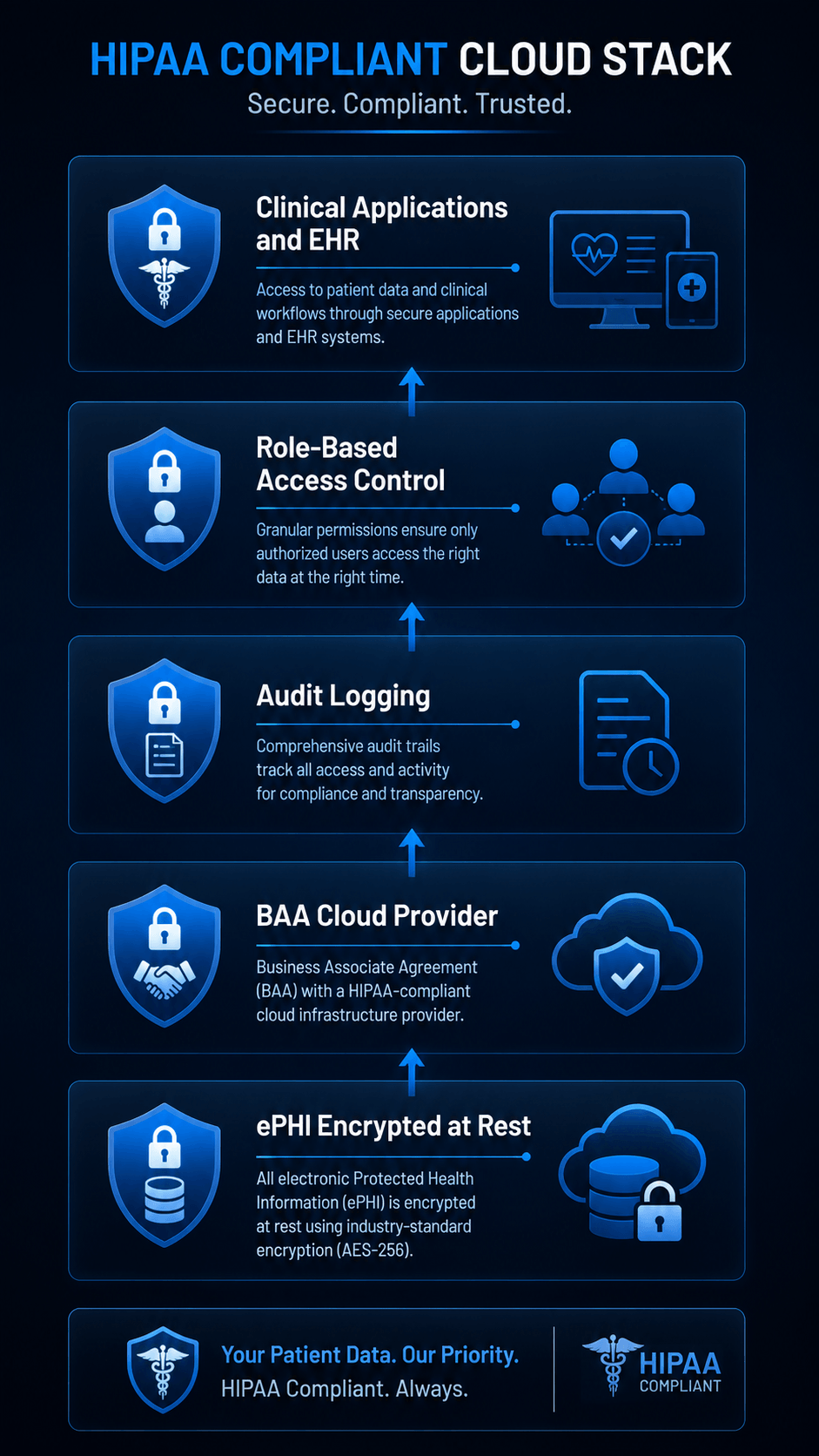
Healthcare cloud security in a HIPAA compliant architecture rests on five pillars: encryption of ePHI in transit and at rest, role-based access controls with minimum necessary access, comprehensive audit logging of every data access event, a Business Associate Agreement with the cloud provider, and real-time anomaly detection that identifies unusual access patterns before a breach becomes a reportable incident. AWS, Microsoft Azure, and Google Cloud all offer HIPAA-eligible services with signed BAAs. The compliance architecture sits above those services: who can access which data, under what conditions, from which devices, and with what audit visibility.
For healthcare organizations seeking healthcare software development support that covers both technical architecture and regulatory compliance, the implementation partner selected needs deep familiarity with HIPAA, HITECH, and any applicable state-level data protection requirements.
What HIPAA Compliance Requires in a Cloud Architecture?
- Encryption at rest and in transit for all ePHI across storage, databases, and data pipelines
- Role-based access controls ensuring minimum necessary access to patient data at every system level
- Comprehensive audit logging of all ePHI access events, including user, timestamp, and action taken
- Business Associate Agreement signed with the cloud provider covering all HIPAA-eligible services in use
- Incident response and breach notification capabilities meeting HIPAA notification timelines
- Regular risk assessments and penetration testing as required by the HIPAA Security Rule
EHR Cloud Migration: Moving Clinical Systems Without Disruption
EHR cloud migration is the most complex component of any healthcare cloud migration program. Electronic health records are the operational core of a clinical organization. They carry decades of patient history. They integrate with dozens of downstream systems: lab, pharmacy, imaging, billing, and scheduling. A migration that disrupts any of those integrations disrupts patient care. That constraint defines the entire approach.
Successful EHR cloud migration follows a phased sequence that moves non-clinical workloads first to validate the environment, then progressively migrates clinical systems in controlled windows with rollback capability preserved until stability is confirmed. Cloud based health records that are migrated correctly deliver faster application performance, lower IT maintenance overhead, improved disaster recovery capability, and the unified data layer that AI-powered clinical decision support requires.
EHR Cloud Migration Phases: Step-by-Step
From assessment to optimized production, the full migration sequence:
- Assessment: catalog every system handling ePHI, document dependencies, data volumes, uptime requirements, and integration points
- Architecture design: define the HIPAA compliant cloud environment, encryption strategy, access controls, and BAA requirements
- Non-clinical migration: move lower-risk administrative workloads first to validate the environment and migration pipeline
- EHR staging: run parallel cloud and on-premise environments, test all clinical integrations, validate data integrity end to end
- Controlled cutover: migrate in a planned low-activity window with rollback capability active and clinical leadership informed
- Optimization: tune performance, decommission on-premise infrastructure, and begin expanding cloud-native capabilities
Cloud Scalability in Healthcare: Infrastructure That Grows With Demand
Cloud scalability in healthcare solves a problem that on-premise infrastructure structurally cannot: unpredictable, variable demand. A flu season surge that doubles patient volumes. A new hospital acquisition that adds three facilities overnight. A telehealth rollout that multiplies concurrent user sessions. Each requires infrastructure that scales immediately, not after a hardware procurement cycle that takes months.
Cloud platforms provision additional compute and storage in minutes and release capacity when demand drops. Healthcare organizations pay for what they use, not for peak capacity that sits idle for most of the year. For multi-site health systems, cloud computing in healthcare also eliminates the infrastructure inconsistency between facilities. Every site runs on the same platform, the same security controls, and the same software version, making compliance management, IT support, and system upgrades significantly more manageable.
Scalability is also what makes the AI layer accessible. Large language models, diagnostic imaging AI, and predictive risk scoring systems require substantial compute that most health systems cannot economically run on-premise. A healthcare cloud compliance-aligned cloud architecture provides that compute on demand, enabling AI applications that a fixed on-premise server room cannot support.
Cloud infrastructure also transforms disaster recovery for healthcare organizations. On-premise systems require duplicate hardware investments to achieve meaningful redundancy. Cloud platforms replicate data automatically across geographically distributed data centres, ensuring that a local hardware failure, a natural disaster, or a ransomware incident does not result in permanent data loss or prolonged clinical system downtime. For health systems operating under regulatory requirements around data retention and availability, that built-in redundancy is a compliance advantage as much as an operational one.
AI in Healthcare Cloud: Building an AI-Ready Infrastructure
AI in healthcare cloud is not a future consideration for health systems completing their cloud migration. It is the primary strategic reason the migration matters. Healthcare cloud migration done correctly does not just replace on-premise servers with cloud servers. It creates a unified, scalable data layer that AI models can train and operate against across every facility, every patient population, and every clinical workflow simultaneously.
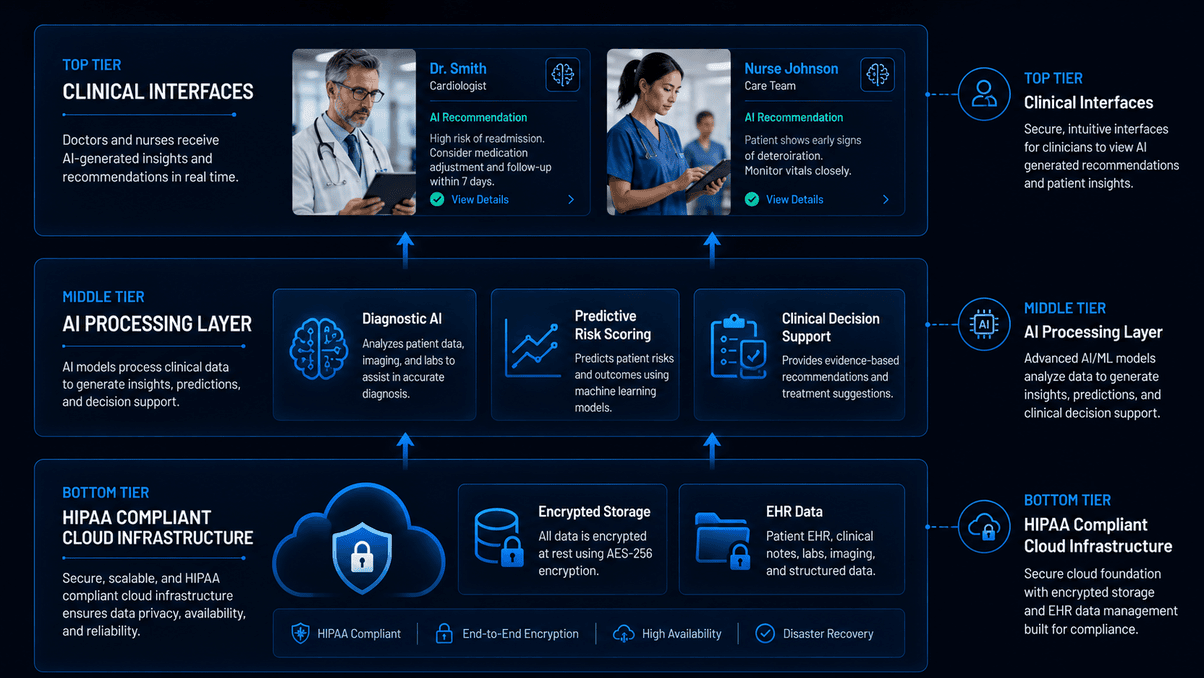
Cloud computing in healthcare enables AI integration in three specific ways. First, it consolidates patient data from fragmented on-premise systems into a single accessible layer, giving AI models the breadth of data they need to generate clinically useful outputs. Second, it provides the compute scale that AI inference requires without requiring capital investment in dedicated AI hardware. Third, it enables continuous model deployment: when a diagnostic AI model is updated, the improvement is available across every connected facility immediately.
In practice, a health system with cloud-consolidated patient data can run a sepsis prediction model that monitors every patient across every ward simultaneously, identifying early risk indicators hours before clinical deterioration becomes visible. It can deploy a readmission risk scoring system that flags high-risk discharge patients for targeted intervention. Each of these applications requires the unified data layer and on-demand compute that only cloud infrastructure provides. They are not achievable on fragmented on-premise systems regardless of the level of investment.
The distinction between different types of AI systems matters for healthcare deployment planning. Understanding how agentic AI vs generative AI differ in their clinical applications helps health system IT leaders select the right architecture for each use case. And understanding how agentic AI automation is already being deployed in enterprise workflows provides a practical model for how healthcare organizations can begin implementing AI on top of their cloud infrastructure.
Conclusion
Healthcare cloud migration is not a technology project with a fixed end date. It is an infrastructure transition that determines a health system's ability to protect patient data, meet compliance requirements, serve variable clinical demand, and integrate the AI capabilities that are rapidly becoming standard in modern healthcare delivery.
Cloud computing in healthcare built on a HIPAA compliant architecture, with properly migrated EHR systems, scalable infrastructure, and an AI-ready data layer, gives health systems the operational foundation they need to compete, comply, and care effectively.
The organizations that complete this transition now will spend the next decade delivering better patient outcomes at lower operational cost. Those that delay will continue managing the constraints of infrastructure that was not designed for what healthcare has become
Frequently Asked Questions
1. What is healthcare cloud migration and why does it matter now?
Healthcare cloud migration is the process of moving clinical systems, patient data, and operational infrastructure from on-premise servers to cloud-hosted environments. It matters now because on-premise infrastructure cannot meet the data volume growth, compliance complexity, scalability demands, and AI integration requirements of modern healthcare delivery. Health systems that complete this transition gain the infrastructure foundation needed for everything from telehealth to AI-powered diagnostics.
2. How does a HIPAA compliant cloud environment work in practice?
A HIPAA compliant cloud environment is built on cloud platforms (AWS, Azure, or Google Cloud) that offer HIPAA-eligible services and sign a Business Associate Agreement with the healthcare organization. On top of that platform, the compliance architecture enforces encryption of all ePHI at rest and in transit, role-based access controls, comprehensive audit logging, and real-time anomaly detection. Healthcare cloud security in this model is enforced at the platform level, not dependent on individual IT practices at each facility.
3. How long does EHR cloud migration typically take?
EHR cloud migration timelines vary by organization size, system complexity, and integration dependencies. A single-site medical practice can complete migration in weeks. A multi-site health system with complex integrations across lab, pharmacy, imaging, and billing systems typically takes six to eighteen months for a full phased migration. The critical factor is not speed but sequence: validating the environment with non-clinical workloads before moving clinical systems ensures that patient care is never disrupted during the transition.
4. How does cloud scalability support peak demand in healthcare?
Cloud scalability in healthcare means compute and storage resources provision automatically when demand spikes and release when it drops, without manual IT intervention or hardware procurement. A flu season surge, a new facility onboarding, or a telehealth volume increase are absorbed by the platform in minutes. Healthcare organizations pay for actual usage rather than fixed peak capacity, which significantly reduces infrastructure cost during normal operating periods.
5. How does cloud infrastructure enable AI integration in healthcare?
Cloud infrastructure enables AI in healthcare cloud by providing three things that on-premise systems cannot: a unified data layer across all facilities that AI models can train and operate against, on-demand compute scale for AI inference without capital expenditure, and continuous model deployment so improvements reach every connected facility simultaneously. Cloud based health records consolidated on a well-architected cloud platform become the training and inference data foundation for diagnostic AI, predictive risk scoring, and clinical decision support systems.