When most people hear about generative AI in banking, fraud detection is usually the first example that comes to mind. And it is a good one. But it is also just the beginning.
McKinsey estimates the annual value of generative AI for financial services at $200to $340 billion across the global banking sector. That figure spans loan underwriting, compliance automation, wealth advisory, customer service, and internal operations. Fraud detection is one slice. The other five represent an equally large, and in many cases more immediately actionable, opportunity.
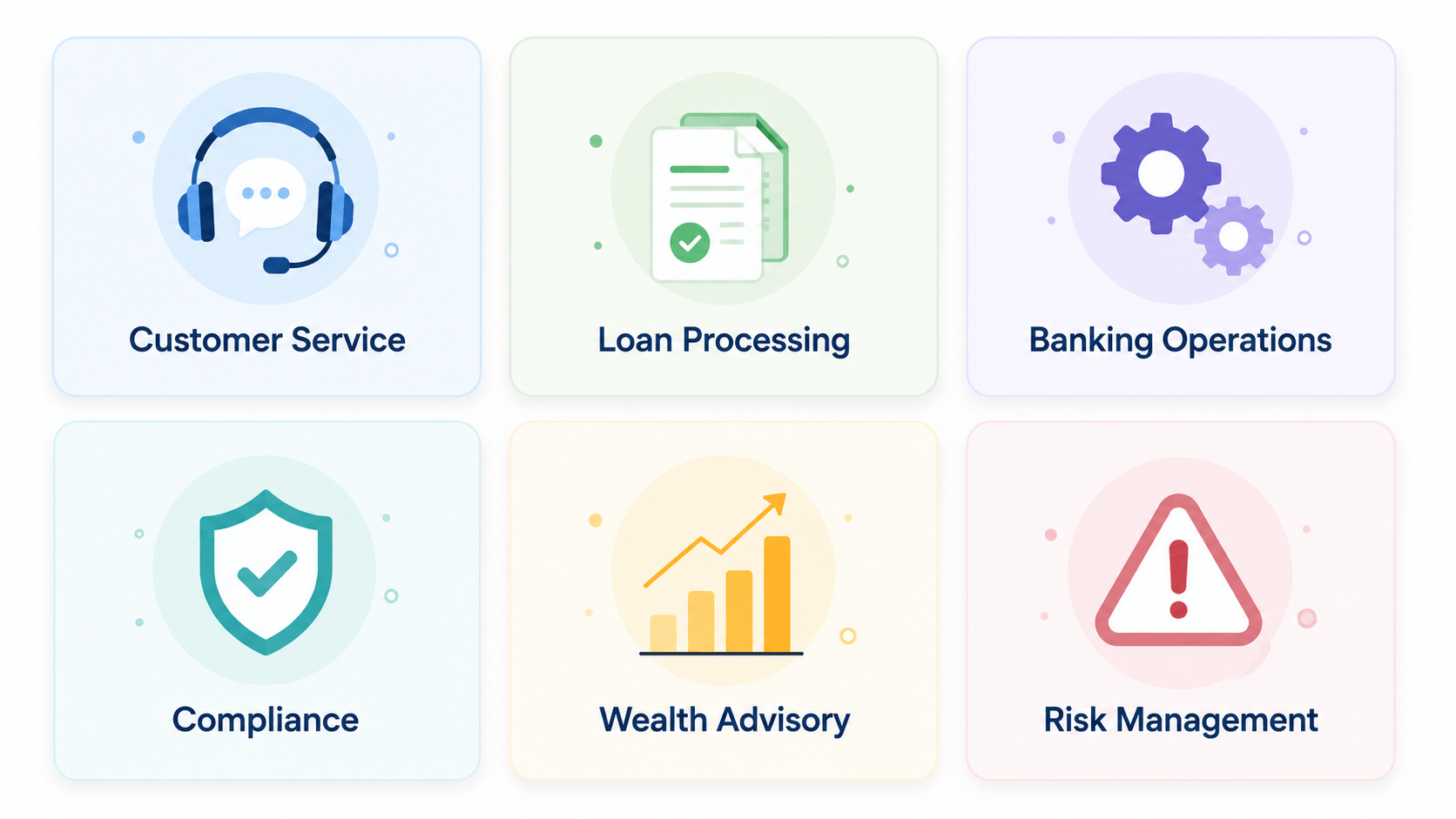
Pace Wisdom is an AWS Advanced Tier Partner specializing in fintech software and AI implementation for financial institutions. This blog covers six AI use cases in banking that are moving from pilot to production in 2026, and what it takes to implement each one effectively.
What Makes Generative AI Different in Financial Services
Traditional AI in banking was largely predictive: given historical data, what is likely to happen? Generative AI for financial services adds the ability to generate new content, synthesize large volumes of unstructured data, draft documents, and reason across complex multi-step tasks.
This matters for banks because so much of banking operations involve unstructured data: contracts, regulatory filings, customer correspondence, financial reports, loan documents. Generative AI reads, reasons, and acts on that content in ways that traditional rule-based systems simply cannot.
Our engineers will audit your workflow and estimate time-to-value at no cost.
Claim your free audit
Use Case 1: Customer Service Automation in Banking
Customer service automation in banking is one of the highest-volume applications of generative AI in the sector. Banks deal with millions of routine interactions monthly: balance inquiries, transaction disputes, product questions, account changes.
Generative AI enables banks to handle these interactions through intelligent virtual assistants that understand natural language, maintain context across a conversation, and resolve issues without requiring a human agent. Wells Fargo's AI assistant processed over 245 million customer interactions in 2024 alone.
What this looks like in practice:
- AI assistants handle balance queries, dispute initiation, and account updates around the clock
- Agents escalate to human representatives only when complexity exceeds their defined authority
- Every conversation generates a traceable evidence record for compliance and quality review
- Response quality stays consistent regardless of time, volume, or channel
Use Case 2: AI for Loan Processing and Credit Assessment
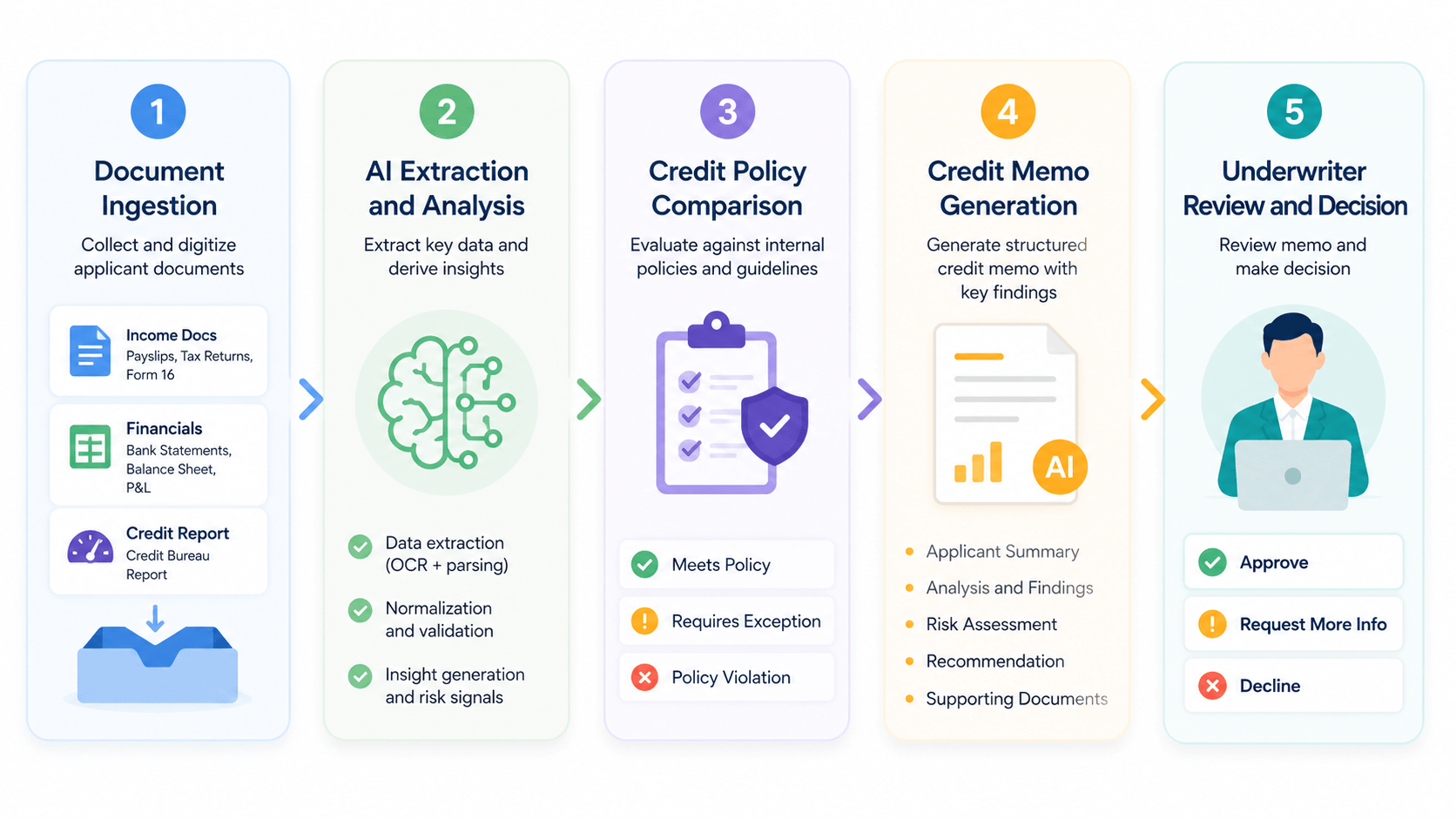
AI for loan processing addresses one of the most time-consuming workflows in banking. Traditional loan origination requires underwriters to manually review income documents, credit histories, business financials, and regulatory guidelines before issuing a credit recommendation.
Generative AI reads and interprets all of these inputs simultaneously. It extracts relevant data from unstructured documents, compares findings against the bank's credit policy, and generates a structured credit memo with a recommendation and full reasoning chain. What once took underwriters days can now complete in hours.
For a deeper look at how generative AI is reshaping lending workflows end to end, see our blog on GenAI in Digital Lending
Use Case 3: Banking Operations Automation
Banking operations automation covers the high-volume, repeatable back-office tasks that consume significant staff time without requiring complex judgment: report generation, data reconciliation, internal document drafting, and workflow routing.
Generative AI automates report generation from structured and unstructured data sources, produces first drafts of internal communications and regulatory submissions, and routes exceptions to the right human reviewers based on context rather than rigid rules.
Key operations where AI delivers immediate impact:
- Automated generation of risk summaries, portfolio performance reports, and board dashboards
- Reconciliation of transactions across systems with AI-flagged discrepancies
- Intelligent document routing based on content classification
- Drafting of internal policies, procedures, and client-facing communications
Use Case 4: Banking Compliance Automation
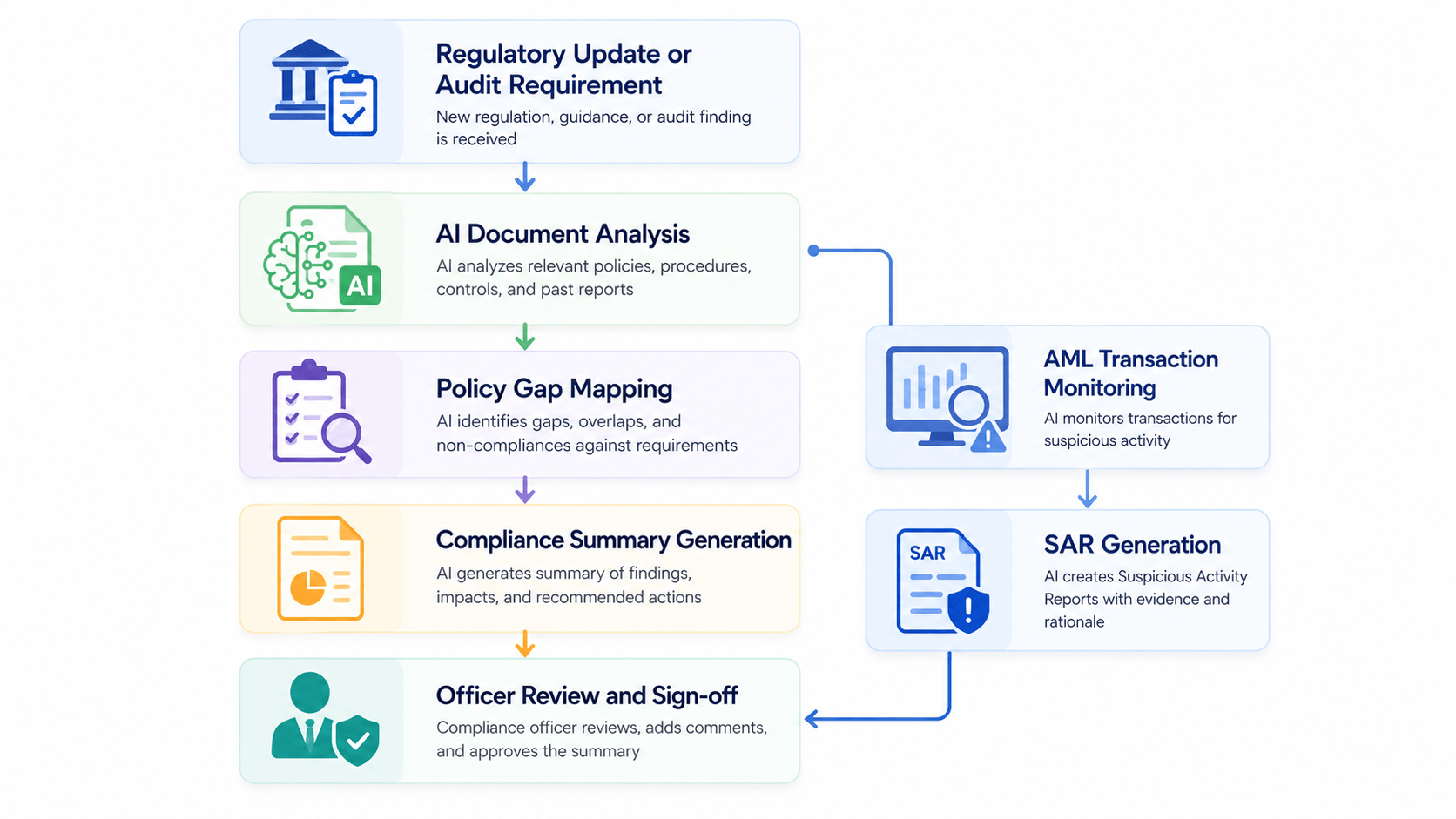
Banking compliance automation may be the single highest-value application of generative AI for large financial institutions. Compliance teams manage a continuous flood of regulatory updates, internal audit requirements, and reporting obligations across multiple jurisdictions.
Generative AI reads new regulatory publications, summarizes key obligations, maps changes to affected internal policies, and flags deadlines for compliance officers to action. Citigroup used a generative AI system to analyze and summarize 1,089 pages of new US capital rules, compressing weeks of legal work into hours.
Banking process automation in compliance also covers AML investigations. AI maps transactions to watchlists, identifies suspicious activity networks, synthesizes evidence across data sources, and generates structured Suspicious Activity Reports ready for compliance officer review.
Use Case 5: Personalized Wealth Advisory and Financial Planning
Digital transformation in banking has made it possible for banks to offer personalized wealth advisory at a scale that was previously only viable forhigh-net-worth clients with dedicated relationship managers.
Generative AI analyzes a customer's transaction history, savings behavior, life events, and stated financial goals to generate personalized financial plans, investment recommendations, and product suggestions. These are delivered through digital channels in real time, without requiring a human advisor for every interaction.
WhatAI-driven wealth advisory delivers:
- Personalized savings and investment recommendations based on individual financial patterns
- Proactive alerts for upcoming expenses, low balances, or missed savings opportunities
- Context-aware product offers tied to life events like home purchase, retirement, or education funding
- Consistent advice quality that scales across millions of customers simultaneously
Use Case 6: AI-Powered Risk Management in Banking
AI-powered risk management extends well beyond fraud detection into credit risk, market risk, and operational risk monitoring. Generative AI continuously analyzes transaction patterns, market signals, counterparty behavior, and internal controls to surface emerging risks before they crystallize into losses.
On the credit side, AI monitors existing loan portfolios for early warning signals: changes in payment behavior, revenue trends in business accounts, and shifts in macroeconomic conditions relevant to specific sectors. On the market side, AI synthesizes news, financial filings, and pricing data to generate forward-looking risk summaries for traders and risk officers.
How Pace Wisdom Helps Banks Get Started with Generative AI
Implementing AI-powered banking solutions at scale requires more than choosing the right model. It requires clean data pipelines, governance frameworks, integration with core banking systems, and compliance architecture that satisfies regulators in every market you operate in.
Pace Wisdom is an AWS Advanced Tier Partner with proven experience delivering fintech software across lending, payments, compliance, and customer experience. Our Fintech Software Development Services are built for financial institutions that need production-grade AI systems, not proofs of concept.
We help banking teams with:
- Generative AI solution design for loan processing, compliance, and customer service workflows
- AWS Bedrock and Claude integration for enterprise-grade AI deployment
- Core banking system integration and secure data pipeline setup
- Regulatory compliance architecture including explainability and audit logging
- Ongoing model monitoring, retraining, and performance optimization
We'll map the exact workflows from this article to your business - free, in 30 minutes.
Conclusion
Generative AI in banking has moved well beyond fraud detection. In 2026, it is actively reshaping loan processing, compliance workflows, customer service, wealth advisory, risk management, and internal operations. Banks that move now will compound those gains. Banks that wait will find themselves closing a gap that only widens.
The question is not whether to adopt AI use casesin banking. It is which ones to start with and who to build them with.
Frequently Asked Questions
1. What is generative AI in banking?
Generative AI in banking refers to AI that produces new content, synthesizes unstructured data, and reasons across multi-step tasks. Unlike traditional predictive AI, it can read contracts, draft credit memos, generate compliance summaries, and converse with customers in natural language.
2. What are the top AI use cases in banking beyond fraud detection?
The six highest-impact AI use cases in banking in 2026 are: customer service automation, AI-powered loan processing, banking operations automation, compliance automation, personalized wealth advisory, and risk management. McKinsey values this opportunity at $200 to $340 billion annually.
3. How does AI for loan processing work?
AI for loan processing ingests income statements, financials, and credit reports, extracts key data, compares it against credit policy, and generates a structured credit memo with a full reasoning chain, compressing underwriter review from days to hours.
4. What is banking compliance automation?
Banking compliance automation uses AI to read regulatory updates, summarize obligations, map policy gaps, and generate Suspicious Activity Reports. Citigroup used it to analyze 1,089 pages of US capital rules in a fraction of the time a legal team would need.
5. How do banks keep generative AI safe and compliant?
Banks govern generative AI for financial services through audit logging, explainability frameworks, and access controls. On AWS, Bedrock Guardrails, IAM, and CloudTrail provide the compliance layer required under GDPR, Basel III, and emerging AI governance regulations.
You may also want to read
What Is a Cloud Transformation Assessment? A Guide for Enterprises