How many critical decisions in your healthcare organization are being made without access to the full patient picture? For most mid-scale and large providers, the answer is still: too many. Patient data remains fragmented across EHR systems, labs,insurers, and pharmacies, limiting both clinical and operational effectiveness.
The cost of this fragmentation is rising. Delayed diagnoses, duplicate testing, billing errors,and poor care coordination are no longer isolated issues, but systemic outcomes of disconnected healthcare infrastructure.
Healthcare data interoperability, the ability of systems to exchange and use patient data meaningfully, is now foundational. AI and cloud technologies are making it both achievable and scalable.
This article explores why interoperability remains a challenge, how AI and cloud are solving it, and what a unified healthcare data ecosystem looks like in practice.
The Interoperability Gap: Why Healthcare Data Remains Fragmented?
Despite decades of digital transformation investment, most healthcare organizations still operate with fundamentally disconnected data architectures. Patient information lives in proprietary EHR systems, legacy hospital information systems, specialist platforms,and payer databases, rarely in conversation with one another in real time.
The consequences of disconnected systems are not abstract, they are felt daily across clinical, operational, and financial workflows:
- Incomplete clinical decisions: Physician slack access to prior diagnoses, medications, or test results from other providers, increasing diagnostic risk.
- Duplicated testing: Without visibility into prior results, providers order repeat investigations, driving up cost and patient burden.
- Care coordination failures: Transitions between primary care, specialists, and hospitals break down when records do not follow the patient.
- Billing and claims errors: Disconnected coding and documentation systems produce inaccurate claims, increasing denial rates and revenue cycle costs.
- Regulatory compliance exposure: Manual data handling across systems creates audit risk and compliance vulnerabilities.
Our engineers will audit your workflow and estimate time-to-value at no cost.
Claim your free audit
How Do AI and Cloud Technology Enable Healthcare Data Interoperability?
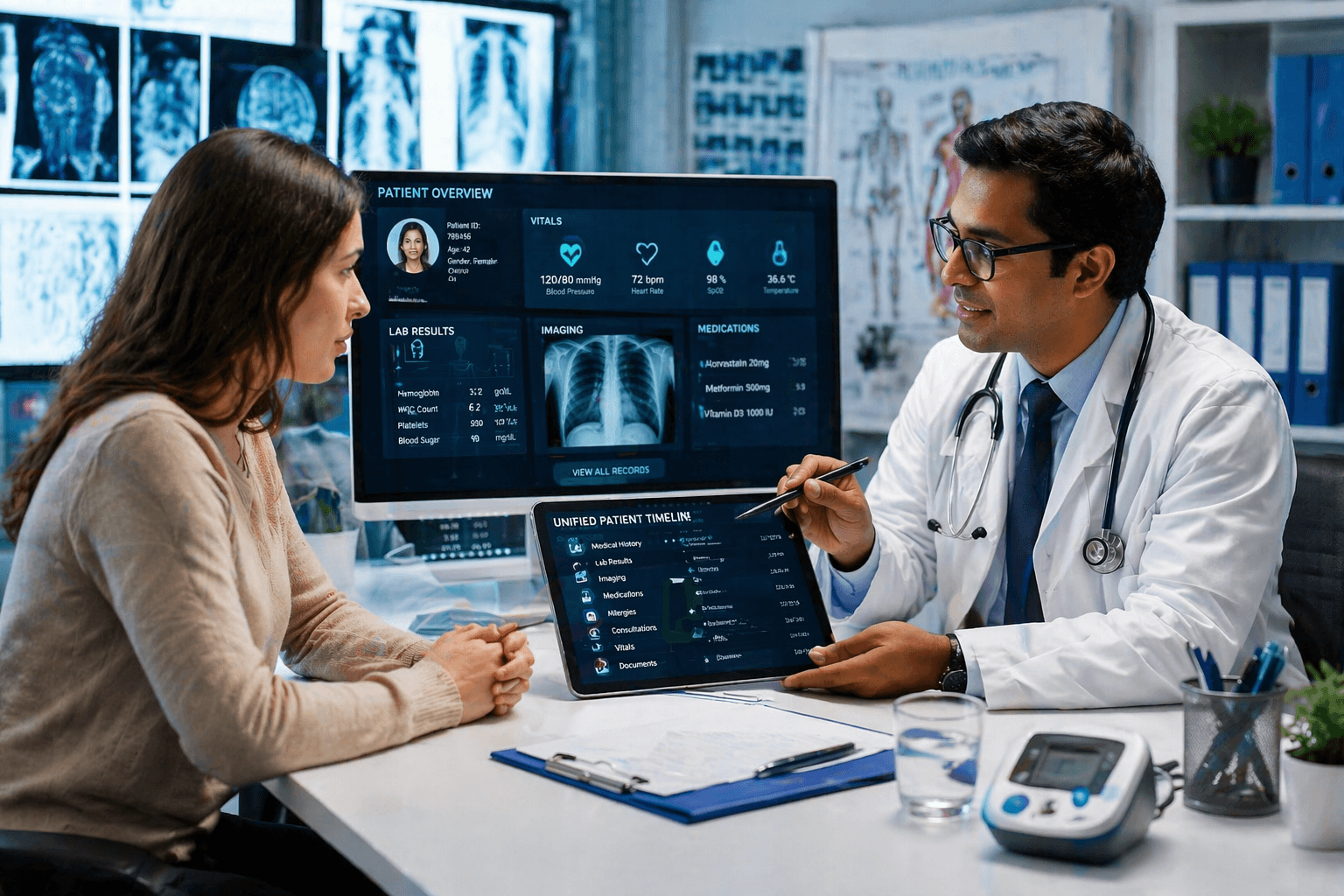
AI-driven EHR integration and cloud-native data infrastructure are the two pillars that make genuine interoperability achievable for large healthcare organizations.Together, they address both the technical complexity of connecting disparate systems and the semantic challenge of making that data meaningful and usable across contexts.
AI-Driven EHR Integration: Connecting Disparate Systems
Modern AI-driven EHR integration goes beyond simple API connections. Machine learning models can map and translate data across different coding standards, automatically identifying how data fields in one system correspond to those in another. Natural language processing (NLP) extracts structured clinical information from unstructured physician notes, discharge summaries, and referral letters, converting them into standardized, searchable records.
According to an article by Research Gate, AI-driven interoperability frameworks significantly enhance healthcare data exchange by enabling faster, more accurate integration across fragmented systems, leading to improved clinical decision-making and operational efficiency.
Secure Health Data Cloud: The Infrastructure Foundation
A secure health data cloud provides the centralized, scalable infrastructure that interoperability requires. Cloud-native platforms designed for healthcare, HIPAA-compliant, withend-to-end encryption, role-based access controls, and immutable audit trails,enable organizations to store, process, and share patient data across the entire provider network without compromising security or regulatory standing.
Cloud infrastructure also eliminates the physical and technical barriers that have historically made real-time data sharing difficult. When data is centralized in a governed cloud environment, every authorized stakeholder, primary care physician, specialist,hospital, insurer accesses the same current record, simultaneously.
FHIR Standards and API-First Architecture
The CMS Interoperability and Prior Authorization Final Rule now mandate FHIR-based APIs for federally funded payers, making FHIR-based API integration a regulatory reality, not merely a best practice. FHIR (Fast Healthcare Interoperability Resources) provides a standardized data format and exchange protocol that allows different healthcare systems to communicate reliably, regardless of their underlying technology.
A peer-reviewed study in PMC on FHIR-based interoperability outcomes demonstrates that organizations implementing FHIR API layers alongside AI-driven data mapping experience substantially faster data exchange speeds and significantly lower integration maintenance costs than those relying on legacy point-to-point connections.
Fragmented vs Interoperable: A Performance Comparison
The table below illustrates the operational difference between disconnected and AI-powered interoperable healthcare systems:
What Does a Unified Healthcare Data System Look Like in Practice?
A mature,interoperable healthcare data environment is not a single product, it is an architecture of connected capabilities, each contributing to a continuously updated, organization- wide view of every patient. In practice, this looks like the following end-to-end workflow:
- Data ingestion: Patient data is captured at every touch point EHR entries, lab results, imaging, wearables, remote monitoring devices and routed to a centralized cloud data layer
- Standardization and mapping: AI models automatically translate data into common formats (FHIR, HL7), reconciling inconsistencies across source systems
- Clinical data unification: A single longitudinal patient record is assembled, continuously updated, and made available to all authorized providers in real time
- AI enrichment: Predictive analytics run on the unified dataset, surfacing clinical risk signals, care gaps, and recommended interventions
- Workflow integration: Insights are embedded directly into clinical decision support tools, care management workflows, and billing systems
- Patient data governance: Automated access controls, consent management, and audit logging ensure ongoing HIPAA compliance without manual overhead
We'll map the exact workflows from this article to your business - free, in 30 minutes.
From Billing to Bedside - Real-World Impact
One domain where the impact of unified patient data is particularly tangible is healthcare revenue cycle management. When billing systems have access to accurate, complete,real-time clinical data, rather than relying on manual coding from fragmented records - claims accuracy improves dramatically, denial rates fall, and administrative overhead contracts
This transformation is already visible in real-world implementations - as seen in Take Control of Your Medical Bills: Empower Your Healthcare Decisions case study, where improved data visibility and system integration enabled better financial transparency and patient decision-making.
AI and Cloud Capabilities vs Healthcare Outcomes: At a Glance

The following infographic summarizes the six core AI and cloud capabilities that drive measurable improvements in healthcare data interoperability:
Conclusion
Healthcare data interoperability is no longer a future ambition, it is an urgent operational and strategic priority. Every day that patient data remains siloed across disconnected systems, clinical decisions are made within complete information, operational costs inflate, and patient outcomes suffer.
AI and cloud technologies have fundamentally changed what is now achievable. The combination of intelligent data integration, FHIR-based API architecture, and secure cloud infrastructure removes the technical barriers that have historically made true interoperability impractical at scale. For mid-scale and large healthcare organizations,the moment to act is now - before the gap between interoperable and fragmented health systems becomes a competitive and compliance of liability.
The organizations that invest in unified patient data infrastructure today will be better positioned to deliver better care, operate more efficiently, and meet the increasingly stringent demands of regulators, payers, and patients alike.
To explore how Pace Wisdom Solutions can help your organization build a connected, AI-powered health data ecosystem, visit our Healthcare & Pharma Solutions.
Frequently Asked Questions
1. What is healthcare data interoperability?
It is the ability of different health information systems - EHRs, laboratory platforms, insurance portals, and more to communicate, exchange, and use patient data seamlessly and meaningfully across organizational and technological boundaries, enabling a unified view of each patient.
2. How does AI-driven EHR integration work?
AI models map and translate data between different EHR systems and coding standards automatically. Natural language processing extracts structured information from unstructured clinical notes, while machine learning reconciles inconsistencies across platforms.
3. What is FHIR and why does it matter for healthcare interoperability?
FHIR (Fast Healthcare Interoperability Resources) is a standardized data format and API protocol that enables different healthcare systems to exchange patient data reliably. CMS regulations now mandate FHIR-based APIs for federally funded payers, making adoption both a regulatory requirement and a technical best practice.
4. How does a secure health data cloud support HIPAA compliance?
Cloud platforms designed for healthcare include end-to-end encryption, role-based access controls, immutable audit trails, and automated consent management enabling organizations to store and share patient data securely across their network while maintaining continuous HIPAA compliance without manual oversight.
5. How long does it take to implement a healthcare interoperability solution?
Implementation timelines vary based on system complexity and scope. Most organizations see initial integration milestones such as FHIR API deployment and EHR connection within 3 to 6 months. Full clinical data unification across a large provider network typically requires 12 to 24 months of phased implementation.
You may also want to read