Most engineering roles come with a clear boundary: you build the product, someone else sells it, and a third team implements it. A Forward Deployed Engineer collapses all three. You are the engineer, the implementation consultant, and often the closest thing to a CTO the client's AI project has seen.
The role has been around since Palantir invented it in the mid-2000s, but 2025 and 2026 changed its profile dramatically. AI deployment is complex enough that no enterprise can simply install a frontier model and go. Someone with engineering depth needs to be inside the client's environment, understanding their data, their architecture, their compliance requirements, and their actual problem, then building something that works in that specific context. That someone is a forward deployed engineer. By mid-2026, 70 percent of companies were actively planning to hire FDEs, up from just 5 to 10 percent at the start of the year.
Our engineers will audit your workflow and estimate time-to-value at no cost.
Claim your free audit
What Is a Forward Deployed Engineer?
Palantir Technologies created the Forward Deployed Engineer role in the mid-2000s out of operational necessity, not organisational theory. Palantir's early government and defence clients had data environments so sensitive and architecturally idiosyncratic that remote delivery was simply not viable. A solutions architect who handed off a specification and flew home left a ticket queue, not working software. So Palantir embedded its own engineers inside client facilities for weeks or months at a time, and the role was born.
The model spread slowly at first, then rapidly. In 2026, OpenAI launched what it called The Deployment Company, a large-scale enterprise AI deployment initiative built explicitly around forward deployed engineers embedded within customer organisations. Anduril, Scale AI, Anthropic, and Salesforce all now hire FDEs as a formal role. Deloitte and Accenture have built Palantir-specific FDE practices within their consulting divisions.
FDE vs FDSE: The Title Distinction
FDSE stands for Forward Deployed Software Engineer, a title used primarily by Palantir. Many companies use Forward Deployed Engineer, FDE engineer, or simply "deployment engineer" interchangeably. The underlying role is the same: an engineer who builds inside the client's environment rather than from a product team.
At AI companies and startups, the role may also appear as Forward Deployed AI Engineer, Forward Deployed Solutions Engineer, or Embedded Software Engineer. The variation in titles reflects how widely the model has spread beyond Palantir's original implementation.
We'll map the exact workflows from this article to your business - free, in 30 minutes.
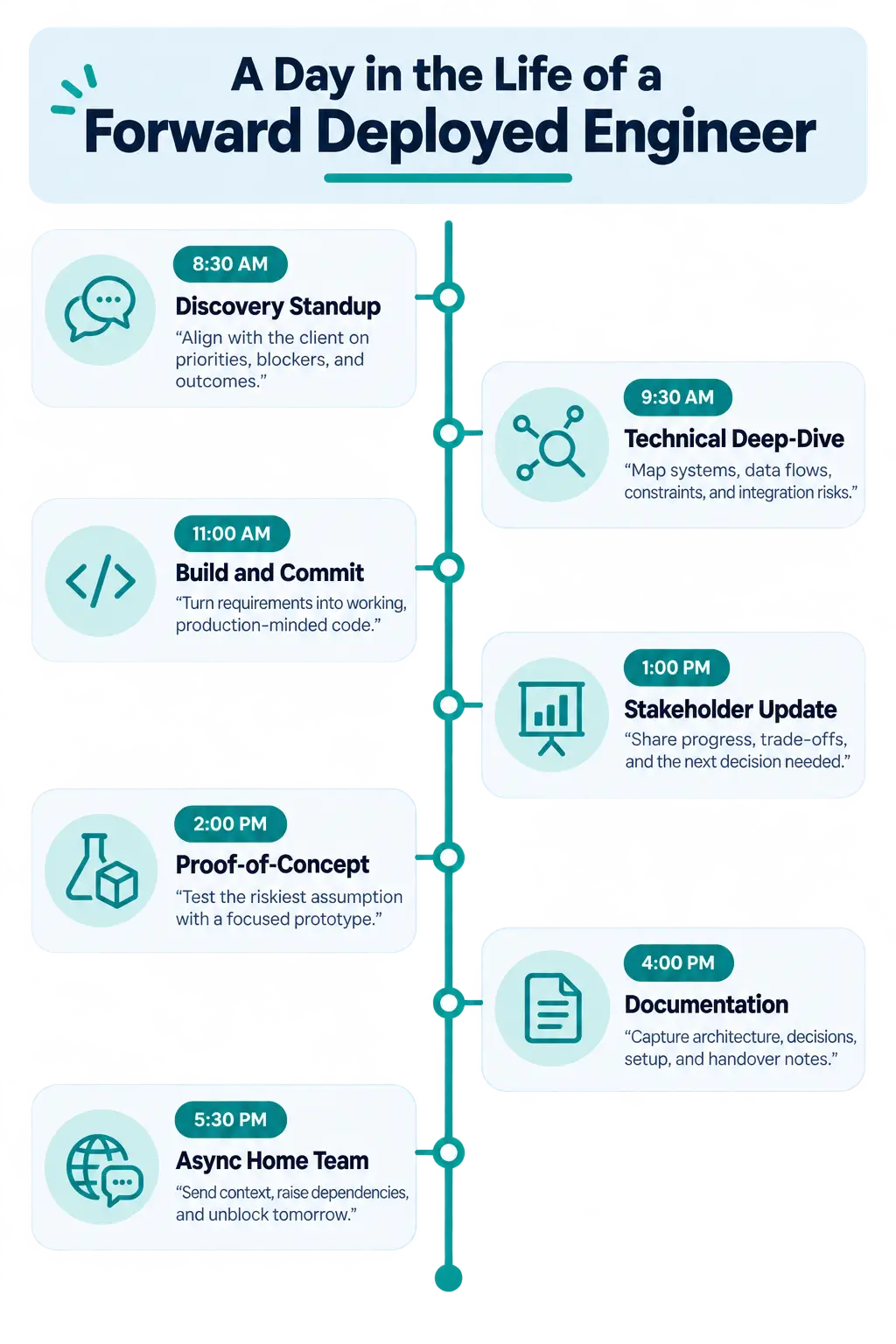
What Does a Forward Deployed Engineer Do? A Day in the Life
The best way to understand what a forward deployed engineer does is to follow one through a typical day. The specifics vary by company and client, but the structure is consistent.
How This Differs Across Companies
At Palantir, an FDE might be on-site at a government agency for months, operating inside a classified network. At an AI startup, the cycle is compressed to weeks or days, with a proof-of-concept replacing the multi-month engagement. At a consulting firm running Palantir or AI implementations, the FDE works within a delivery pod, with more structured project management around them.
The constant across all three contexts is the same: the FDE is the person in the room who can both understand the client's problem at a domain level and build the solution at a production engineering level.
Forward Deployed Engineer Roles and Responsibilities
The forward deployed engineer responsibilities span both technical delivery and client relationship management. What makes the role distinctive is that neither can be deprioritised: shipping great code that no one in the client organisation understands is a failed deployment, and building client trust without shipping working software is equally useless.
Core forward deployed engineer responsibilities:
- Embed within the client's engineering team: attend standups, use their tools, commit to their repositories
- Conduct technical discovery: understand the client's current architecture, data environment, and the actual problem before writing any code
- Architect and build solutions: design and implement integrations, pipelines, agents, or workflows that work in the client's specific environment
- Own the technical depth end-to-end: from first conversation through production deployment, with no handoff to a separate implementation team
- Communicate to non-technical stakeholders: translate technical decisions into business terms for executives, compliance teams, and end users
- Manage scope and expectations: surface scope changes early, advise clients on trade-offs, and keep delivery timelines realistic
- Feed product insights back to headquarters: the FDE's field experience is a primary source of product improvement signals
- Build the client's capability to operate independently: write documentation, train client engineers, and plan for the time when the FDE is no longer on-site
Domain Variation
In government and defence, FDE roles involve operating inside classified or air-gapped environments, with long-tenure engagements and deep institutional knowledge requirements. In enterprise SaaS and AI, the cycles are shorter and the technical environment more accessible, but the expectation for speed is higher. In consulting, FDEs work within structured delivery frameworks, often on fixed-scope contracts with defined handover milestones.
Forward Deployed Engineer Skills: What You Need to Succeed
The forward deployed engineer skills profile is one of the hardest to hire for precisely because it combines attributes that do not often appear together: deep engineering capability and strong interpersonal and communication skills. Most strong engineers do not want client-facing roles. Most people who thrive in client-facing roles do not write production code.
Technical Skills in Depth
The minimum technical bar for most FDE roles in 2026 is full-stack competency: the ability to write production-quality code in at least one backend language (Python is the most common), work with databases and APIs, and deploy to cloud infrastructure. AI/ML fluency is increasingly a requirement rather than a differentiator, with LLM integrations, RAG pipelines, and agent frameworks appearing in most enterprise AI deployments FDEs are now involved in.
The Non-Technical Skills That Actually Determine Success
The FDE candidates who interview well on technical dimensions but fail in the role almost always fail on the non-technical dimensions. Discovery, the ability to ask the right questions before writing any code, is the most undervalued skill. Scope creep, misaligned expectations, and failed deployments most commonly trace back to an FDE who started building before they fully understood the problem.
Ambiguity tolerance is the other critical non-technical requirement. A forward deployed engineer's scope can change between morning standup and afternoon. A client executive can reframe the problem entirely based on a conversation with their board. The FDE who needs complete requirements before starting will consistently fail to deliver in this environment.
Forward Deployed Engineer Salary and Compensation
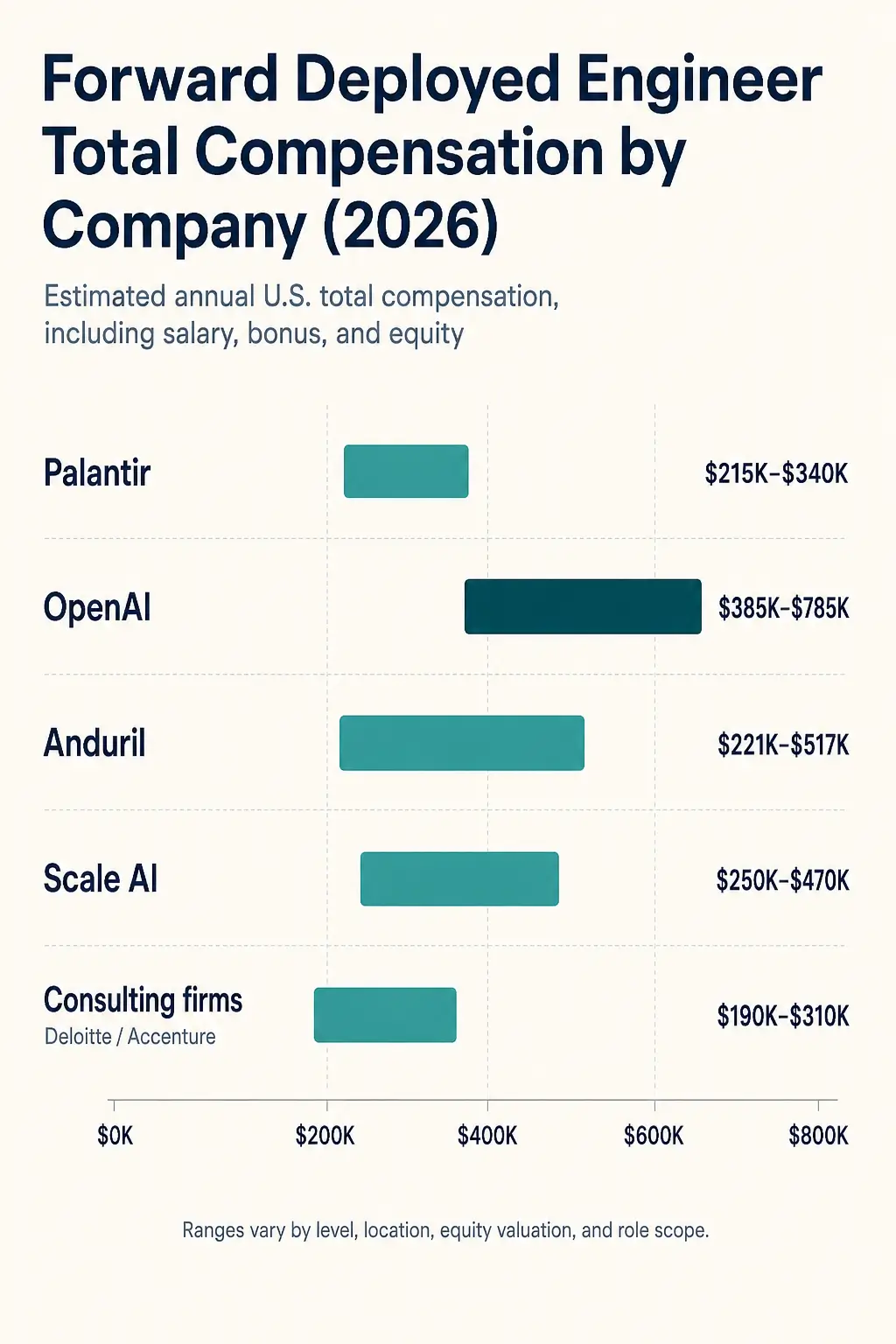
The forward deployed engineer job commands premium compensation because the combination of engineering depth, communication capability, and domain knowledge required to succeed is genuinely rare. The salary ranges below reflect 2026 data from compensation trackers including Levels.fyi and direct company postings.
The wide range within each company reflects the outsized equity component in tech compensation. A senior Palantir FDSE at the staff level with a strong equity grant can earn well above the $415,000 figure. OpenAI's compensation structure includes substantial equity that has made even mid-level roles significantly above the base salary numbers.
Why FDEs Earn a Premium
The compensation premium for FDE engineers reflects supply constraints rather than company generosity. Organisations can hire engineers and they can hire consultants, but finding someone who does both well and is comfortable operating inside a client's environment for extended periods is significantly harder. With only an estimated 17,000 US FDEs on the market against demand that jumped from 5 to 10 percent of companies to 70 percent in a single year, the market is structurally undersupplied. The roughly $9 billion committed to FDE organisations by four major technology providers in just 10 weeks in 2026 reflects the industry's recognition that this gap will not close quickly.
Forward Deployed Engineer Career Path and Progression
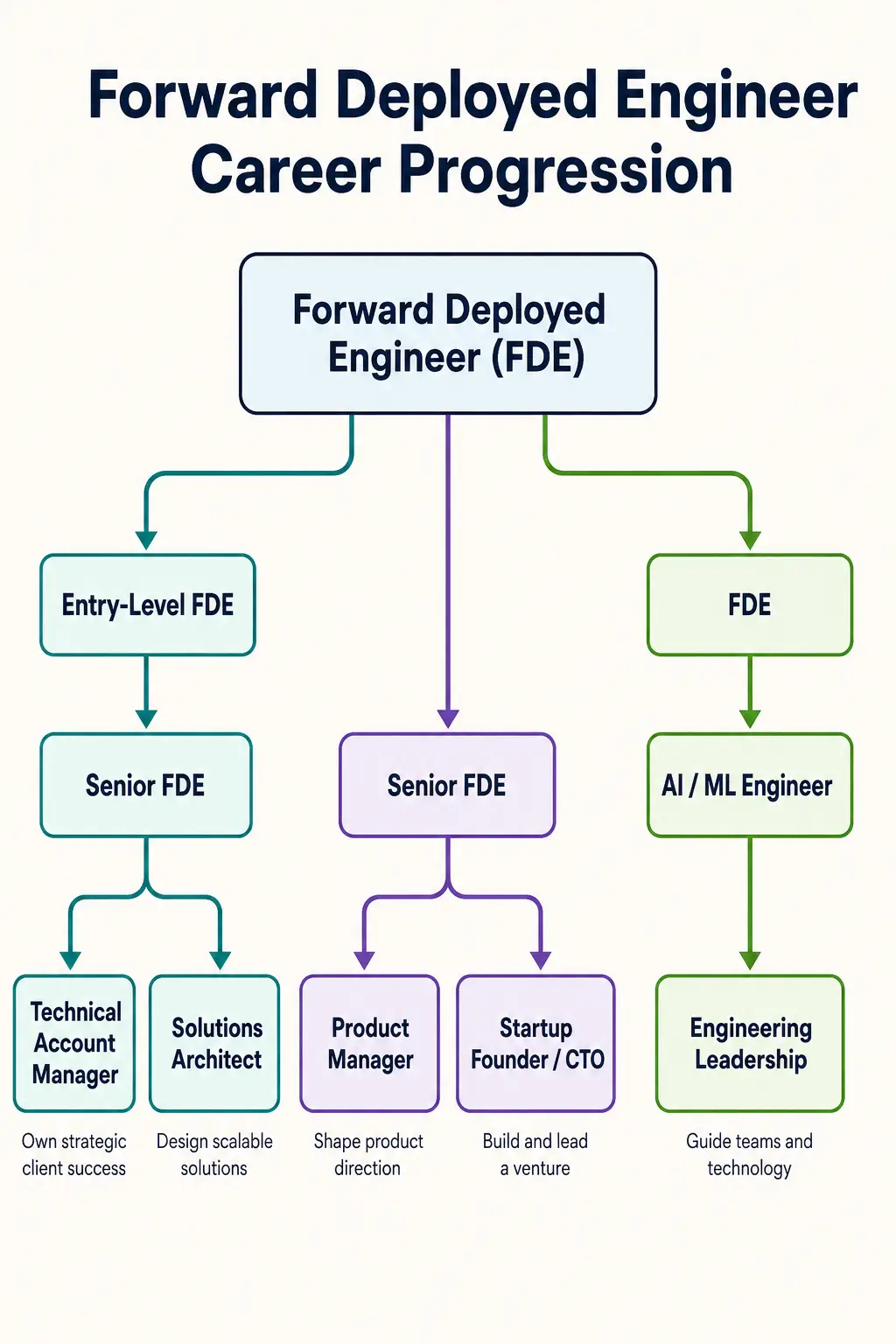
The forward deployed engineer career path is less linear than a traditional software engineering ladder but offers a wider range of exit points and transition opportunities. The skills developed in an FDE role, particularly domain knowledge, client relationship management, and the ability to operate autonomously in ambiguous environments, are highly transferable.
Entry-Level FDE: What Background Qualifies
Most companies hiring entry-level FDEs require 2 to 4 years of software engineering experience, with demonstrated ability to ship production code independently. A computer science degree is common but not universal. What matters more is evidence of self-directed delivery: personal projects, open source contributions, or startup experience where you owned an entire feature from design through deployment.
Palantir specifically hires new graduates for FDSE roles through its internship-to-hire pipeline, looking for candidates who demonstrate high agency and comfort operating without detailed specifications rather than deep domain expertise. This pathway is less common at companies that require FDEs to operate in highly regulated sectors.
Senior FDE: What Progression Looks Like
Senior forward deployed engineers own accounts rather than tasks. Where a junior FDE is assigned to a specific implementation and delivered specific requirements, a senior FDE scopes the engagement, manages the client relationship at the executive level, and decides how to allocate technical resources across the account. The jump from engineer to account owner is the critical transition in the FDE career ladder.
Exit Paths from FDE Roles
The FDE role has unusually rich exit options because it develops a combination of skills that most career paths produce only one side of. Common transitions include:
- Product Manager: FDE experience in client-facing delivery and problem scoping translates directly to product ownership, particularly for enterprise or developer-tools products
- Solutions Architect or Technical Account Manager: the client relationship and technical depth combination maps well to architect-level consulting roles
- Startup Founder or CTO: Palantir explicitly describes senior FDE responsibilities as similar to those of a hands-on AI startup CTO. Many FDE alumni go on to found companies based on problems they saw repeatedly in client environments
- Engineering Leadership at the client: some FDEs are hired directly by the clients they embedded with, valued for the institutional knowledge and trusted relationships built during the engagement
- AI/ML Engineering: FDEs working on AI deployments frequently develop deep practical ML engineering skills that qualify them for staff-level AI engineering roles
How to Position for a Forward Deployed Engineer Role
The most effective preparation for a forward deployed engineer job is building evidence of the hybrid skill set. On the engineering side, this means demonstrating production delivery, not just tutorials or toy projects. On the communication side, it means roles with client or stakeholder contact: technical project lead, developer relations, solutions engineering, or consulting.
In interviews, FDE candidates are evaluated less on algorithmic problem-solving and more on how they approach ambiguous problems, how they communicate trade-offs to non-technical audiences, and how they handle changing requirements mid-engagement. Preparing examples from experience that demonstrate these attributes is more valuable than grinding LeetCode.
Forward Deployed Engineering in the AI Era
The 800% surge in forward deployed engineering roles in 2025 was not random. It was a direct consequence of the AI deployment problem.
Frontier AI models are powerful but not self-implementing. An enterprise wanting to integrate a large language model into its claims processing workflow, supply chain management system, or customer service infrastructure faces a genuinely complex engineering challenge: data pipelines need to be built, model behaviour needs to be evaluated against the specific data environment, security and compliance requirements need to be addressed, and the whole thing needs to be reliable enough for production use. A product demo does not solve this. A remote implementation team does not solve this. An engineer embedded in the client's environment who understands both the AI technology and the client's specific context does.
OpenAI codified this in 2026 when it launched The Deployment Company, an initiative explicitly designed around forward deployed engineers embedded within enterprise customers to implement AI systems and workflows. Anthropic, Scale AI, and a generation of AI infrastructure companies have built similar models. The FDE has become the implementation layer between frontier AI capability and enterprise operational reality.
Where FDE Demand Is Growing in 2026
- AI and LLM companies: every frontier AI lab now has a deployment or solutions engineering function built on the FDE model
- Government and defence: regulated environments require on-site technical delivery; defence-tech companies like Anduril have built their entire delivery model around embedded engineers
- Financial services: banks and insurers adopting AI face complex regulatory and data environment constraints that make remote implementation impractical
- India and Southeast Asia: rapid enterprise AI adoption in regulated markets is creating significant demand for FDE capability in-market
- Healthcare: clinical AI implementations require engineers who understand both the technology and the clinical and regulatory environment
The FDE as AI Translation Layer
The practical role of the FDE in 2026 is translation. They translate what frontier AI can do into what this specific enterprise's systems can support. They translate technical decisions into business terms that compliance teams, executives, and end users can evaluate. They translate customer feedback from the field into product signals that improve the core platform. This translation function is what the standard product-to-customer delivery model cannot provide, and why the role has grown so rapidly as AI complexity has increased.
Conclusion
The forward deployed engineer role exists because the gap between what technology can do and what a specific organisation can operationalise is always larger than it appears from the outside. FDEs close that gap by being inside the client's environment with the engineering capability to build and the communication skills to make the build make sense.
As AI deployment complexity continues to grow, the demand for engineers who can operate in this embedded, client-facing model will only increase. Whether at a frontier AI lab, a defence-tech company, or a consulting practice, the forward deployed engineer is the role at the frontier of how organisations adopt technology that actually matters.
Frequently Asked Questions
1. What is a Forward Deployed Engineer?
A Forward Deployed Engineer is a software engineer who embeds inside a client's organisation, working on-site, using their tools, and committing to their codebase. The role originated at Palantir and has expanded across AI, defence-tech, and enterprise software companies.
2. What does a Forward Deployed Engineer do day to day?
What a forward deployed engineer does includes attending client standups, conducting technical discovery, building and shipping solutions in the client's environment, updating non-technical stakeholders, and feeding product insights back to their employer's engineering team.
3. What skills does a Forward Deployed Engineer need?
Forward deployed engineer skills include full-stack engineering, AI/ML fluency (LLMs, RAG, agents), technical communication, discovery and scoping ability, stakeholder management, and high ambiguity tolerance. The rarest combination is strong engineering capability plus genuine comfort in client-facing delivery.
4. How much does a Forward Deployed Engineer earn?
Total compensation for a forward deployed engineer ranges from approximately $173,000 at entry level to $630,000+ at senior AI company levels. Palantir FDSE total comp typically runs $171K-$415K+; OpenAI forward deployed roles run $350K-$600K+ including equity.
5. Is Forward Deployed Engineer a good career path?
Yes, particularly in the current AI environment. The forward deployed engineer career develops a rare combination of technical depth and client delivery skills with strong exit paths into product management, solutions architecture, startup founding, and AI engineering leadership.
6. How is a Forward Deployed Engineer different from a Solutions Engineer?
A Solutions Engineer typically works pre-sale, demonstrating and configuring products for prospects. A Forward Deployed Engineer works post-sale, building custom implementations inside the client's environment. FDEs write production code committed to the client's repository; solutions engineers typically do not.
You may also want to read