Every major e-commerce event tells the same story. Traffic spikes ten times or more in minutes. Conversion windows are measured in seconds. And the platforms that stay online capture revenue that competitors lose to timeouts and crashed checkouts. Peak period downtime can cost online retailers over $9,000 per second in lost revenue, which makes infrastructure resilience a board-level concern rather than a backend detail.
Traditional cloud auto scaling reacts to load after it has already started climbing. By the time new instances spin up, the damage to conversion rates and customer trust is already done. This is the gap that AI native cloud architecture closes.
This blog walks through what AI native cloud architecture actually means, why it matters specifically for e-commerce cloud architecture, and the core components, practices, and trade-offs involved in building infrastructure that scales ahead of demand instead of behind it.
Our engineers will audit your workflow and estimate time-to-value at no cost.
Claim your free audit
What Is AI-Native Cloud Architecture?
AI native cloud architecture refers to infrastructure where machine learning is built into the core scaling, routing, and cost-management decisions, not added on top as a monitoring layer. Instead of fixed thresholds that trigger scaling after CPU or memory usage crosses a set percentage, AI-native systems use predictive models trained on historical and real-time data to anticipate demand before it arrives.
This is a meaningful shift from cloud-native architecture as most teams know it today. Cloud-native design (microservices, containers, managed services) gives you the building blocks for flexibility. AI-native design adds a decision-making layer on top: forecasting traffic, predicting checkout-time bottlenecks, and dynamically rebalancing workloads, often before a human operator would even notice a problem forming.
Why E-commerce Platforms Need AI-Native Cloud Architecture for Peak Demand?
Peak shopping events are no longer occasional spikes. Black Friday alone drives 15 to 20% of annual retail sales for many merchants, concentrated into a handful of high-stakes hours. This is exactly the scenario where e-commerce cloud architecture built on static rules tends to fail.
The Real Cost of Downtime
Performance issues during peak events are well documented across the industry. Retailers have lost an estimated 60% of online sales in a single day when infrastructure could not handle a traffic surge, and similar stories repeat every holiday season across major markets. The financial impact is immediate and the reputational impact lingers far longer.
Why Fixed-Rule Auto Scaling Falls Short
Traditional Cloud Auto Scaling reacts to thresholds that have already been crossed. By the time new capacity is provisioned, checkout pages may already be timing out and customers may already be abandoning carts. For a high-traffic e-commerce platform, every minute of lag during a flash sale compounds directly into lost revenue and lower customer lifetime value.
AI native cloud architecture addresses this by forecasting demand from historical patterns, marketing calendars, and real-time signals, scaling resources up before the surge hits rather than during it.
We'll map the exact workflows from this article to your business - free, in 30 minutes.
Core Components of an AI-Native Cloud Architecture for E-commerce
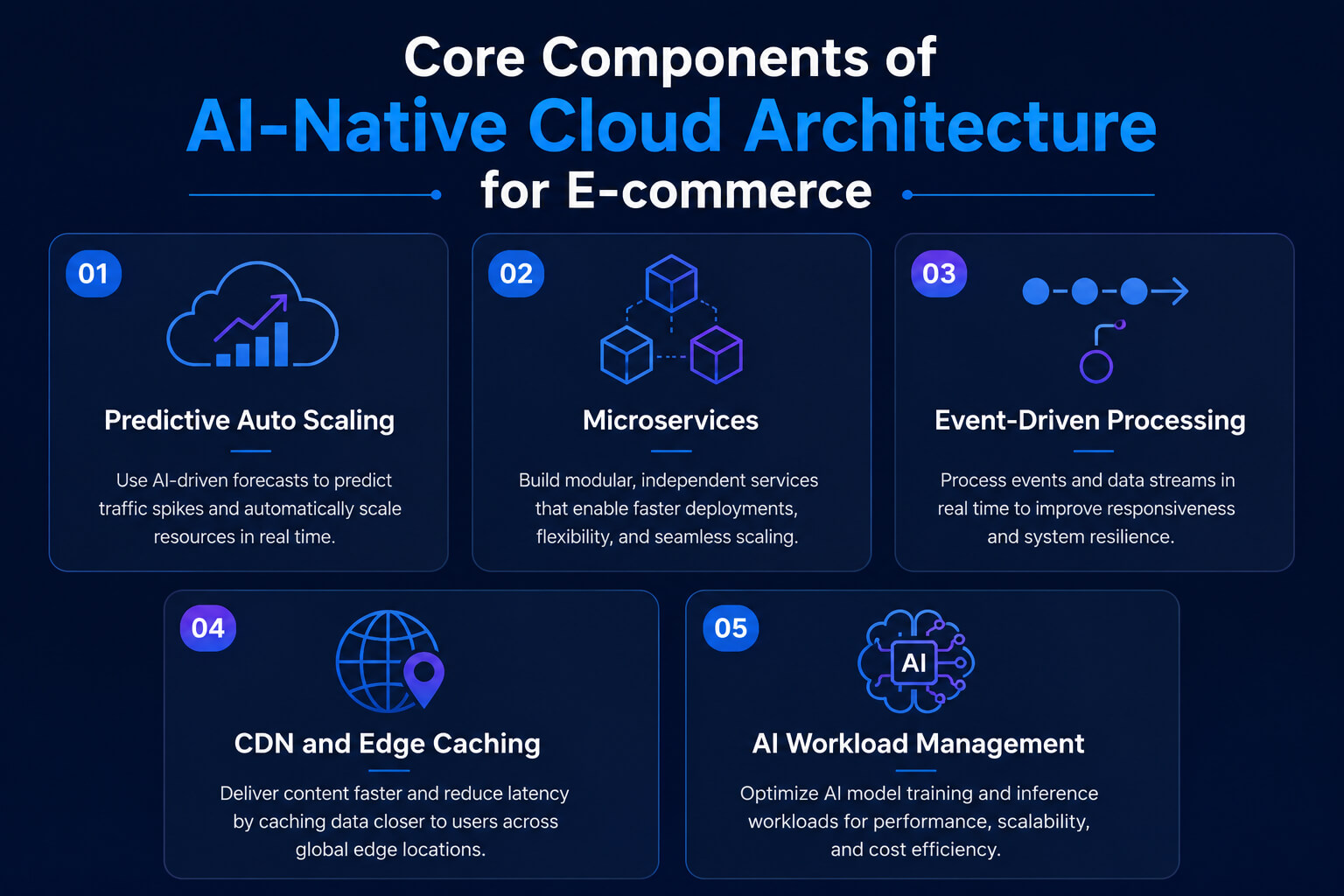
Building a resilient AI native cloud architecture for e-commerce involves several components working together, not a single tool or service.
Predictive Auto Scaling Using ML Demand Forecasting
Machine learning models trained on historical traffic, seasonal patterns, and live campaign data forecast resource needs ahead of time. This allows infrastructure to pre-provision capacity before a sale launches rather than scrambling once traffic has already spiked.
Microservices and Decoupled Architecture
Loosely coupled microservices allow individual functions like search, cart, and checkout to scale independently. This supports E-commerce Scalability by isolating failures: if the recommendation engine slows down, checkout keeps working.
Event-Driven, Asynchronous Processing
Streaming platforms such as Apache Kafka or AWS Kinesis allow inventory updates, pricing changes, and personalised offers to be processed in real time without blocking the main transaction path, keeping the platform responsive even as event volume spikes.
CDN and Edge Caching for Global Traffic
Distributing static content and product pages through a global CDN reduces origin server load and latency, which matters most during exactly the moments when traffic is highest and origin capacity is most constrained.
Building this kind of layered architecture from the ground up, or modernising an existing one, is where dedicated cloud transformation services make the difference between a platform that merely survives peak season and one that performs better because of it.
AI Workload Management and Cloud Auto Scaling in Practice
AI Workload Management goes beyond simply adding servers when traffic rises. It involves continuously analysing usage patterns to decide which workloads need dedicated capacity, which can run on lower-cost spot instances, and when to scale down without risking a performance cliff.
Predictive vs Reactive Scaling Triggers
Predictive scaling uses forecasted demand, marketing calendars, and even weather or regional events to provision resources ahead of time. This is the meaningful difference between modern Cloud Auto Scaling and the reactive, threshold-based scaling most platforms still run on.
Spot Instances, Rightsizing, and Workload Scheduling
AI-driven rightsizing continuously matches instance types to actual workload needs, while intelligent spot instance management can capture significant discounts on non-critical batch workloads without risking customer-facing services.
For e-commerce platforms specifically, pairing predictive analytics with auto scaling is increasingly the standard approach. Pace Wisdom's guide on e-commerce dynamic scaling with predictive analytics and ML breaks down how this is implemented in practice across real retail workloads.
Cloud Cost Optimization Without Sacrificing Performance
Scaling for peak demand without a cost strategy simply trades one problem for another. Cloud Cost Optimization in an AI-native architecture is not a once-a-quarter review; it is a continuous, automated discipline.
Real-Time Cost Visibility and Anomaly Detection
AI-driven FinOps tools monitor spend in real time, flagging unusual cost spikes (an idle GPU node, an unexpectedly large batch job) before they show up as a surprise on the monthly bill. Nearly half of FinOps teams have already adopted AI-driven anomaly detection as a standard practice.
Balancing Reserved, Spot, and On-Demand Capacity
E-commerce platforms typically run a mix of reserved capacity for predictable baseline traffic, spot instances for flexible batch workloads, and on-demand capacity reserved specifically for unpredictable peak surges. Getting this mix right, and letting AI continuously rebalance it, is where most of the savings come from.
Cloud Infrastructure Best Practices for High-Traffic E-commerce Platforms
Beyond the architecture itself, a set of operational habits separates platforms that handle peak demand smoothly from those that scramble every single season. These are the Cloud Infrastructure Best Practices most consistently seen across resilient high-traffic e-commerce platform deployments.
Load Testing and Chaos Engineering Before Peak Season
Simulating peak-level traffic and deliberately injecting failures weeks before a major sale surfaces weak points while there is still time to fix them. Retailers who skip this step are the ones most likely to discover bottlenecks live, during the event itself.
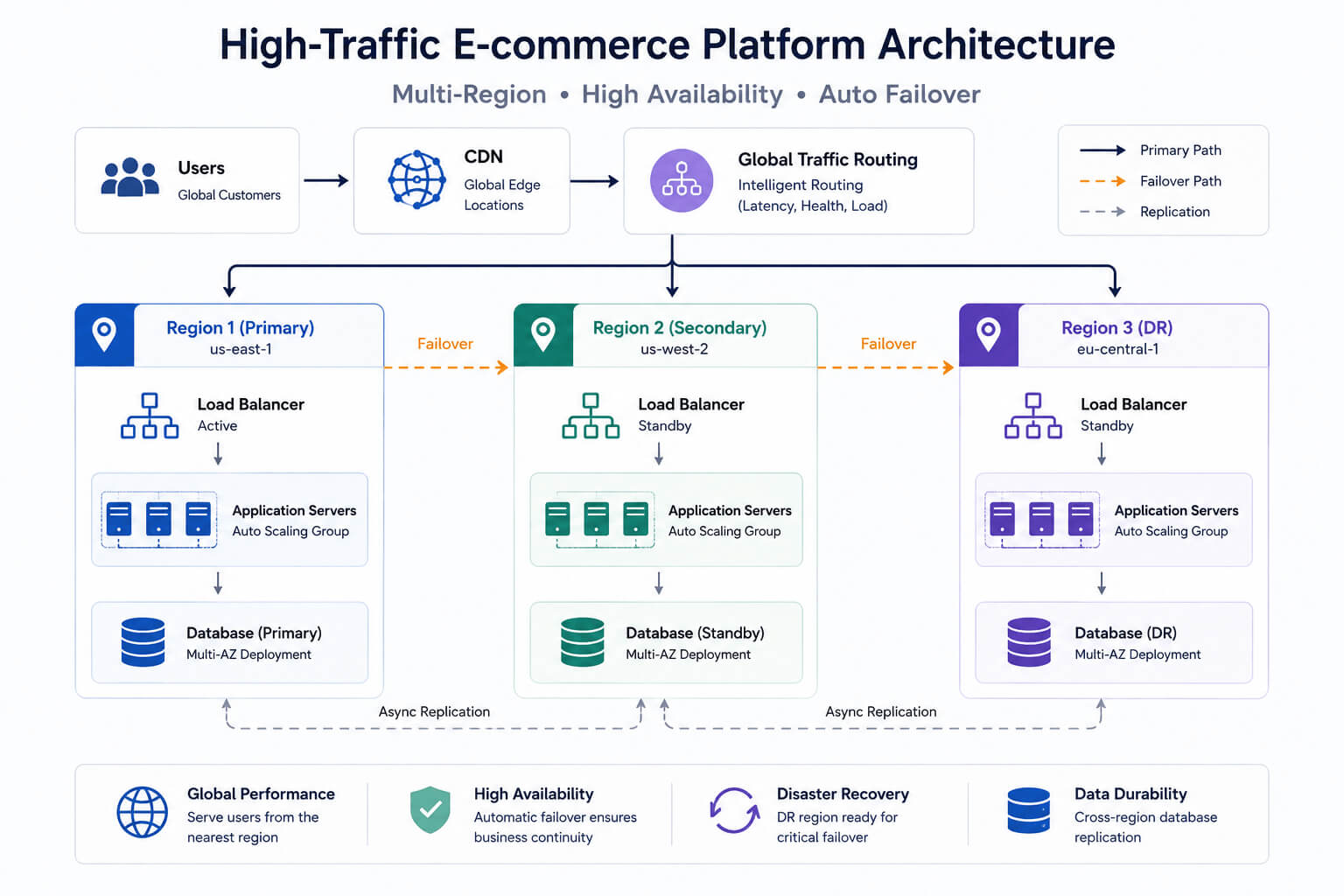
Multi-Region Failover and Redundancy
Distributing infrastructure across multiple regions ensures that a single data centre or availability zone issue does not take the entire platform offline during the highest-revenue hours of the year.
Observability and AIOps for Faster Incident Response
Unified observability, paired with AI-driven anomaly detection, closes the gap between a metric changing and a human noticing. AIOps platforms can correlate signals across services and trigger automated remediation before customers ever experience the issue.
For platforms planning a rebuild or a major scaling initiative ahead of peak season, Pace Wisdom's e-commerce development services team works directly on this kind of architecture and readiness planning.
Key Benefits of AI-Native Cloud Architecture at a Glance
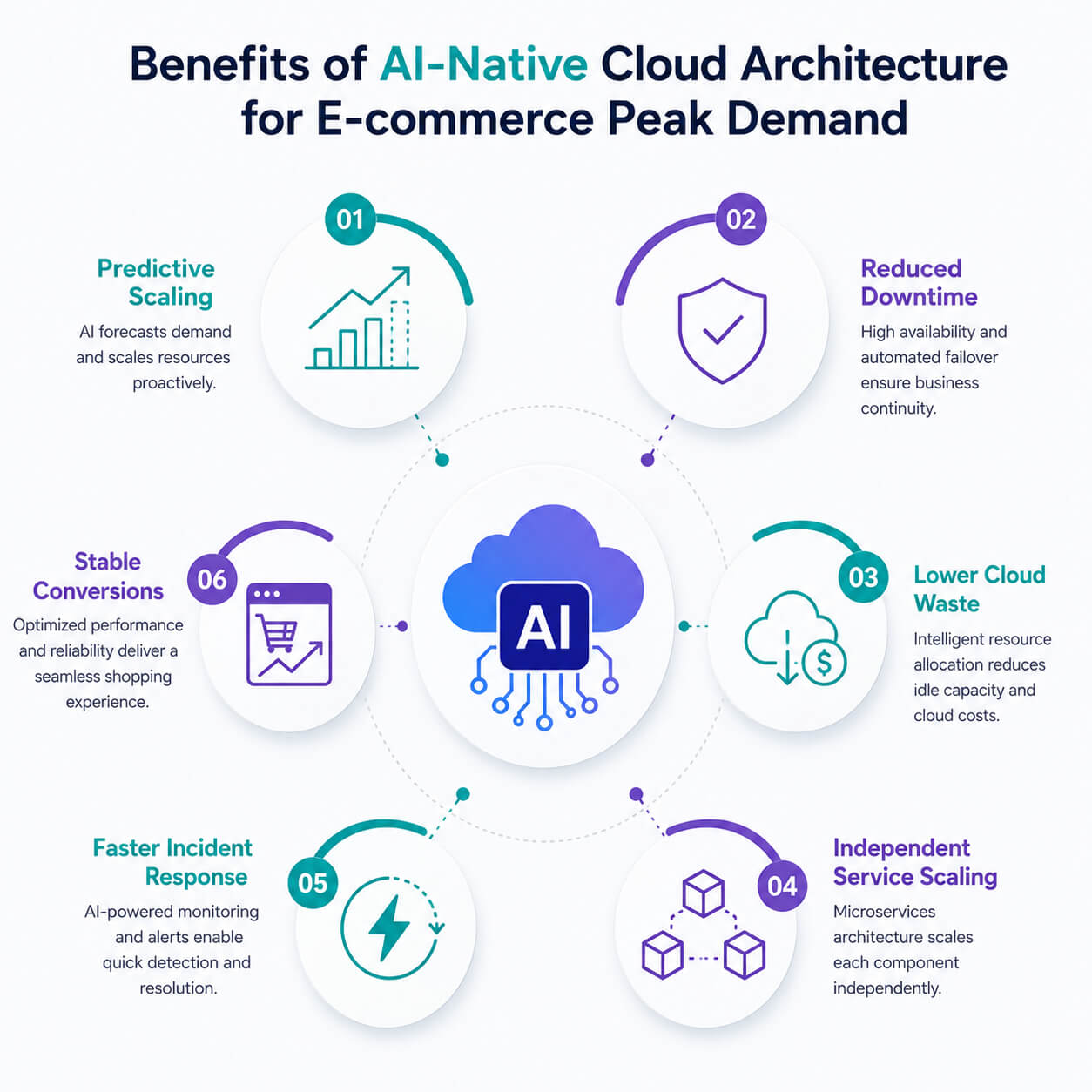
Here is a summary of what a well-built AI Native Cloud Architecture delivers for an e-commerce cloud architecture strategy:
- Predictive scaling that provisions capacity before demand spikes, not after
- Reduced downtime risk during high-revenue events like Black Friday and flash sales
- Lower cloud waste through continuous, AI-driven rightsizing and anomaly detection
- Independent scaling of checkout, search, and recommendation services via microservices
- Faster incident response through AIOps-driven observability
- Improved customer experience and conversion stability under unpredictable load
- A cost structure that flexes with seasonal demand instead of running at peak capacity year-round
Conclusion
AI native cloud architecture has moved from an emerging idea to an operational necessity for any platform that depends on peak shopping events for a meaningful share of annual revenue. The retailers who treat scaling as a predictive, AI-driven discipline are the ones who stay online, stay fast, and stay profitable during the exact hours that matter most.
The technology and the patterns are mature. Predictive auto scaling, AI workload management, and continuous cost optimisation are not experimental anymore; they are standard practice among the platforms that handle peak demand well.
The real question for engineering and e-commerce leaders is not whether to modernise toward e-commerce cloud architecture built on AI-native principles. It is how quickly that transition happens, and which partner helps design and implement it before the next peak season arrives.
Frequently Asked Questions
1. What is AI-Native Cloud Architecture?
AI-native cloud architecture is an infrastructure where machine learning is embedded directly into scaling, routing, and cost-management decisions rather than added as a separate monitoring layer. It allows systems to forecast demand and act ahead of traffic spikes, rather than reacting once thresholds have already been crossed.
2. How is this different from traditional auto scaling?
Traditional auto scaling reacts to fixed thresholds, such as CPU usage crossing 80%, after the load has already increased. AI-native scaling uses predictive models trained on historical and real-time data to provision resources before demand actually arrives, reducing the lag that causes slowdowns during sudden traffic spikes.
3. How does AI help manage peak e-commerce traffic?
AI forecasts demand using historical sales data, marketing calendars, and live signals, then pre-provisions compute, adjusts caching, and reroutes traffic across regions to keep checkout and search responsive. This proactive approach significantly reduces the risk of downtime during high-revenue events like Black Friday.
4. Does AI-native architecture reduce cloud costs?
Yes, when implemented well. Continuous AI-driven rightsizing, anomaly detection, and a balanced mix of reserved, spot, and on-demand capacity typically reduce monthly cloud spend by 25 to 30% compared to static, manually managed infrastructure.
5. What are the best practices for peak readiness?
The most effective practices include load testing and chaos engineering before peak season, multi-region failover for redundancy, and AIOps-driven observability for faster incident response. Together these reduce both the likelihood and the impact of infrastructure issues during high-traffic events.
6. How can an e-commerce business get started with AI-native cloud architecture?
The most effective starting point is auditing current scaling triggers and cost allocation to identify where reactive, rule-based scaling is creating risk. From there, businesses typically need predictive scaling models, decoupled microservices, and a cloud partner experienced in retail workloads. Pace Wisdom's cloud transformation services and e-commerce development services teams help retailers design and implement this transition ahead of peak demand cycles.
You may also want to read
What Is a Cloud Transformation Assessment? A Guide for Enterprises